
Leafbuyer Technologies Extends Cannabis Marketing Reach Despite Revenue Challenges
Latest quarterly results reveal revenue pressures from regulatory changes but spotlight platform compliance upgrades and new partnerships fostering recovery.
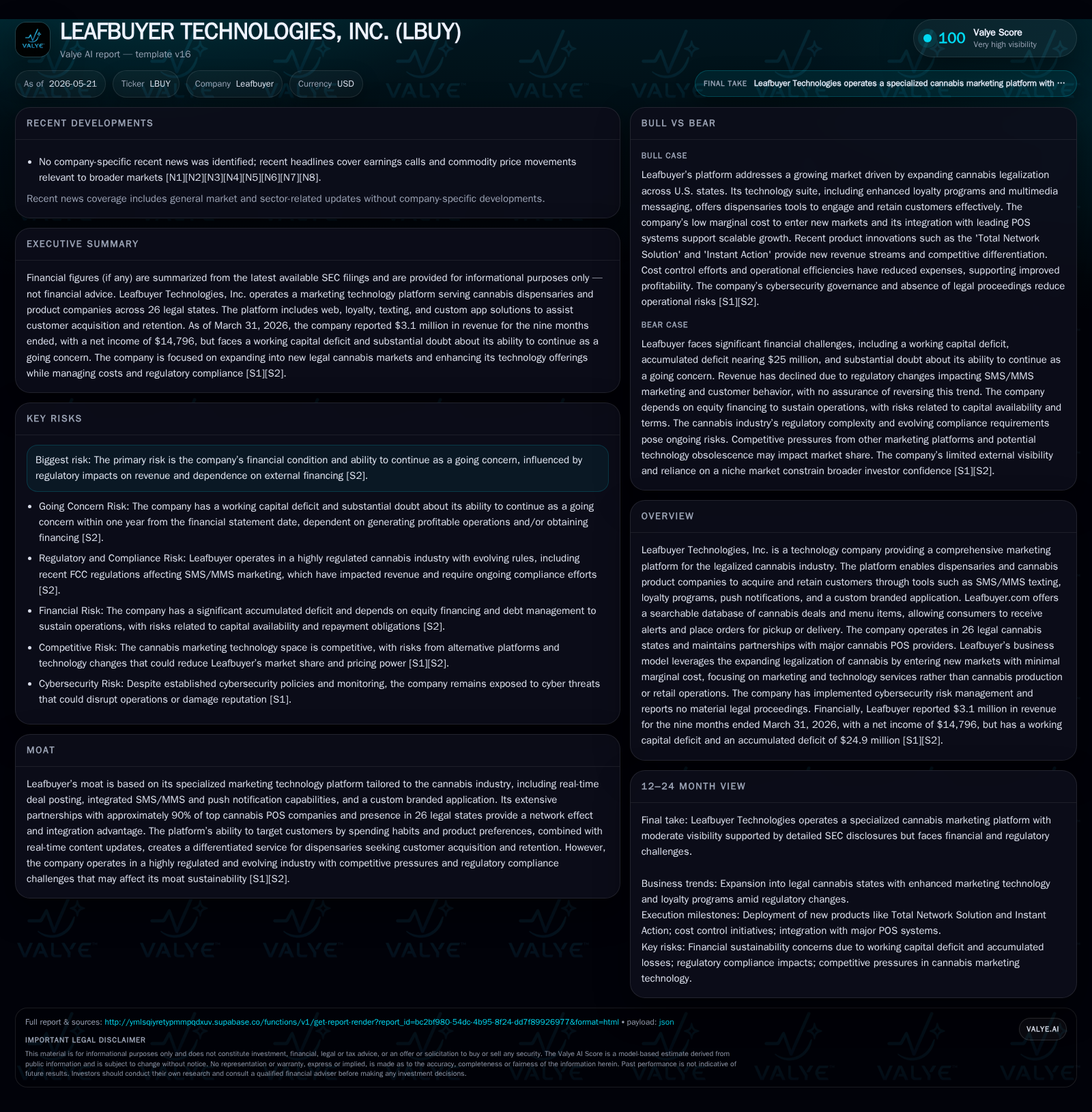
Leafbuyer Technologies reported a notable revenue decline in its latest quarter largely driven by regulatory constraints around SMS/MMS marketing, impacting customer messaging volumes. The company has completed a significant platform restructuring to ensure full compliance with these regulations, which alongside new channel partner agreements, is expected to aid revenue stabilization. Leafbuyer’s business model centers on providing cannabis dispensaries and product companies with a specialized marketing technology platform integrated across major POS systems in legal cannabis states. Despite a challenging regulatory environment and competitive pressures, Leafbuyer’s growth strategy hinges on geographic expansion, technology innovation, and leveraging extensive industry partnerships. Financially, the company contends with liquidity constraints and going concern risks, dependent on profitable operations or successful capital raises.
Recent Quarterly Operating Update
Leafbuyer Technologies’ most recent quarterly filing dated May 14, 2026 reveals ongoing operational headwinds primarily driven by regulatory changes affecting SMS/MMS text marketing volumes. Revenue declined approximately 35% to $1.13 million compared with the same period last year as cannabis dispensaries reduced messaging activity or sought alternative providers that attempted to circumvent newly imposed FCC 23-107 and 10DLC campaign registry requirements [S2][S25]. These regulations introduced an age-gated mechanism restricting how messages are sent, reshaping text marketing tactics industry-wide.
Despite this revenue contraction, Leafbuyer managed to decrease operating expenses by about 14%, mainly through reductions in stock-based compensation and sales commissions tied to lower revenue levels [S2][S10][S20]. Gross profit correspondingly dropped by around 25% to $605K but was partially offset by cost containment measures [S2][S20]. The platform underwent a comprehensive restructuring to achieve strict compliance with all messaging regulations [S5]. This effort has begun to regain some customer accounts that left during the transitional disruptions; management anticipates that this compliance foundation combined with newly secured channel partner agreements will help reclaim lost revenues going forward [S2][S5][S20].
Business Model and Platform Capabilities
Leafbuyer operates as a technology-driven marketing services provider targeting legalized cannabis dispensaries and product companies across medical and recreational markets [S1][S12]. The centerpiece is its proprietary Leafbuyer.com platform plus related software tools that enable clients to acquire and retain consumers effectively. Key services include SMS/MMS texting campaigns, push notifications within custom branded mobile applications, loyalty program management, online ordering ahead features, and real-time deal postings [S1][S12].
Importantly, Leafbuyer integrates closely with leading point-of-sale (POS) vendors—capturing an estimated presence in approximately 90% of major cannabis dispensaries—creating a network effect that enhances data-driven segmentation capabilities. Dispensaries can target customers based on spending limits, brand affinities, purchase frequency, and product categories exploiting personalized marketing with near-instant updates via “Live Deals” posted online [S1][S23].
This model emphasizes scalable technology solutions over physical retail or cultivation investments. Subscriptions or licensing fees paid by dispensaries underpin recurring revenue streams linked to message volume / usage metrics. The reliance on tech enables rapid geographic expansion into newly legalized states at minimal marginal cost while adapting technology rapidly in response to evolving regulatory requirements.
Competitive Landscape and Industry Dynamics
The cannabis marketing software sector is marked by fragmentation fueled by varying state regulations and intense oversight over digital communications channels. The final phase of FCC rulemaking implemented in April 2025 introduced critical telecom compliance barriers requiring registration in campaign registries with enforced age verification gates impacting all SMS/MMS marketers [S20][S25]
Competitors have attempted workarounds or non-compliant approaches to preserve message volume but often face enforcement risk or sustainability issues [S5][S20]. Leafbuyer’s commitment to complete compliance differentiates it by limiting legal risk exposure for clients but introduces short-term churn risks as customers evaluate alternatives amid transition friction
Leafbuyer’s extensive relationship with virtually all top cannabis POS providers creates a high switching cost barrier for end customers since integration facilitates seamless menu updates, deal postings, loyalty point tracking, and analytics reporting—features critical for dispensary operators focused on consumer retention amid intense market competition [S1]. This integration network functions as a key moat against emerging platforms lacking comprehensive POS alignment.
Growth Catalysts: Expansion and Product Innovation
Leafbuyer’s primary growth driver remains aggressive geographic expansion into legal cannabis markets opening across states where recreational or medical use is newly authorized [S1][S23]. The fixed-cost nature of deploying its cloud software service allows the company to leverage existing infrastructure in entering these markets swiftly.
Since March 2023, Leafbuyer launched the “Total Network Solution,” allowing segmented marketing campaigns targeted by detailed consumer behavior data such as brand preferences or spending thresholds. This capability supports more granular client targeting improving retention effectiveness [S1]. Alongside loyalty program enhancements and push notification features embedded in custom mobile apps, these innovations aim to deepen client engagement.
Cross-selling opportunities arise from bundling online ordering ahead technology together with messaging services providing dispensaries full-funnel engagement tools. Continued additions of channel partners expand reach without heavy incremental cost while enhancing distribution channels [S2].
Risks and Execution Challenges
The foremost operational risk is continued pressure on revenue stemming from restrictive telecommunications regulations impacting traditional SMS/MMS volumes fundamental to Leafbuyer’s core offering [S2][S5]. Customer churn induced by platform transitions combined with competitors aggressively pursuing non-compliant niches could curtail growth.
Financially, Leafbuyer maintains a significant working capital deficit approaching $907K with cash reserves near $956K at quarter-end March 31, 2026 [F1][S2]. The dependency on equity financing or debt raises substantial doubt about sustainable operations absent profitable cash flows or sufficient fundraising [S2][S3]. Legal uncertainty surrounds evolving cannabis regulation broadly impacting market dynamics.
Cybersecurity risk governance is proactively managed involving board oversight given sensitivity around client data integrity—a material operational safeguard reflecting industry norms [S1]. Nonetheless, failures in compliance or security could impose reputational damage affecting customer trust.
Key Milestones and Investor Watchpoints
Upcoming critical milestones include monitoring message volume recovery trends post-platform restructure—a vital barometer of client retention success under new regulatory rules [S2]. Additionally, announcements relating to new channel partnership deployments will signify broadening distribution potential.
Geographic market entry updates into newly legalized states provide measurable evidence of growth execution alongside technology rollouts of enhanced segmentation or loyalty features signaling product relevance retention [S1][S2]. Close attention should be paid to reported changes in deferred revenue balances reflecting future contracted income streams against churn risks.
Financial Status and Going Concern Considerations
As of March 31, 2026 Leafbuyer held $956K cash against a working capital deficit of approximately $907K indicating liquidity tightness constrained by current liabilities exceeding current assets by nearly two times [F1][S2]. Total debt primarily comprises notes payable including SBA EIDL loan approximating half million USD. Interest expense remains modest but persistent at ~$18K per quarter reflecting manageable financial cost though raising refinancing concern under current cash flow levels [S2].
Net income was positive but minimal at roughly $15K over nine months ended March 2026 versus prior periods showing income erosion due to revenue softness balanced partially by expense reductions [S5][S20]. Accumulated deficit stands entrenched at nearly $25 million funded through historical equity injections highlighting financial challenges typical for growth-phase tech companies in emerging regulated sectors [S3].
Management explicitly acknowledges substantial doubt regarding continuation as a going concern reliant upon securing either additional capital infusion or achieving consistent profitability within one year after reporting date [S2][S3]. Strategic focus remains therefore on executing commercialization initiatives bolstered by enhanced platform compliance capabilities while managing cash conservatively.
Disclaimers: This analysis does not constitute investment advice nor an offer or solicitation for securities trading. It reflects factual findings derived solely from publicly filed SEC documents and validated news sources as indicated without extrapolation beyond stated facts. Readers should perform independent due diligence before forming opinions concerning LEAFBUYER TECHNOLOGIES INC. (LBUY).
Financial position in context
As of 2026-03-31, companyfacts shows $956154 in cash and equivalents [F1]. Current assets of $1104556 and current liabilities of $2mm imply a current ratio near 0.55x for 2026-03-31 [F1].
Disclaimer: This is research-only, informational analysis and not investment advice. It may include AI-generated interpretation and general industry context. Always verify important details using primary sources.

Comments