
Lennox International Faces Margin Pressure Amid Supply Chain and Seasonal Demand Challenges in Q2 2026
The latest quarterly report reveals shifts in Lennox’s HVACR segment performance influenced by raw material costs, seasonal demand, and integration progress.
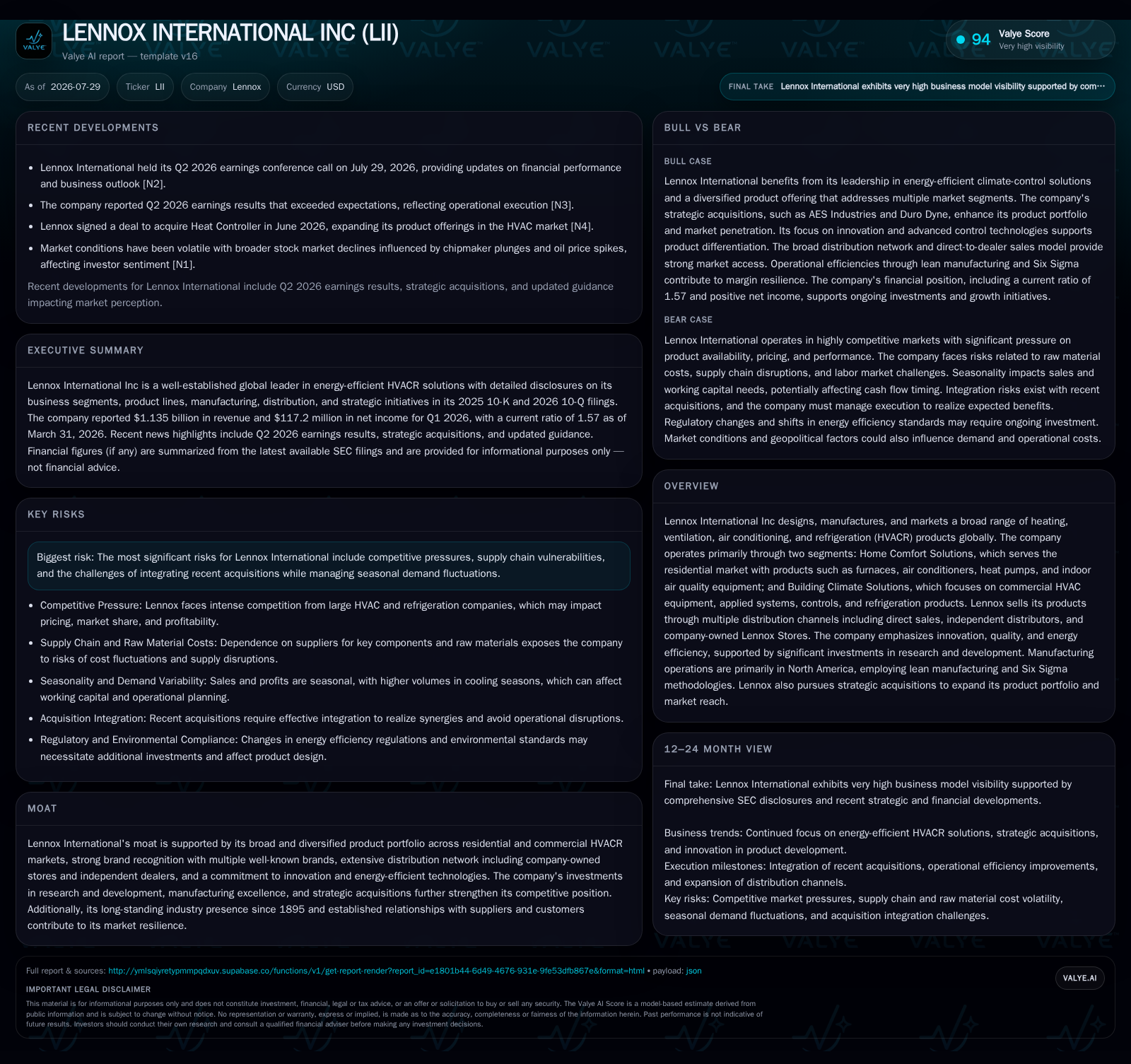
Lennox International’s Q2 2026 operating update highlights revenue growth tempered by margin compression largely due to inflationary input costs and supply chain constraints. The company’s bifurcated Home Comfort and Building Climate business segments continue to experience distinct demand and margin profiles influenced by seasonal weather variability and ongoing strategic acquisitions. Lean manufacturing and Six Sigma initiatives support operational efficiency but face headwinds from elevated raw materials prices. The balance sheet shows stable liquidity with manageable leverage amid funding of acquisitions and capital expenditures. Key near-term indicators include order backlog trends, pricing passes on cost inflation, and successful integration of acquired HVAC parts suppliers.
Recent Operating Update
Lennox International’s Q2 2026 results reveal a revenue increase driven by core HVACR equipment sales and expanded parts distribution following recent acquisitions. However, margin pressures intensified due to elevated raw material costs, notably steel and refrigerants, alongside higher freight expenses, which outpaced pricing actions in the quarter [S2][N2]. Despite management’s efforts to implement price increases, gross margin compression persisted, reflecting the lag in cost pass-through relative to volume growth—a challenge common across the HVACR manufacturing sector amid inflationary input cost trends.
Seasonal demand patterns influenced performance, with warmer-than-average summer temperatures boosting air conditioning unit shipments within the Home Comfort Solutions segment, while variability in weather conditions continues to pose volume risks [S2][S1]. The Building Climate Solutions segment showed steady growth supported by commercial HVAC equipment sales and parts, augmented by the integration of acquisitions such as Duro Dyne and Supco [S1]. Supply chain disruptions remain a headwind, impacting component availability and operational efficiency despite ongoing lean manufacturing and Six Sigma initiatives aimed at quality and yield improvements.
Business Model Overview
Lennox International operates through two primary segments: Home Comfort Solutions (HCS) and Building Climate Solutions (BCS). The HCS segment targets residential customers with furnaces, heat pumps, air conditioners, packaged heating and cooling systems, indoor air quality products, controls, and replacement parts. The BCS segment serves commercial clients with unitary HVAC equipment, variable refrigerant flow (VRF) systems, commercial refrigeration units, controls, installation, and maintenance services [S1].
Revenue generation is predominantly driven by equipment sales, supplemented by aftermarket replacement parts and service offerings that provide recurring revenue streams. These aftermarket sales are supported by Lennox’s extensive distribution network, which includes direct sales to large contractors, independent dealers, and company-operated Lennox Stores. The company’s product portfolio emphasizes energy efficiency and regulatory compliance, which are critical differentiators in a market increasingly shaped by environmental standards and consumer demand for sustainable solutions.
Seasonality significantly impacts revenue and working capital management. Residential air conditioner sales peak in summer months, while furnace demand rises in colder periods, requiring careful inventory planning to balance order fulfillment against carrying costs and avoid backlog accumulation [S1][S2]. The multi-channel distribution strategy mitigates concentration risk but necessitates managing channel-specific pricing and inventory logistics to maintain service levels and market penetration.
Industry Structure and Competitive Position
Within the global HVACR manufacturing industry, Lennox competes alongside major players such as Carrier Global Corporation, Trane Technologies, Johnson Controls, and Daikin Industries. Lennox’s competitive positioning is strengthened by its broad product portfolio spanning residential and commercial HVACR applications, enhanced through strategic acquisitions that expand its parts and service offerings [S1][N6].
Operational excellence is underpinned by lean manufacturing and Six Sigma quality methodologies implemented across North American facilities, which focus on yield improvement and defect reduction. These practices are essential to maintaining gross margins amid rising input costs and supply chain constraints that affect component availability and delivery schedules [S1].
The acquisitions of Duro Dyne and Supco in October 2025 have expanded Lennox’s footprint in the HVAC parts and supplies market, a traditionally fragmented segment with higher margin potential if integration is successful [S1][N6]. AES acquisition further enhances service capabilities in light commercial sustainability markets, supporting cross-segment synergies and incremental revenue growth
Growth Drivers
Key structural growth drivers for Lennox include:
- Regulatory mandates promoting energy-efficient HVACR installations, driving demand for compliant, next-generation products.
- Residential new construction growth fueled by demographic trends, complementing replacement demand cycles from aging equipment.
- Expansion in the commercial segment driven by urbanization and the need for sophisticated HVAC systems with integrated digital controls.
- Increasing consumer focus on indoor air quality, boosting demand for specialized filtration and air purification products.
- Technological innovation in smart thermostats and IoT-enabled controls (e.g., iComfort), enhancing retrofit appeal and supporting aftermarket services.
- Strategic acquisitions enabling cross-selling opportunities and consolidation of distributor relationships.
- Geographic expansion in Canada and emerging North American markets where infrastructure upgrades stimulate equipment replacement cycles [S1].
Risks and Watchpoints
Lennox faces several risks that could impact near-term performance:
- Volatility in raw material prices, particularly steel, copper, and refrigerants, which are critical inputs for HVAC coils, fans, and cooling systems, may increase production costs and compress margins [S23].
- Supply chain disruptions affecting component availability could delay shipments, increase backlog, or result in lost sales if customers switch suppliers.
- Competitive pricing pressures, especially in commoditized residential heating and cooling products, may limit pricing power despite product differentiation efforts [S1][N6].
- Integration risks from recent acquisitions could delay synergy realization and affect short-term profitability.
- Seasonal demand variability driven by weather unpredictability complicates manufacturing capacity planning and working capital management.
- Potential increases in warranty claims as product complexity rises with embedded technologies, necessitating robust quality controls to protect brand reputation.
- Regulatory changes related to refrigerants and building codes may require additional R&D investment and product redesign, increasing fixed costs and development timelines [S23][S1].
- Labor market tightness in manufacturing regions could constrain productivity gains despite lean and Six Sigma initiatives.
What to Watch Next
Key operational and financial indicators to monitor include:
- Unit shipment volumes by residential and commercial segments to assess demand trends and backlog normalization post supply chain disruptions.
- Average selling price (ASP) trends to evaluate pricing power and effectiveness of inflation pass-through strategies.
- R&D spending as a percentage of sales, reflecting commitment to energy efficiency and product innovation critical for competitive positioning.
- Progress on integration of Duro Dyne, Supco, and AES acquisitions, focusing on synergy capture and cost structure improvements.
- Seasonally adjusted order backlog comparisons to prior periods as a gauge of supply chain tightness or easing.
- Warranty claims frequency as an indicator of product reliability amid increasing technology content.
- Updates on raw material sourcing strategies and adoption of alternative refrigerants in response to regulatory changes.
- Capital expenditure efficiency in manufacturing capacity expansion balanced against free cash flow generation to maintain financial flexibility.
Financial Profile Discussion
Lennox maintains investment-grade credit ratings (Moody’s Baa1 and S&P BBB), which facilitate access to capital markets at favorable borrowing costs relative to some peers with lower ratings [S6][S20]. This financial flexibility supports the company’s strategic initiatives, including acquisitions and R&D investments necessary to sustain competitiveness in the evolving HVACR market.
This analysis integrates Lennox International’s latest quarterly operating results with its broader strategic and financial framework, highlighting the interplay between sector dynamics, company-specific initiatives, and macroeconomic factors shaping near-term performance. Continued focus on supply chain resilience, pricing discipline, and integration execution will be pivotal in navigating margin pressures and capitalizing on growth opportunities in the HVACR industry.
This report is for informational purposes only and does not constitute investment advice.
Disclaimer: This is research-only, informational analysis and not investment advice. It may include AI-generated interpretation and general industry context. Always verify important details using primary sources.

Comments