
Lemonade Inc’s AI-Powered Insurance Model Drives Rapid Growth but Profitability Challenges Persist
Lemonade leverages proprietary AI technology and a vertically-integrated platform to scale in the competitive property and casualty insurance market with a focus on customer experience and risk alignment.
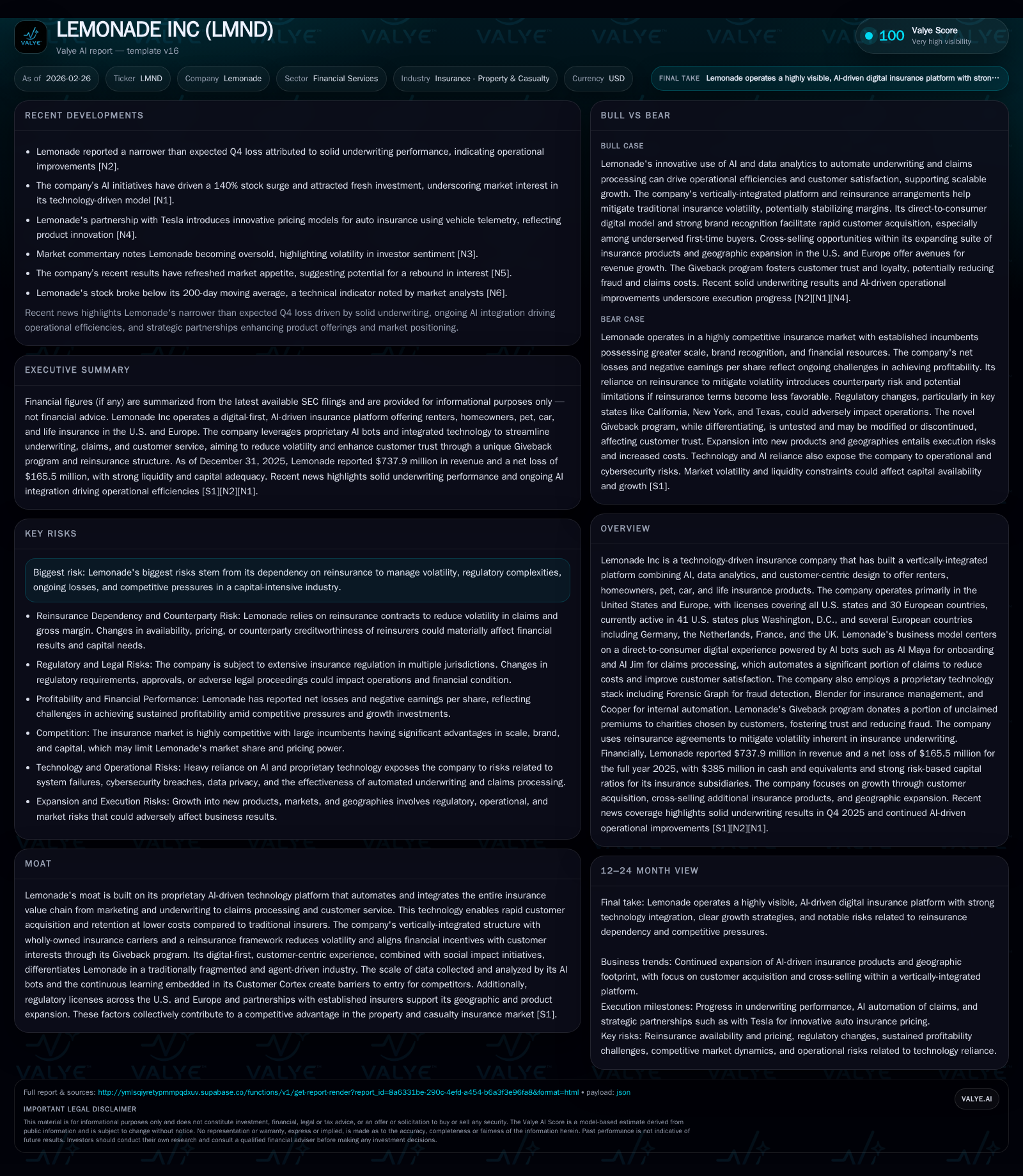
Lemonade has demonstrated robust revenue growth driven by its disruptive, AI-centric approach to renters, homeowners, pet, car, and life insurance across the US and parts of Europe. Despite scaling top line by over 40% in 2025, the company continues to operate at a loss, reflecting heavy investments in marketing and technology as it seeks to expand its customer base and product offerings. The firm’s differentiated approach centers on automation through AI bots for onboarding and claims processing, proprietary fraud detection technology, and a reinsurance-backed business model aimed at dampening earnings volatility. Looking forward, Lemonade aims to deepen penetration within its existing customers while broadening geographic reach and product scope, although profitability hinges on sustaining growth momentum amid regulatory complexity and competitive pressure.
Company Overview
Founded in 2015, Lemonade Inc has carved out a distinctive niche within the Property & Casualty (P&C) insurance sector by deploying an end-to-end digital platform powered heavily by artificial intelligence (AI), behavioral economics, and modern design principles. This digital-first approach targets underserved segments such as renters insurance but extends into homeowners, pet, car, and life insurance products. With fully-owned insurance carriers in the United States and Europe—including key licenses enabling direct-to-consumer sales across all US states (operating currently in 41 states plus D.C.) plus a pan-European license covering 30 countries—Lemonade aims to disrupt an industry traditionally reliant on agents and legacy infrastructure [S4][S13].
Central to Lemonade’s offering is its integration of proprietary AI bots: AI Maya powers customer onboarding simplifying policy issuance through natural conversational interfaces; AI Jim automates claims intake and adjudication—processing over half of claims instantly—significantly trimming traditional claims overhead [S4][S6][S9]. Supporting these bots is a broader technology suite including sophisticated fraud detection tools like Forensic Graph combined with Blender for claim workflows that marshal human experts only when necessary. The company’s vertically integrated stack links marketing through underwriting to claims handling seamlessly within this framework.
Historical Performance Analysis
Over the trailing four years ending December 31, 2025, Lemonade has exhibited exceptional top-line growth from $257 million in revenue in fiscal 2022 to nearly $738 million by fiscal 2025—a compound annual growth rate well above industry averages driven primarily by strong customer acquisition enabled via digital channels [F1]. However profitability remains elusive: net losses have contracted from approximately $298 million in FY22 to $165.5 million in FY25 but negative earnings persist amid elevated spending on customer acquisition and product development.
Operating cash flows improved notably from -$163 million in FY22 to -$16.5 million in FY25 although still negative reflecting ongoing reinvestment; capital expenditures have hovered roughly near $9 million per annum indicating steady technology infrastructure investment rather than aggressive CapEx expansion at this stage. Equity declined from $867 million at end-2022 to approximately $534 million at end-2025 mirroring accumulated deficits over time [F1].
Historical performance (annual)
| FY | Rev ($mm) | Net ($mm) | CFO ($mm) | Capex ($mm) | Rev YoY | Net YoY |
|---|---|---|---|---|---|---|
| 2025 | 738 | -165 | -16 | 9 | +40.2% | +18.2% |
| 2024 | 527 | -202 | -11 | 9 | +22.5% | +14.6% |
| 2023 | 430 | -237 | -119 | 9 | +67.4% | +20.4% |
| 2022 | 257 | -298 | -163 | 10 |
Source: SEC companyfacts cache [F1].
Capital returns and efficiency (annual)
| FY | FCF ($mm) | ROE% |
|---|---|---|
| 2025 | -26 | -31.0 |
| 2024 | -21 | -34.1 |
| 2023 | -128 | -33.4 |
| 2022 | -173 | -34.4 |
Source: SEC companyfacts cache [F1].
The table highlights strong top-line growth accompanied by narrowing losses but ongoing negative cash flow.
Business Model & Competitive Moat
Lemonade's business model emphasizes a direct-to-consumer digital experience facilitated by AI automation which lowers costs throughout the insurance lifecycle—from marketing outreach (leveraging targeted digital advertising including on platforms like TikTok and Instagram) through underwriting using machine learning models that analyze high-impact questions with far fewer touchpoints compared to conventional carriers [S6][S23].
Claims handling is similarly disrupted via AI Jim who autonomously processes the majority of claims without human intervention or loss adjustment expenses (LAE), thereby reducing friction points common in incumbent insurers' claims services known for poor customer satisfaction.
Crucially, Lemonade’s unique “Giveback” program fosters alignment between insurer and insured interests by donating unclaimed premiums back to nonprofits selected by customers which discourages fraudulent claims behavior enhancing pooled risk quality while strengthening brand trust—a differentiation point unlikely replicated easily given incumbents’ crediting shareholder value motives [S6].
The full stack ownership of insurance carriers paired with an extensive reinsurance strategy helps Lemonade reduce uninsured third-party insurance risk exposure preserving margin stability despite weather or catastrophe volatility that often plagues P&C firms [S4][S6]. This combination of data-driven precision underwriting matched with social impact initiatives establishes formidable moats against traditional insurers reliant on agents or manual processes.
Market Position & Products
While primarily operating across renters insurance segments historically plagued by low digitization penetration rates nationally (~41 states operational plus D.C.), Lemonade has scaled into homeownership policies (including buildings coverage across UK, France & Netherlands aided through partnerships with Aviva and BNP Paribas Cardif), pet insurance competing against Nationwide & Embrace players, car insurance challenging incumbents like Progressive & GEICO thanks partly to a landmark Tesla partnership signaling innovative auto pricing models leveraging telematics data streams [N6] [S8][S13]. Life insurance lines further diversify the product suite aiming to house multiple policies per customer unlocking long-term wallet share expansions as customers ‘graduate’ up economic ladders feeding into retention gains without incremental acquisition costs [S11].
International expansion into Europe reflects leveraging linguistic agility embedded within their platform facilitating regulatory navigation while scaling marketing campaigns tailored locally—however complexities remain including GDPR compliance costs potentially affecting data collection strategies essential for AI improvements [S15][S19].
Future Growth Prospects & Constraints
Lemonade’s growth trajectory remains supported by:
- Deepening penetration within existing insurer base capturing cross-sell opportunities for car, pet, home upgrades enhancing premiums per customer at near-zero acquisition costs [N2][N3][S11]
- Expanding geographic footprint gradually across remaining U.S states plus broadening European presence beyond current markets leveraging pan-European license architecture minimizing go-to-market barriers [S13][S18]
- Enhancing AI capabilities improving customer experience automation raising conversion rates while reducing service cost per policy.
However constraints include:
- Regulatory tightening around use of AI algorithms under emerging frameworks like EU AI Act with fines up to 7% global turnover could necessitate costly compliance adjusts or reduce effectiveness of proprietary algorithms undermining competitive edge [S19][S27]
- Increasing competition as incumbents invest heavily into digital transformation eroding differentiation alongside tech giants entering insurtech elevating pricing pressure risks limiting margin improvements [S21]
- Dependence on reinsurance markets whose cost or availability may fluctuate curbing ability to manage claim volatility effectively impacting capital requirements or underwriting capacity during periods of significant catastrophe losses such as California wildfire exposures seen recently resulting in multi-million dollar charges impacting margin temporarily [S12][S24]
- Customer trust challenges regarding privacy or AI usage perceptions may hamper acquisition efforts especially given heavy reliance on third-party digital advertising channels subject to changing algorithms or policies restricting messaging reachability negatively affecting CAC efficiency ratios over time [S14][S27]
Financial Forecasts / Milestones To Watch
Explicit forward-looking guidance was not provided; thus key indicators merit monitoring:
- Quarterly revenue growth trajectories particularly new product uptake velocities indicate success gaining multi-product customers driving deeper lifetime value accruals.
- Loss ratios improvement as automation penetrates further into claims adjudication validating underwriting discipline offsetting increasing gross written premium scale.
- Marketing spend efficiency reflected by decreasing cost per new policy issued while maintaining retention levels indicative of sustainable unit economics.
- Regulatory filings or updates around new AI compliance standards adoption timelines influencing operational adjustments costs.
- Reinsurance agreement renewals pricing changes signaling shifts in underlying risk transfer economics critical to gross margin stability.
Investor feedback during recent earnings calls recognized solid progress executing on these fronts despite ongoing loss generation reinforcing marketplace confidence though profitability inflection horizon remains cautious given continuing investments N2-N4.
Returns & Capital Allocation
Lemonade has yet to report positive returns metrics such as ROE given persistent net losses; rough calculation yields approximately -31% based on latest net income relative to book equity highlighting continued capital consumption as a tactical choice for growth acceleration rather than near-term profitability focus [F1].
Operating cash flows are still negative though significantly improved from peak deficits suggesting better operational leverage but free cash flow also remains negative given steady technology capex commitments with no dividend payouts or share repurchase activity noted reflecting conservative capital deployment stance prioritizing product development maturation over shareholder returns currently [F1][S10][N4].
Financing arrangements like the amended Customer Investment Agreement with General Catalyst providing up to additional $200 million facility endorse ongoing capital needs mainly for marketing expenditure enabling scale without immediate dilution though incur interest expense burdens adding future financial costs that need balancing against growth benefits realized [S20].
Risks Summary
Material risk factors include:
- Reliance on reinsurance exposes Lemonade to counterparty default risk and potential limitation on new business volume if terms deteriorate.
- Regulatory uncertainty particularly concerning emerging legal frameworks governing artificial intelligence use could mandate operational overhaul or disclosures disadvantaging competitive positioning.
- Litigation exposure inherent in insurance claim disputes compounded by privacy/data protection lawsuits related to automated decision making could impose financial penalties or reputational damage.
- Intense competition from large incumbents offering bundled products backed by extensive agent networks potentially constrains market share gains especially among higher-value homeowner/autopolicy segments where brand longevity matters more.
- Concentration risk evident with roughly half of premiums sourced from top US states vulnerable to localized catastrophic events or adverse state regulatory changes disrupting underwriting economics materially impacting margins unexpectedly.
Conclusion
Lemonade represents one of the most advanced uses of artificial intelligence within P&C insurance blending technology innovation with customer-centric values embodied through social impact giving it a differentiated profile relative to legacy players entrenched in manual processes burdened by fixed distribution costs. Its rapid revenue scaling evidences marketplace acceptance driven by convenience coupled with novel underwriting precision.
Nonetheless ongoing deficits combined with emerging regulatory headwinds spotlight challenges ahead requiring sustained execution rigor not only expanding revenues but also driving operating leverage necessary for path toward sustained profitability expected over medium term horizons conditioned upon navigating increasingly complex compliance landscapes alongside intensifying competitive threats.
Disclaimer: This analysis is intended solely for informational purposes reflecting publicly available data as of February 26, 2026. It does not constitute investment advice nor an endorsement of any security mentioned herein.
Disclaimer: This is research-only, informational analysis and not investment advice. It may include AI-generated interpretation and general industry context. Always verify important details using primary sources.

Comments