
Lantheus Holdings Navigates Patent Expirations and Reimbursement Shifts Amid Portfolio Expansion
Dedicated radiopharmaceutical manufacturer faces competitive pressures while pursuing growth through product innovation and strategic acquisitions.
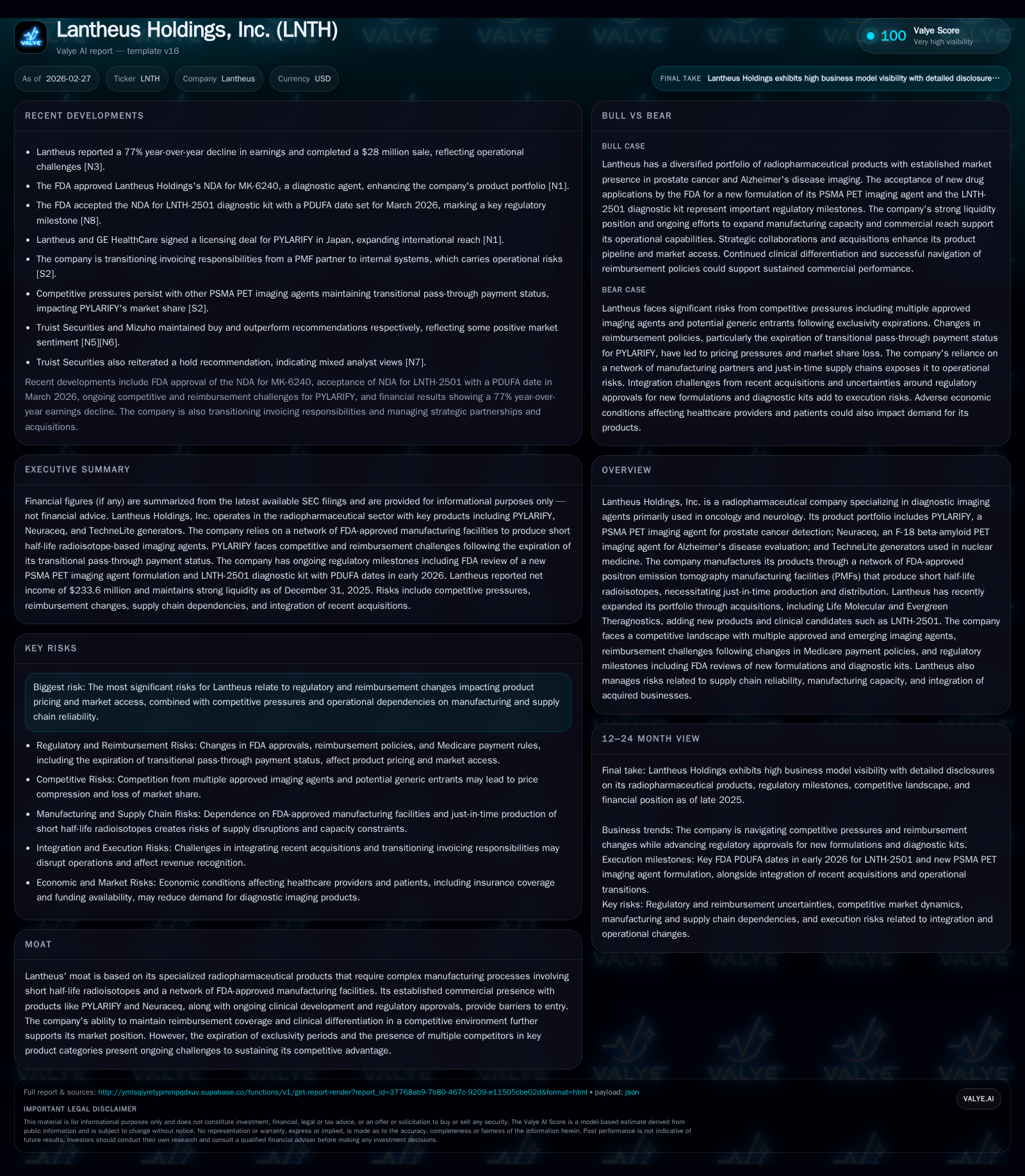
Lantheus Holdings, Inc. operates in the specialized radiopharmaceutical space with products such as PYLARIFY and Neuraceq anchored in oncology and neurology imaging. The company has demonstrated steady revenue growth driven by its core imaging agents but faces notable challenges from patent expirations, evolving reimbursement frameworks, and competitive entries. Recently completed acquisitions expand its product pipeline and commercial footprint, though integration risks remain. Capital allocation emphasizes stock repurchases alongside investments in manufacturing capacity and clinical development. Investors should monitor upcoming FDA decisions on new formulations and patent-litigation developments, which will materially influence near-term performance.
Company Overview
Lantheus Holdings, Inc. specializes in radiopharmaceuticals focused primarily on diagnostic imaging agents utilized in oncology and neurology. Its flagship products include PYLARIFY®, a prostate-specific membrane antigen (PSMA) PET imaging agent approved for prostate cancer detection, Neuraceq®, an F-18 beta-amyloid imaging agent employed to evaluate Alzheimer's disease pathology, and TechneLite generators servicing nuclear medicine providers. The firm operates through a nationwide network of FDA-approved positron emission tomography manufacturing facilities (PMFs), enabling small-batch production of short-lived radioisotopes vital to these diagnostics.
In recent years, Lantheus has pursued growth via targeted acquisitions to expand its product portfolio. In April 2025 it acquired Evergreen Theragnostics, adding clinical candidates like LNTH-2501 under FDA review. Further bolstering its Alzheimer's disease footprint, Lantheus acquired Life Molecular Imaging Ltd. in July 2025—including Neuraceq—which offers an established global commercial infrastructure.
Historical Performance and Growth Drivers
Lantheus reported steady revenue growth over the past several years culminating in a fiscal year 2025 top line slightly higher than prior years with growth of about 3.6% [F1]. This upward trajectory was supported primarily by ongoing adoption of PYLARIFY and expanding uptake of Neuraceq from the Life Molecular acquisition.
Historical performance (annual)
| FY | Net ($mm) | CFO ($mm) | OpInc ($mm) | Capex ($mm) | Net YoY |
|---|---|---|---|---|---|
| 2025 | 234 | 390 | 311 | -25.2% | |
| 2024 | 312 | 545 | 457 | -4.4% | |
| 2023 | 327 | 305 | 365 | 45 | +1063.9% |
| 2022 | 28 | 282 | 36 | 260 |
Source: SEC companyfacts cache [F1].
Capital returns and efficiency (annual)
| FY | Buybacks ($mm) | FCF ($mm) | ROE% |
|---|---|---|---|
| 2025 | 300 | 21.4 | |
| 2024 | 100 | 28.7 | |
| 2023 | 0 | 260 | 40.0 |
| 2022 | 75 | 22 | 6.3 |
Source: SEC companyfacts cache [F1].
Operating income contracted significantly (-32%) from the prior year largely due to incremental costs associated with expanding the PMF manufacturing network and integrating recent acquisitions [F1][S2][S4]. Net income also declined by roughly one-quarter year-over-year as margin compression surfaced amid rising operating expenses.
Growth drivers have historically hinged on Lantheus’ ability to sustain reimbursement coverage particularly from Medicare and private insurers and maintain clinical preference among clinicians for PYLARIFY as the leading PSMA-targeted PET imaging agent. The expiration of transitional pass-through payment status (TPT Status) on December 31, 2024 removed an incremental Medicare payment that had boosted early uptake but was later partially offset by CMS's unbundling rule effective January 1, 2025 allowing separate payment for certain radiopharmaceuticals exceeding $630 mean unit cost [S2][S15][S21].
Future Growth Prospects
Looking forward, Lantheus’ prospects center around several key catalysts:
New formulation approval for PYLARIFY: The FDA accepted an NDA filed by Lantheus' subsidiary Aphelion on August 6, 2025 to introduce a new formulation designed to optimize manufacturing efficiency by increasing batch sizes roughly by half [S16][S24]. The PDUFA date is set for March 6, 2026 [S16][N2]. Approval could enhance supply reliability and support application for three years of renewed TPT Status with CMS, potentially restoring favorable reimbursement dynamics.
Patent landscape: While PYLARIFY holds multiple Orange Book-listed patents protecting up to at least 2037, regulatory exclusivity under the new chemical entity (NCE) designation expires May 26, 2026 [S20]. This opens pathways for generic challengers who may file Paragraph IV Certifications triggering potential Hatch-Waxman litigation extending potential delays through late 2028 depending on resolution timelines [S9][S16]. The company has not yet received such certification notices but remains vigilant.
Expansion of patient populations: Clinical trials are underway evaluating use cases such as detecting additional lesions in intermediate-risk prostate cancer patients and aiding selection for PSMA-targeted therapies like PLUVICTO®, potentially unlocking new addressable markets [S25]. However, uncertainty remains around eventual label expansions or clinical adoption.
Alzheimer’s disease diagnostics: Leveraging the acquisition of Life Molecular affords Lantheus strategic positioning within an expanding Alzheimer’s therapeutic ecosystem supporting Neuraceq’s growth [S12][S26]. Success here depends on continued clinical differentiation against competitor agents from companies like Lilly and GE HealthCare as well as securing adequate reimbursement coverage.
Pipeline assets: Evergreen-derived LNTH-2501 is under FDA review with a target decision expected March 29, 2026 [S12]. While promising as a novel candidate, commercial success depends heavily on regulatory approval outcomes and market acceptance.
Operationally, growth is constrained by complex manufacturing requirements inherent to short half-life radioisotopes produced at individually FDA-approved PMFs nationwide [S2][S7][S8]. Scheduling limitations or delays in site approvals can impact product availability critical to customer scheduling preferences—a key factor influencing modality choice by end users.
Forecasts and Milestones to Watch
While explicit forward guidance has not been provided publicly beyond regulatory timelines noted above [N1], stakeholders should monitor:
- FDA verdicts on Aphelion’s NDA for the new PYLARIFY formulation (PDUFA March 6, 2026).
- FDA decision on LNTH-2501 NDA (PDUFA March 29, 2026).
- Developments regarding generic challenge filings against PYLARIFY patents post-NCE expiry.
- CMS policy adjustments impacting diagnostic radiopharmaceutical reimbursement especially around mean unit cost methodologies.
- Clinical trial data readouts supporting label expansion opportunities.
Returns and Capital Allocation
Financial health at end-2025 remains solid with cash & equivalents of $359 million versus current liabilities of $333 million yielding a strong current ratio (~2.7x) supportive of ongoing operations including planned manufacturing investments [F1]. Approximate return on equity computed using net income over equity stands near a healthy ~21% [F1].
Operating cash flow has moderated from peaks seen in prior years but remains strong at approximately $390 million in fiscal year ended December 2025 [F1]. Capital expenditures declined significantly year-over-year to ~$45 million after an elevated capex run tied to previous facility investments though future capital spend is likely linked to manufacturing footprint expansion associated with new product formulations and capacity scale-up [F1].
The board authorized an aggressive $400 million share repurchase program spanning mid-2025 through end-2027 under which $300 million was executed during fiscal year-to-date September 30, indicating management’s strategy to deploy excess capital toward shareholder returns while navigating market uncertainties [S4][S13][F1]. No dividends have been reported recently.
Industry Context Analysis
Radiopharmaceuticals such as those manufactured by Lantheus sit at the nexus of complex manufacturing logistics due to their short isotope half-lives necessitating large regional networks of GMP-compliant cyclotron-equipped PMFs capable of just-in-time delivery. This differentiates companies able to maintain stable supply chains from smaller or less resourceful entrants.
Moreover, pricing dynamics are tightly linked not only to clinical efficacy but also evolving value-based reimbursement frameworks influenced heavily by government healthcare payors like Medicare—where policy changes can rapidly alter economic viability for providers using expensive imaging agents.
Competition includes sizable multinational pharmaceutical players like Novartis (Telix), GE HealthCare, Bracco Healthcare along with emerging biotech firms focusing on diverse molecular targets or alternative imaging modalities which may fragment market share further.
Risks Summary
Key risk factors feature prominently within Lantheus’ disclosures:
- Manufacturing risk: Potential delays or denials from FDA PMF site approvals threaten supply continuity crucial to meeting demand timing preferences [S2][S7][S8].
- Regulatory & Reimbursement Risk: Alterations in coding systems or CMS payment policies can materially affect usage volumes or pricing levels; loss of TPT Status diminished prior incremental hospital outpatient payments forecasted to continue pressure margins [S21][S15][S17].
- Competitive landscape: Increasingly crowded PSMA PET imaging space risks eroding market share especially if generic analogues launch post-NCE expiry or competitors secure preferential reimbursement terms [S8][S20].
- Acquisition execution risk: Integrating Life Molecular's Alzheimer’s commercial infrastructure plus Evergreen's clinical assets presents operational challenges; any failure could impair growth prospects [S26][S28][S29].
- Macroeconomic variables: Inflationary pressures impact cost inputs including raw materials subject to tariffs; adverse economic conditions may reduce elective diagnostic procedure volumes impacting sales [S23][S14].
Conclusion
Lantheus Holdings presents a nuanced profile blending solid foundational franchise assets with considerable near-term opportunities tied largely to regulatory approvals of new formulations and pipeline candidates alongside strategic acquisitions extending its reach into adjacent diagnostic categories. However, the imminent expiration of exclusivity protections coupled with shifts in reimbursement paradigms constrains operational leverage relative to historical margins. Management appears committed to balancing growth investments with shareholder-focused capital returns evidenced by substantial buyback activity aided by healthy free cash flow generation.
Market participants closely watching upcoming FDA decisions this spring will gain critical insight into whether key catalysts materialize as planned shaping medium-term trajectory amidst intensified competitive dynamics that characterize diagnostic radiopharmaceutical markets today.
Disclaimer: This report is intended solely for informational purposes based on available data through February 27, 2026. It does not constitute investment advice or recommendations regarding securities transactions. Readers should perform their own due diligence before making any financial decisions.
Disclaimer: This is research-only, informational analysis and not investment advice. It may include AI-generated interpretation and general industry context. Always verify important details using primary sources.

Comments