
Local Bounti Accelerates Retail Expansion with Innovative Salad Kits
Strong Q1 momentum driven by new product velocity gains and broader retailer distribution signals advancing Local Bounti's growth trajectory amid capital intensity.
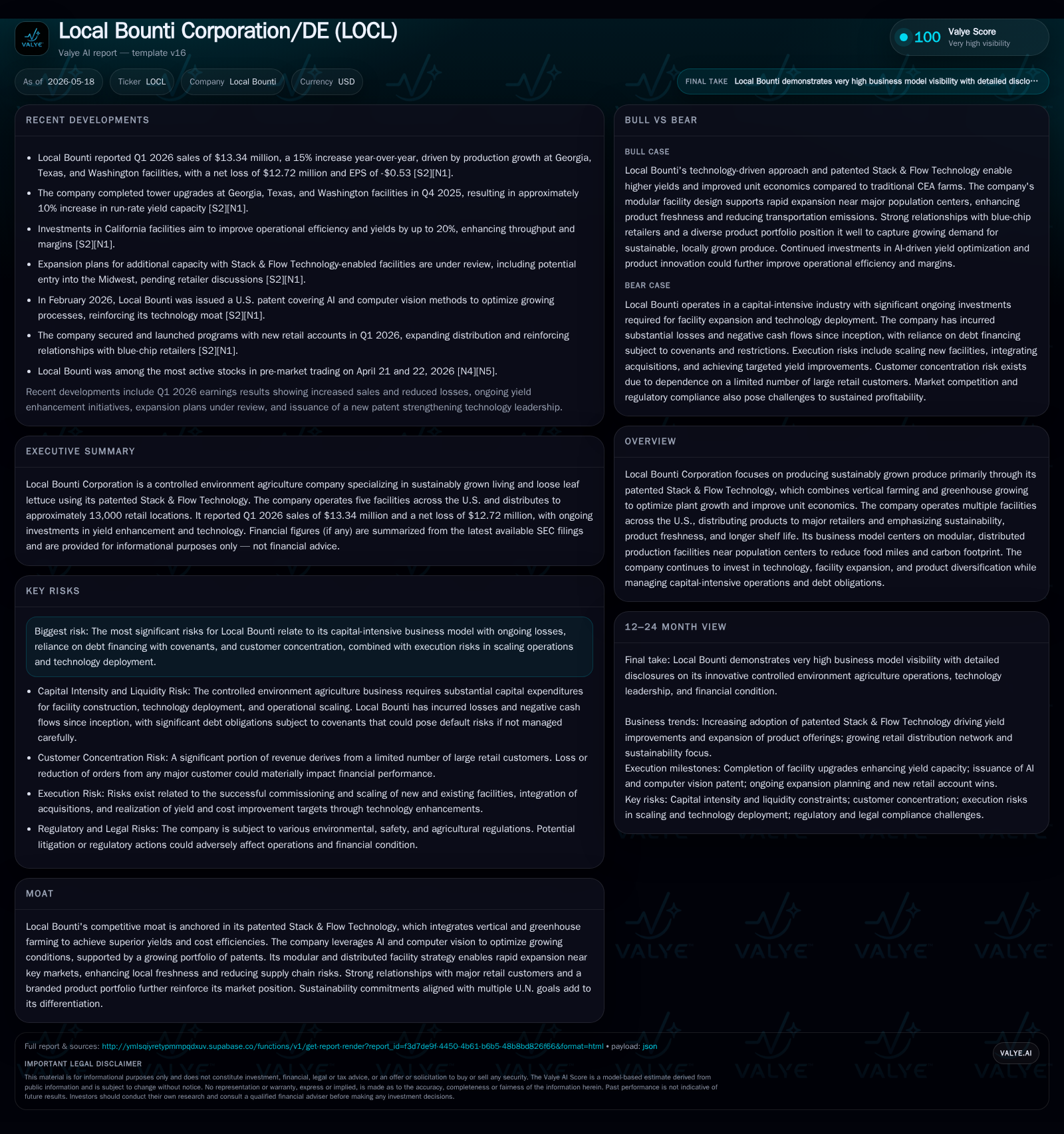
Local Bounti Corporation’s first quarter of 2026 demonstrates tangible progress, notably a 75% increase in baseline sales velocity for its Romano Caesar Salad Kit and securing an additional national retailer distribution center launching in May. The company’s business model leverages patented Stack & Flow Technology to optimize sustainable, controlled-environment agriculture, enabling premium product freshness and efficiency. While expansion into new products such as arugula and new geographic markets continues, the capital-intensive nature of its facilities and significant debt burden pose execution and financial risks. Upcoming milestones include key retail rollouts and monitoring facility expansions aligned with customer demand.
Recent Quarterly Operating Momentum and Product Launches
Local Bounti’s latest quarterly report for Q1 2026 [S2] highlights strong commercial traction in its fresh produce portfolio, centered on the Romano Caesar Salad Kit. This family-sized 10-ounce salad kit launched in the Pacific Northwest gained notable consumer adoption resulting in a significant 75% uplift in baseline velocity units sold per store per week during Q4 2025 [S1]. Building on this success, the company secured an additional distribution center agreement with a prominent national retailer slated for rollout in May 2026, anticipated to further enhance market penetration.
In parallel, the company is actively expanding its arugula offering following initial launches at its Washington and Texas facilities in early 2025 [S2][S1]. Arugula has been described as a category where conventional supply fails on reliability and sufficiency; Local Bounti’s controlled environment baby leaf capabilities present a differentiated solution targeting unmet demand.
Facility operations are increasingly technology-enabled using AI-driven analysis of plant growth metrics alongside environmental data to standardize output quality and maximize yield consistency. These innovations underpin tangible success translating to improved volume throughput and product freshness [S2]
Business Model: Integrating Innovation and Sustainability in Fresh Produce
Local Bounti operates within the controlled environment agriculture (CEA) sector through its patented Stack & Flow Technology—a hybrid system initially employing vertical farming for early plant stages followed by greenhouse systems for maturation. This approach tightly controls growth environments to optimize resource efficiency including water usage reductions around 90%, land use savings also near 90%, as well as significant decreases in chemical pesticide/herbicide use compared to traditional outdoor agriculture [S1][S2].
The business emphasizes proximity to key U.S. metro population centers via modular distributed facilities designed to reduce food miles and carbon footprint while ensuring longer shelf life translates directly into retail freshness advantages. The controlled environment elements allow higher consistency in product quality which facilitates standardization across their network.
Revenue drivers stem from sales to major retailers both through direct contracts and distributor networks serving approximately 13,000 retail doors across over 35 states primarily focused on living butter lettuceand packaged salad kits or leafy greens [S1][S2]. Pricing power derives partially from product differentiation enabled by the company’s technology platform as well as strong relationships in high-velocity retail channels.
Industry Positioning: Competitive Moat Through Patented Technology and Retail Relationships
Local Bounti's competitive advantage lies heavily in its Stack & Flow Technology® protected by patents that integrate vertical farming early-stage plant development with greenhouse finish. This combination delivers superior yields, cost efficiencies, and enhances product freshness compared to conventional or standalone vertical farms [S1]. Moreover, the company incorporates AI-powered analytics for dynamic environmental tuning ensuring operational optimization through data-driven growth condition adjustments [S2].
Their branded portfolio targets blue-chip retailers like Walmart, Kroger, Target, Whole Foods Market, Albertsons, Sam's Club, Brookshire’s, H-E-B among others representing about 13,000 outlets—a broad base which supports customer stickiness but with some concentration risks given top accounts dominance [S1]. Notably, Local Bounti holds approximately an 80% share of the CEA living butter lettuce market within Western U.S., marking clear scale advantages over smaller or less integrated competitors.
The distributed modular facility strategy confers flexibility allowing capacity build-up close to population hubs mitigating typical supply chain volatility inherent in fresh produce logistics [S1]. This positioning supports enhanced control over shelf life deliverability—an increasingly critical attribute amid growing consumer expectations around freshness and sustainability.
Growth Drivers: Retail Expansion, Product Diversification, and Geographic Scaling
Key revenue growth catalysts include continued rollout of innovative products like the Romano Caesar Salad Kit which now enjoys multi-quarter velocity gains incentivizing additional retail distribution center placements [S2][S1]. Expansions of the arugula line reflect strategic moves into specialty leafy greens categories that are poised for stable demand but lack reliable traditional supply chains.
Geographic expansion remains under evaluation with plans to enter Midwest markets pending retailer discussions aimed at configuring facility capacities aligned with localized product assortments [S1]. Such moves reflect thoughtful scaling strategies balancing investment intensity against validated demand signals from key account partners.
Facility investment decisions follow a rigorous build-versus-buy analysis framework that gauges cost-effectiveness relative to potential acquisitions while seeking opportunities to retrofit acquired greenhouses with core Stack & Flow Technology [S1]. Incremental capacity additions from two recently completed Washington and Texas sites already contribute materially while existing California (Pete's Acquisition) and Georgia plants scale volume outputs.
KPI monitoring such as baseline unit velocity improvements at store-level serve as proxies for consumer traction reflecting effective go-to-market execution [N1]. Distribution breadth coupled with velocity gains provide quantifiable momentum markers informing capacity deployment planning.
Risks and Operational Constraints: Capital Intensity, Execution, and Financial Leverage
The core risks confronting Local Bounti relate mainly to its capital-intensive nature requiring continuous significant investment in production-capable controlled environment facilities amid sustained operating losses since inception [S1][S2][F1]. Total debt stood near $431.7 million as of late September 2024 ([F1]), underscoring sizable leverage exposure partially mitigated by cash & equivalents of approximately $12.3 million at March-end 2026 ([F1]). This leverage level constrains flexibility while demanding careful covenant compliance given restrictive terms under Cargill Financial credit agreements including minimum liquidity thresholds [S2][S5].
Execution complexity magnifies as operations scale across multiple states incorporating diverse facility builds plus retrofitting acquired assets requiring integration of proprietary technology stacks alongside workforce ramp-ups [S1][S2]. Concentration risk exists given reliance on a relatively narrow group of large retailers accounting for the majority of revenue—a vulnerability if any materially reduce orders or contract terms shift unfavorably.
Cost control pressures also persist due to inflationary factors impacting input costs linked to seeds, nutrients, packaging materials plus energy requirements for climate control systems integral to CEA platforms [S1][S2]. Litigation-related professional fees spiked during Q1 adding about $1 million expenses partially offsetting reductions elsewhere in payroll or insurance costs showing ongoing legal/compliance overhead volatility [S2].
Outlook: Key Milestones and What to Monitor Next
Near-term attention focuses on execution against new national retailer distribution center launches commencing May 2026 aiming to amplify reach of growing salad kit offerings including Romano Caesar lineup [S2]. Progress indicators will include fresh velocity metrics post-launch rollout assessing consumer adoption curves relative to earlier test markets.
Monitoring expansion progress of arugula volumes will shed light on success pivoting into secondary leafy green categories beyond core butter lettuce dominance [N1][S2]. Further developments around Midwest market entry plans contingent upon finalized retailer collaborations remain critical signposts.
Operationally tracking capital deployment effectiveness at Washington and Texas site expansions including any incremental throughput or yield improvements enabled by AI-driven environmental controls will be important execution barometers.
Product innovation pipeline updates beyond currently disclosed salads would provide insight on potential new verticals reinforcing diversification pathways although no specific new variety announcements were reported this quarter.
Financial Profile: Supporting Capital Structure and Expense Dynamics
For Q1 ending March 31, 2026 Local Bounti reported net cash used in operating activities narrowed moderately to $6.07 million compared with prior year period’s $9.55 million driven partly by reduced net loss ($12.7 million vs. $37.7 million year-over-year) [S17]. General & administrative expenses decreased by $0.6 million notably due to lower salaries/benefit outlays but were offset by a $1.0 million increase in professional fees predominantly related to ongoing litigation matters plus transactional financing work [S2].
Cash flow from financing activities showed inflows totaling $15.2 million chiefly backed by proceeds from issuance of U.S. Bounti convertible notes illustrating reliance on external capital sources continuing into early 2026 alongside existing credit facilities leveraged up to roughly $303 million principal balance under Cargill arrangements as of March-end [S5][F1]. The current ratio stood at a moderate 1.62 providing short-term liquidity cushion albeit not ample relative to total leverage burdens ([F1]).
Interest expense notably declined relative to prior years reflecting amended debt pricing effective late 2025 lowering rates materially despite incremental interest on sale leaseback financing obligations associated with select greenhouse/conveyor equipment assets being carried separately [S5][S12]
Overall financial posture underscores balancing act required between sustaining operational scale-up investment needs against managing ballooning accumulated deficit surpassing half a billion dollars reflecting prolonged subsidy phase common within rapidly evolving technology-enabled ag-tech enterprises [F1][S2].
This analysis is based exclusively on publicly filed SEC reports up to May 15, 2026 ([S1], [S2], [S3]) supplemented by companyfacts balance sheet data ([F1]) without conjecture beyond documented disclosures. It focuses purely on operational developments alongside contextually grounded industry perspectives within controlled environment agriculture without investment advice or valuation judgments.
Disclaimer: This is research-only, informational analysis and not investment advice. It may include AI-generated interpretation and general industry context. Always verify important details using primary sources.

Comments