
Lowe’s Companies Advances Service Innovation and Digital Initiatives Amid Housing Market Dynamics
Lowe’s latest quarterly filing highlights a strategic pivot toward subscription-based home maintenance and digital transformation as key growth levers amid a challenging housing market environment.
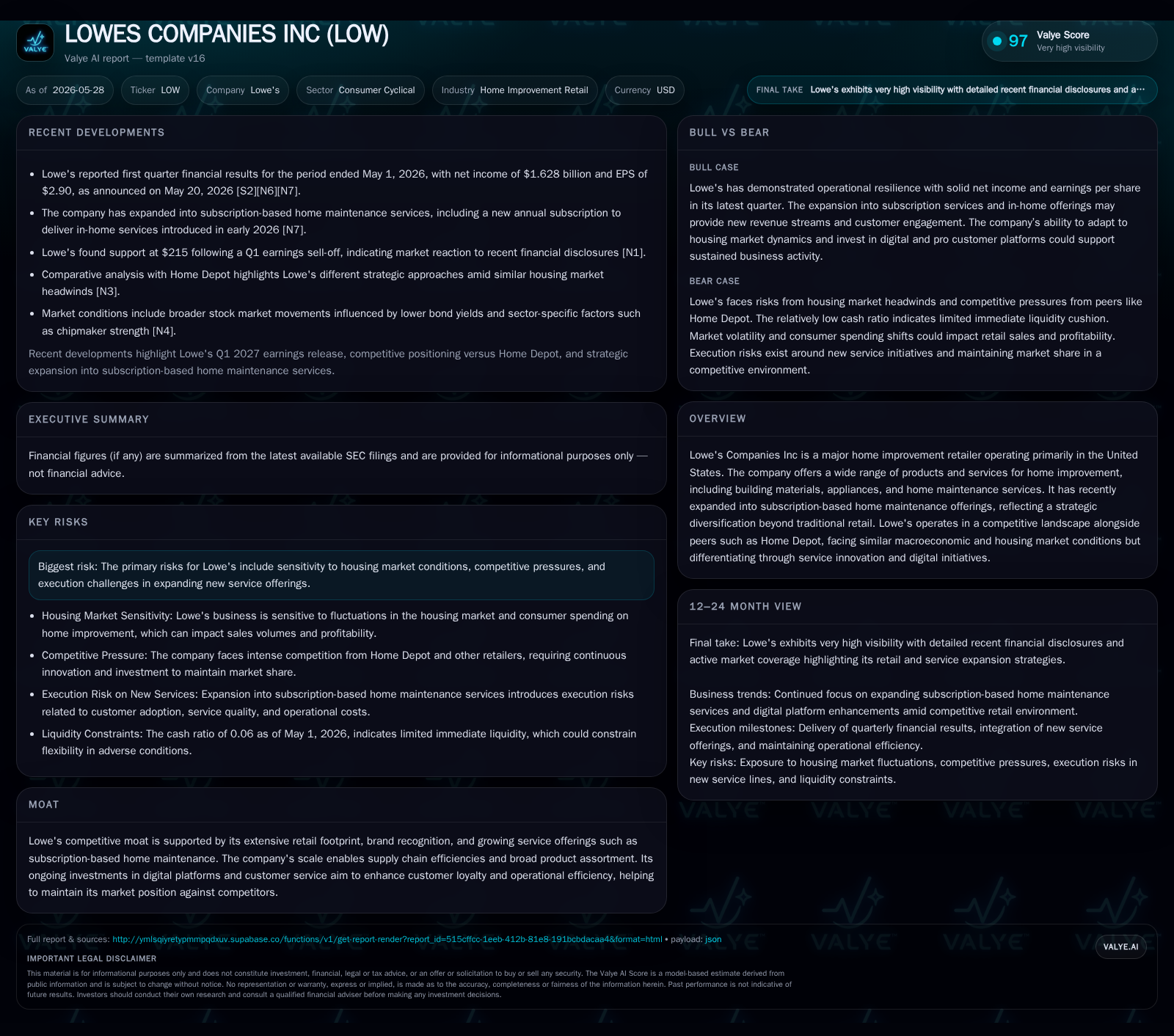
In its Q1 FY2027 report, Lowe’s Companies Inc revealed a pronounced shift in its business model, emphasizing service innovation through the launch of subscription-based home maintenance offerings alongside its traditional retail operations. This strategic diversification aims to mitigate cyclical housing market risks by generating recurring revenue streams and enhancing customer retention via digital platforms. While Lowe’s competes closely with Home Depot, its growing service arm and digital investments represent critical differentiation points. Near-term growth depends on adoption rates for new services, operational execution, and sustaining pricing power amidst ongoing sector headwinds.
Latest Quarterly Operating Update
Lowe's Companies Inc's first quarter of fiscal year 2027 (ending May 1, 2026) disclosed in the SEC Form 10-Q filed May 28, 2026, reflects critical strategic updates that frame its near-term operating outlook [S2]. Most notably, Lowe's has broadened its service portfolio with the introduction of subscription-based home maintenance plans. This initiative marks a substantial pivot from the company's historical reliance on core product retail sales toward a recurring revenue model aimed at stabilizing demand during housing market variability [S3].
Concurrently, Lowe's reported stable but modestly pressured same-store sales growth consistent with industry-wide softness tied to housing starts and renovation activity [N4]. Management commentary during the earnings call highlighted ongoing investments in digital platforms designed to enhance customer engagement and improve the efficiency of both online and in-store channels [N4]. The service rollout is expected to benefit from these digital tools by facilitating targeted marketing and streamlined customer interaction.
Margins faced typical compression driven by promotional activities necessary to sustain traffic against competitive pressures; however, the service line's margin profile is anticipated to be accretive over time given the lower capital intensity compared to traditional retailing [S2]. This signals an early inflection in Lowe’s cost structure dynamics that could improve overall profitability if effectively scaled.
Business Model and Product Differentiation
Lowe's revenue fundamentally derives from selling an extensive array of home improvement products ranging from building materials to appliances through its large multi-format store network complemented by e-commerce channels [S1]. The breadth of product assortment underpins consumer traffic via a one-stop-shop value proposition that leverages robust supplier relationships secured at scale for optimal pricing.
Over recent years, Lowe's has been augmenting this traditional retail foundation with service offerings—most prominently now via subscription-based home maintenance plans launched recently. These packages offer customers proactive upkeep solutions encompassing routine inspections, repairs, or seasonal services payable on a recurring subscription basis [S3]. This not only enhances customer lifetime value by embedding Lowe's deeper into homeowners’ routine expenditures but also generates predictable cash flows less sensitive to discretionary spending swings.
Digital investments are a core enabler of this shift. Advanced data analytics facilitate personalized marketing campaigns that efficiently convert prospects into subscribers while also supporting service delivery logistics [S1]. Such integration reduces customer acquisition cost compared with traditional advertising-heavy retail models. Furthermore, increasing online channel penetration supports cross-selling opportunities between product sales and service subscriptions.
The combination of traditional retail scale plus innovative service diversification positions Lowe's to partially insulate itself from pure merchandise volume volatility by expanding higher-margin recurring revenue lines. This nuanced revenue mechanics evolution reflects an adaptive strategic approach responsive to evolving consumer preferences.
Competitive Position and Industry Structure
Within the home improvement retail industry dominated by giants such as Home Depot and Lowe's itself stands as the second-largest player primarily operating across the U.S. market [S1]. The sector structure is oligopolistic with high fixed costs tied to maintaining sprawling physical footprints complemented by sophisticated supply chains enabling nationwide distribution.
Lowe’s competitive position benefits significantly from:
- Scale advantages that reduce procurement costs allowing competitive pricing.
- A broad geographic presence enhancing brand accessibility.
- Deepening service integration differentiating it materially from peers reliant principally on transactional retail sales alone.
Compared against Home Depot—the largest peer—Lowe’s historically lags slightly in average ticket size but compensates with stronger performance in ancillary services including installation and now home maintenance subscriptions [N13]. Both players face comparable macroeconomic headwinds as residential construction fluctuates; however, Lowe’s emphasis on digital tooling for customer engagement may afford improved channel synergy over time.
Inventory management remains critical given category breadth; Lowe's benefits from supply chain efficiencies but must carefully balance inventory turns with markdown risk amidst slower demand cycles [S1]. Pricing power is somewhat constrained by fierce peer rivalry yet partially supported by differentiated service offerings which command incremental margins beyond commodity products.
Growth Drivers from Service Expansion and Digital Initiatives
The centerpiece growth driver in current Lowe's strategy is accelerating penetration of subscription-based home maintenance services launched recently [S2][S3]. These offerings cater to shifting consumer behaviors favoring convenience and preventative care over reactive repairs. If adoption scales successfully across the installed base of existing customers plus new house purchases nationally, this could materially augment sales predictability.
Digital platforms support several key operational efficiencies:
- Enhanced targeting lowers marketing expenditures per acquired subscriber.
- Integration with mobile order management systems increases user convenience boosting retention rates.[S1]
- Data capture enables continuous product/service refinement driving higher satisfaction levels.
Moreover, digital transformation improves overall customer experience throughout brick-and-mortar + online channels thus supporting traffic stabilization even when macro conditions soften. An expanding digital share also moderates operational fixed asset intensity while supporting omnichannel commerce trends prevalent across retail sectors.
Collectively these elements weave a multi-layered growth fabric: recurring revenue streams lengthen customer lifetime relationships while channel modernization optimizes operating leverage. This combination should ultimately underpin more resilient top-line momentum than merchandise-led-only models vulnerable to cyclical housing dynamics.
Risks and Constraints Including Housing Market Sensitivity
Despite positive directional developments signaled by new service launches and digital upgrades, significant risks remain:
- Housing Market Cyclicality: As revenues remain heavily correlated with residential construction activity, downturns depress core product volumes materially impacting same-store sales [S1][S2].
- Competitive Pricing Pressure: Intense rivalry chiefly against Home Depot limits pricing power especially amid overlapping store footprints.
- Service Execution Risk: Scaling young subscription offerings involves operational complexities including logistics integration and meeting elevated customer expectations; failure here could impair brand reputation or stall uptake.[S2]
- Margin Volatility: Promotional activities required to defend market share compress margins while costs linked to launching new services might weigh temporarily on profitability[S2].
- Supply Chain Disruptions: Global raw material volatility may introduce input cost variability affecting cost control disciplines.[S1]
Hence investors should treat growth projections stemming from new initiatives as contingent upon smooth execution alongside more favorable macroeconomic trends in residential investment.
Key Milestones and What to Watch Next
Looking forward through FY2027 several performance indicators will prove pivotal:
- Subscription Adoption Rates: Quarterly disclosures or proxy KPIs revealing penetration into existing customer base will clarify scalability potential[S2][N4].
- Same-Store Sales Metrics: Trends reflecting resilience or deterioration in core retail traffic serve as proximate gauge for cyclical pressures[S2].
- Margin Trajectory: Monitoring gross/operating margin movement helps assess if service mix improvements materialize or promotional discounting intensifies.[S2]
- Digital Engagement Metrics: Data around online penetration or app usage may hint at underlying shifts improving lifetime value.[S1][N4]
- Management Commentary: Updates regarding rollout progress particularly in newer markets or service segments provide qualitative insight into execution risk mitigation.[S2][N4]
Progress against these milestones can validate whether Lowe's strategic pivot translates into durable competitive advantage or remains vulnerable within an unforgiving consumer sector.
Financial Overview Supporting the Operational Narrative
As of May 1, 2026 – per companyfacts snapshot – Lowe's maintains approximately $786 million in cash & equivalents alongside $36.75 billion total debt resulting in net debt near $35.96 billion [F1]. The current ratio stands modestly above one at 1.09 reflecting balanced short-term liquidity relative to obligations[F1].
Operating income last reported at fiscal year-end January 30, 2026 was $10.15 billion depicting solid earnings generation capacity supportive of ongoing capital allocation toward innovation initiatives[S1][F1]. While precise Q1 profitability metrics were impacted by promotional pressure during transition phases toward subscriptions and digital scaling[S2], underlying cash flow generation appears intact allowing sustained investment funding without jeopardizing financial stability.
This financial profile underpins confidence in Lowe’s capacity to execute planned strategic initiatives even amidst a moderately challenged top-line environment given prudent leverage management paired with healthy operating income generation capabilities.
Disclaimer: This analysis does not constitute investment advice but provides an informed perspective based on publicly available SEC filings and news reports as of May 2026.
Disclaimer: This is research-only, informational analysis and not investment advice. It may include AI-generated interpretation and general industry context. Always verify important details using primary sources.

Comments