
NGL Energy Partners LP Refines Capital Structure with $950M Term Loan Amid Modest Operating Profitability
NGL Energy Partners LP's 2026 Q3 update highlights strategic refinancing and ongoing leverage considerations within its energy services operations.
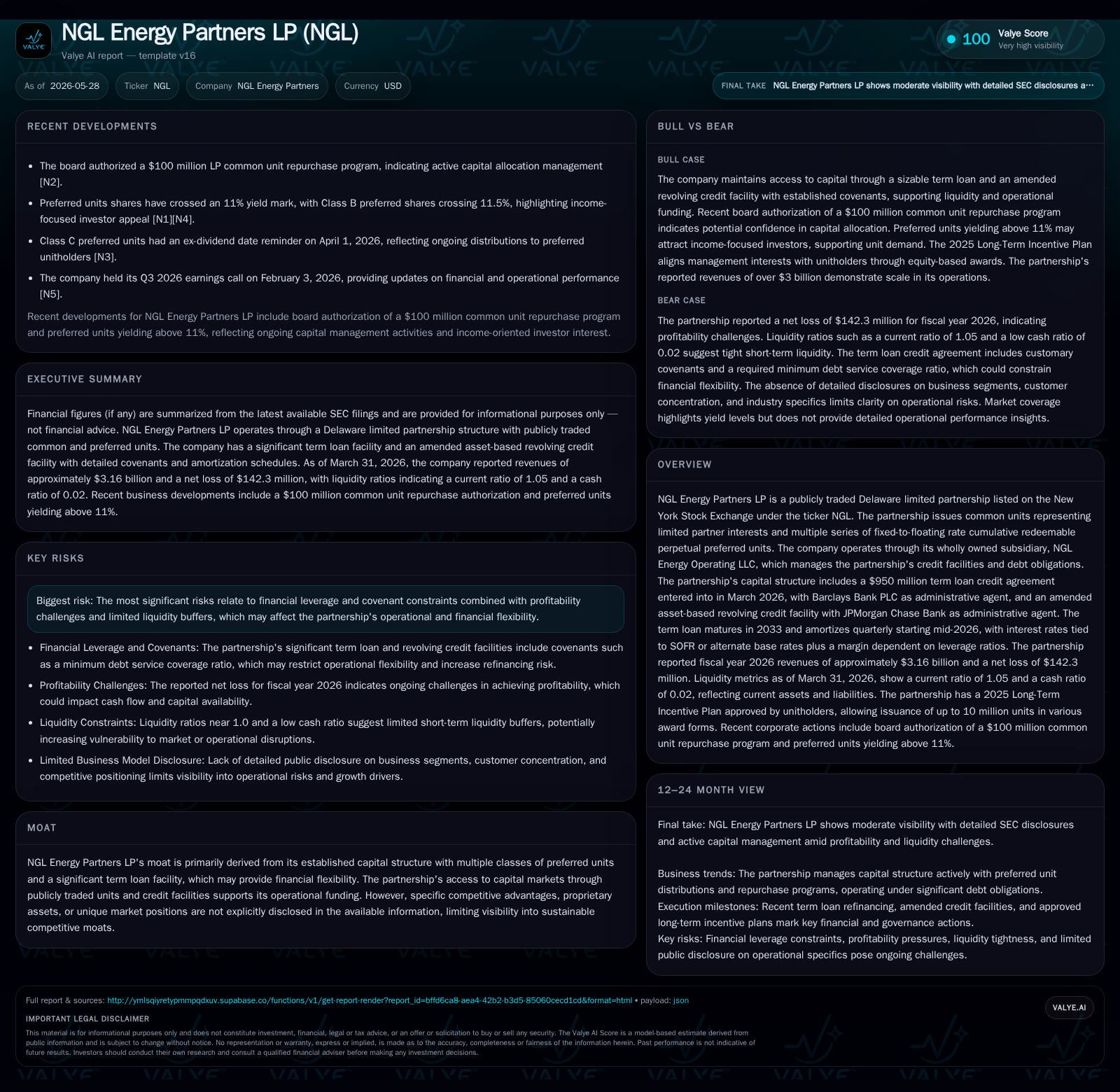
In its latest quarterly filing ending March 31, 2026, NGL Energy Partners LP implemented a significant refinancing by securing a $950 million term loan that replaces a prior facility and strengthens its liquidity profile. Despite generating over $3.1 billion in revenue, the partnership continues to face net losses and maintains a high debt load. The business operates primarily through its operating subsidiary, providing energy logistics and marketing services reliant on commodity market conditions and credit management. Key risks remain tied to financial leverage constraints and profitability challenges amid cyclicality in energy markets. Going forward, the partnership's performance will hinge on managing debt service requirements, sustaining operational cash flows, and potential growth via asset acquisitions or contract expansions.
Recent Operating Update
NGL Energy Partners LP's latest quarterly report for the period ending March 31, 2026 [S2] documents a decisive refinancing milestone: completion of a new $950 million term loan credit agreement dated March 12, 2026 [S6][S7]. This facility supersedes their previous February 2024 credit agreement with Toronto Dominion Bank. The term loan carries an interest rate linked to SOFR plus margins between 3.25% to 3.50%, scaling with first lien net leverage ratios, while amortizing quarterly at 1% of principal beginning Q2 FY2026 through maturity in March 2033.
The operating entity under this facility is NGL Energy Operating LLC ("Operating LLC"), which along with certain subsidiaries act as guarantors. Concurrently, amendments to their asset-based revolving credit facility reduced commitments from $475 million to $425 million while softening interest rate margins based on fixed charge coverage ratios [S8]
Despite top-line resilience—revenue reached approximately $3.16 billion in this quarter—the partnership reported a net loss of $142 million [F1]. Operating income was positive but slim at about $95 million [F1], indicating margin compression likely attributable to commodity market volatility coupled with sizable interest expenses due to elevated leverage.
Liquidity remains constrained although marginally improved; cash balances totaled approximately $8.5 million against current liabilities near $740 million resulting in a current ratio close to parity at 1.05 [F1]. This tight liquidity profile underscores the importance of efficient working capital management in an industry characterized by fluctuating volumes and payment terms.
Business Model
NGL Energy Partners LP functions primarily as an integrated energy logistics company specializing in crude oil gathering and transportation; natural gas liquids (NGL) marketing; refined product distribution; and storage solutions through its wholly owned subsidiary Operating LLC [S1]. Revenue generation hinges on fees collected from throughput volumes handled across pipelines, terminals, and trucking assets as well as margin spreads from commodity marketing activities.
Customers generally include producers seeking midstream services, refiners requiring product distribution channels, and third-party marketers leveraging physical delivery infrastructure. Pricing mechanisms mix fixed-fee contracts for transportation/storage capacity with variable fees tied to commodity price differentials or volume metrics. Credit quality assessment is critical given working capital extensions embedded in billing cycles.
Margins are inherently sensitive to commodity price swings affecting both demand for transportation services and market spreads for NGLs. Hence, revenue is volume-driven but contingent on maintaining strong contract terms amid competition and regulatory compliance costs.
The partnership structure issues common units representing limited partner interests alongside cumulative preferred units which pay fixed-to-floating dividends—a capital framework designed to attract diverse investor profiles but also embedding financial complexity [S1].
Industry Structure and Competitive Position
The midstream energy sector served by NGL occupies a capital-intensive niche with high barriers due to infrastructure scale requirements and regulatory scrutiny regarding safety/environmental standards. Competitors typically include major integrated pipeline operators along with regional specialty service providers.
NGL Energy’s competitive positioning depends on its geographic footprint’s alignment with prolific production basins; breadth of marketed products across hydrocarbons value chains; and agility in credit risk mitigation given exposure to volatile upstream customers [S1]. While no uniquely proprietary assets or exclusive contracts are disclosed, access to substantial credit facilities provides operational funding flexibility.
Customer concentration risk potentially elevates business volatility especially if key contracted volumes decline or counterparties face financial distress—common themes within cyclical upstream/downstream segments [S17]. Distribution effectiveness spans contractual relationships supported through extensive terminal networks.
Growth Drivers
Growth for NGL hinges on several structurally supportive factors:
- Commodity Production Trends: Increased activity in shale plays or conventional basins underpins volume growth for gathering/transport fees.
- Service Expansion: Enhancing terminal/storage capacities or expanding transportation routes can secure additional fee streams.
- Contract Renewals & Pricing: Long-term contracts with customers stabilize revenues; favorable pricing linked to capacity utilization supports margin improvement.
- Capital Market Access: Maintaining investment-grade-like access enables strategic acquisitions or asset upgrades fueling organic growth potential.
- Operational Efficiency: Optimizing logistics workflows reduces operating costs while boosting throughput reliability.
These drivers are counterbalanced by challenging macroeconomic cycles influencing commodity prices that determine midstream demand patterns.
Risks / Watchpoints / Growth Constraints
Principal risks center around financial leverage and covenant adherence post-refinancing:
- Leverage Load: With net debt approximating $3.27 billion against limited liquidity reserves [F1], servicing obligations rely heavily on steady cash flow generation.
- Debt Service Coverage Covenant: The Term Loan mandates maintaining at least a 1.10x debt service coverage ratio quarterly starting June 2026 [S6], exposing the partnership to default risk if earnings falter.
- Profitability Pressure: Persistent net losses despite positive operating income illustrate cost headwinds including financing expenses reducing free cash flow availability.
- Market Cyclicality: Fluctuations in commodity prices directly impact volume throughput and marketing margins causing uneven earnings visibility.
- Regulatory Exposure: Compliance costs related to environmental regulations across multiple states can affect operational expenditures.
- Customer Credit Risk: Downstream insolvencies could drive receivable write-offs impairing liquidity.
Such factors necessitate vigilant financial management strategies combined with operational discipline.
What to Watch Next
Key indicators for monitoring NGL Energy's near-term outlook include:
- Quarterly updates on compliance with Term Loan covenants particularly debt service coverage ratios post-June 2026.
- Cash flow consistency supporting scheduled amortization payments beginning mid-year.
- Renewal rates of long-term contracts underpinning fee stability amidst market fluctuations.
- Management commentary around strategic initiatives including possible asset acquisitions or capacity expansions using available credit lines.
- Movements in preferred unit dividends or repurchases impacting overall capital structure costs observable through market pricing [N1].
- Any amendments or upsizes/extensions of credit facilities indicating adjustments in liquidity outlook.
These elements collectively offer insight into execution success against financial constraints.
Financial Profile Summary
At quarter-end March 31, 2026, NGL Energy recorded revenue of approximately $3.16 billion but reported net losses amounting to $142 million while achieving modest positive operating income near $95 million [F1]. Total debt sits around $3.28 billion against meager cash reserves near $8.5 million resulting in tight liquidity parameters (current ratio ~1.05) [F1]. The recent $950 million term loan replaces earlier indebtedness improving debt maturity profile but introduces amortization obligations starting mid-year along with interest rates sensitive to leverage metrics [S6][S7].
This financial snapshot illustrates an enterprise balancing significant operational scale against pronounced leverage risks requiring disciplined covenant compliance amid industry cyclicality.
Disclaimer: This analysis is for informational purposes only based on public filings and does not constitute investment advice.
Disclaimer: This is research-only, informational analysis and not investment advice. It may include AI-generated interpretation and general industry context. Always verify important details using primary sources.

Comments