
EPLUS INC Strengthens Position with Broad IT Solutions and Stable Dividend Policy
ePlus inc. leverages its integrated technology solutions portfolio and solid financial foundation to maintain competitive momentum and return capital through dividends.
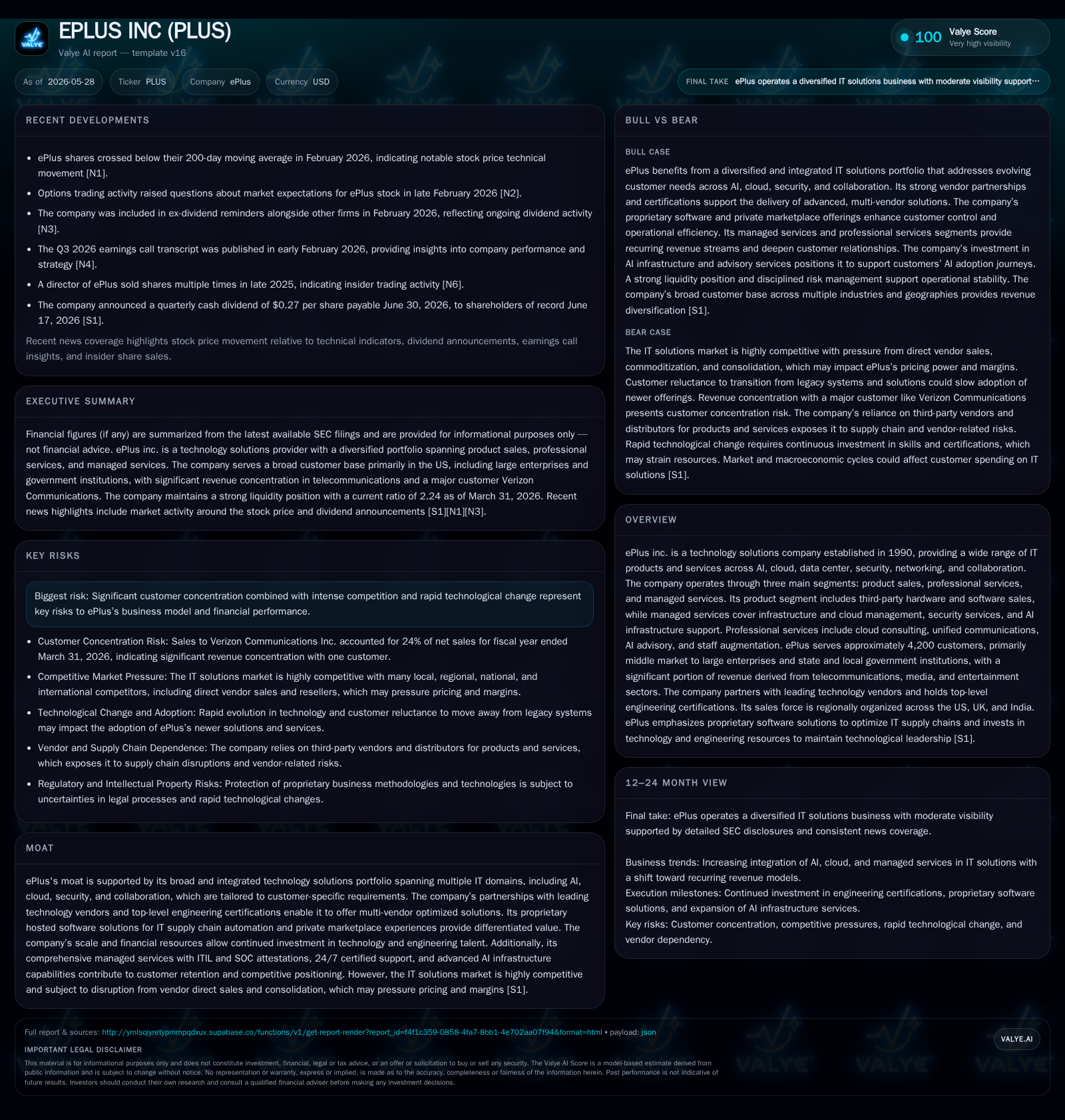
In its latest quarterly filing ending February 2026, ePlus inc. sustained growth across its product, professional, and managed services segments while maintaining operational stability. The company’s May announcement of a $0.27 per share quarterly dividend emphasizes its strong cash flow generation and mature capital allocation strategy. With a diversified customer base focused on telecommunications, government, and enterprise sectors, ePlus’s multi-vendor IT infrastructure offerings—including AI infrastructure support and cloud consulting—anchor its competitive moat amid challenging industry dynamics. Key risks include customer concentration and margin pressure from hardware resale; however, expanding AI and cloud service adoption alongside proprietary supply chain automation platforms provide avenues for further penetration. Monitoring upcoming earnings releases and service expansion progress will be critical to assessing execution.
Recent Quarterly Operating Update and Implications
ePlus's latest quarterly report filed on February 4, 2026 ([S2]) reaffirms operational stability across its core business segments without material changes to previously disclosed risk factors ([S27]). Although the filing does not disclose granular segment-level financial details for the quarter alone, it confirms continuity in business momentum leading up to fiscal year-end March 31.
Crucially, in a May 28, 2026 event release ([S3]), the company's Board declared a quarterly dividend of $0.27 per common share payable on June 30 to shareholders of record as of June 17. This marks an explicit use of excess cash flow to return capital. Consistent dividend policies in the IT solutions space generally reflect mature revenue visibility and confidence in recurring service contracts underpinning profitability.
The timing—soon after the fiscal year finalization—and size of the dividend signals that ePlus views itself as financially robust with sufficient liquidity buffers while pursuing growth investments. It also positions ePlus as attractive to income-focused stakeholders amid an often volatile tech investment environment.
ePlus Inc Business Model and Product Portfolio Overview
Founded in 1990, ePlus operates a diversified technology solutions platform spanning three main segments: product sales, professional services, and managed services ([S1],[S10]).
The product segment deals largely with third-party hardware and software sales—including perpetual licenses and subscriptions—procured primarily on behalf of customers via extensive distribution agreements with leading global vendors such as AWS, Cisco Systems, Microsoft, NVIDIA, Fortinet, VMware by Broadcom, Zoom, Oracle among others ([S1]). These products cover AI infrastructure components (e.g., NVIDIA DGX systems), networking equipment, cybersecurity tools, collaboration hardware/software suites.
Professional services encompass cloud consulting (cloud platform design/build/migration), AI advisory (workshops to accelerate AI readiness), unified communications implementation (integrated voice/video/messaging) plus staff augmentation providing flexible IT talent deployment ([S16],[S23]). These consultative offerings help customers optimize technology adoption aligning with evolving business needs.
Managed services include infrastructure monitoring/management (on-premises/cloud hybrid environments), advanced security operations (SOC-as-a-service vulnerability assessments, incident response), managed collaboration solutions supporting remote/hybrid workspaces plus specialized AI infrastructure support leveraging certifications like NVIDIA DGX SuperPOD Specialization ([S22],[S24]). These recurring subscription-based or contractually committed services drive long-term customer retention through high switching costs created by customized integration and governance protocols.
Notably, ePlus has developed proprietary hosted platforms enabling automation of IT asset procurement and lifecycle management through private marketplace experiences integrated with public clouds' marketplaces—AWS Marketplace et al.—enhancing procurement efficiency for customers managing complex multi-vendor IT estates ([S1]).
This breadth enables cross-selling opportunities whereby customers prefer seamless one-stop solutions rather than piecing together disparate vendors.
Competitive Positioning within the IT Solutions Ecosystem
ePlus operates within an intensely competitive market characterized by large incumbent resellers/direct vendors as well as emerging disrupters leveraging direct-to-customer digital sales channels ([S5]). Commodity-style pricing in hardware sales exerts downward margin pressure.
However, ePlus's moat is fortified by its engineering depth with top-level certifications allowing fine-tuned multi-vendor solution orchestration—tailored precisely to client architectural preferences ([S1]). This skill set extends beyond pure product resale into managing complexities around secure cloud migrations fueled by regulatory compliance (SOC attestations) and cybersecurity vigilance.
Its comprehensive managed services portfolio ensures stickiness through bundled offerings including around-the-clock support certified at multiple levels and analytic reporting dashboards customized per client requirements ([S24]). This mitigates risks that clients might bypass intermediaries given direct vendor offerings.
Direct competition includes vendors establishing their own managed service arms plus national/regional resellers focusing on specific verticals or geographies; indirect competition arises from clients’ inertia clinging to legacy system providers complicating migration cycles ([S5]).
Scale also matters; ePlus’s sizable regional presence with ~705 sales/marketing staff across US/UK/India supports wide-reaching customer engagement backed by digital demand generation co-funded by partners ([S18]). This multi-region approach provides diversification against localized economic cycles.
Key Growth Drivers Enhancing Market Penetration
ePlus benefits from secular trends driving increased spend in technology upgrades mandated by digital transformation imperatives:
AI Infrastructure Support: As enterprise adoption of AI workloads intensifies requiring high-performance computing setups (e.g., NVIDIA DGX platforms), ePlus’s unique specialization delivers differentiated value given limited providers specialize at this tier ([S22]).
Cloud Migration Consulting: Widespread migration from legacy data centers to public/hybrid clouds sustains demand for expert architecture design/deployment assistance found within its professional services ([S16],[S23]).
Managed Security Services: The rising threat landscape elevates companies’ need for outsourced SOCs covering vulnerability management through incident response coupled with ongoing governance risk/compliance advisory ([S22],[S23]).
Customer Vertical Strength: Telecommunications sector forms
30% of revenue with Verizon alone contributing ~24% net sales indicating strong penetration but underscoring concentration risks ([S5],[F1]). Expansion into state/local education clients (13%) provides counterbalance as SLED budgets stabilize with macroeconomic conditions improving ([S5]).Proprietary Platforms: The private marketplace expansions integrate seamlessly into clients’ purchasing workflows reducing friction while expanding total addressable market for recurring revenue beyond traditional product sale cycles ([S1]).
Risks and Industry Challenges Shaping Future Prospects
ePlus faces tangible headwinds:
Customer Concentration: Heavy reliance on Verizon (~24% net sales) creates vulnerability if contractual terms shift or telecom capex is curtailed; similar concentration exists across top clients possibly amplifying revenue volatility ([S5],[F1]).
Margin Pressure: Hardware resale commodities experience fierce pricing competition especially from direct vendor channels or low-value-add resellers risking margin erosion necessitating growth in higher-margin managed/professional offerings to offset (9[S11],[F1]).
Rapid Technological Change: Maintaining relevancy requires continual investment in engineering talent development amid technology shifts toward AI orchestration automation DevSecOps zero trust requiring agile upskilling or potential obsolescence ([S11],[F1],[S7]).
Regulatory & Contractual Risks: Public sector engagements depend on compliance adherence; procurement cycles are lengthy with renewal uncertainties adding unpredictability particularly for state/local government clients exposed to budget reallocations ([S11],[F1]).
Competitive Disruption: Emergence of larger consolidated players plus direct-managed service push by vendors challenge traditional reseller margins & client dynamics (9[S5],[F1]).
Near-Term Catalysts and Monitoring Points for Investors
Investors should closely watch:
- Quarterly earnings releases following fiscal year 2026 end results announced May 28 which will shed light on execution against identified strategic priorities particularly growth trajectory in professional/managed service uptake relative to product sales volume dynamics [S3].
- Updates or commentary regarding the pace of adoption for AI advisory workshops & POC accelerators as indicators of pipeline maturation transforming into revenue realization [S23].
- Expansion efforts into select international markets (UK/EU/India) given growing footprints may help offset domestic concentration risk [S18].
- Private marketplace platform penetration progress across AWS/Azure/Google ecosystems representing potential to increase wallet share beyond traditional procurement methods [S1].
- Any management commentary or guidance adjusting expectations based on macroeconomic factors affecting IT spend patterns especially interest rate inflation impact sensitivity.
Concise Financial Profile Summary
ePlus reported fiscal year ended March 31, 2026 revenues at approximately $2.44 billion with operating income near $166 million confirming profitable scale ([F1]). Net income stood at ~$133 million evidencing stable bottom-line generation amid competitive markets.
Balance sheet liquidity remains robust: cash & equivalents totaled about $410 million while total debt stood significantly lower near $39 million yielding a strong net cash position effectively -$372 million supported by current assets over twice current liabilities; the current ratio was healthy at 2.24 ([F1]), indicating ample short-term financial flexibility.
The recently declared quarterly dividend at $0.27 per share complements this profile reflecting consistent free cash flow generation underpinning shareholder returns while retaining capacity for growth investments ([F1],[S3]). This balance between capital discipline and reinvestment capability strengthens ePlus's positioning amid tech spending uncertainties.
This analysis is based solely on reported SEC filings and validated financial data without offering investment advice. It aims to provide a detailed perspective on ePlus inc.'s operational status and industry context reflecting recent developments as of mid-2026.
Disclaimer: This is research-only, informational analysis and not investment advice. It may include AI-generated interpretation and general industry context. Always verify important details using primary sources.

Comments