
Reservoir Media Advances Growth with Robust Fiscal 2026 Results and Strategic Leadership Agreements
Reservoir Media reported strong fiscal 2026 financials alongside executive employment contracts that align leadership incentives with growth objectives.
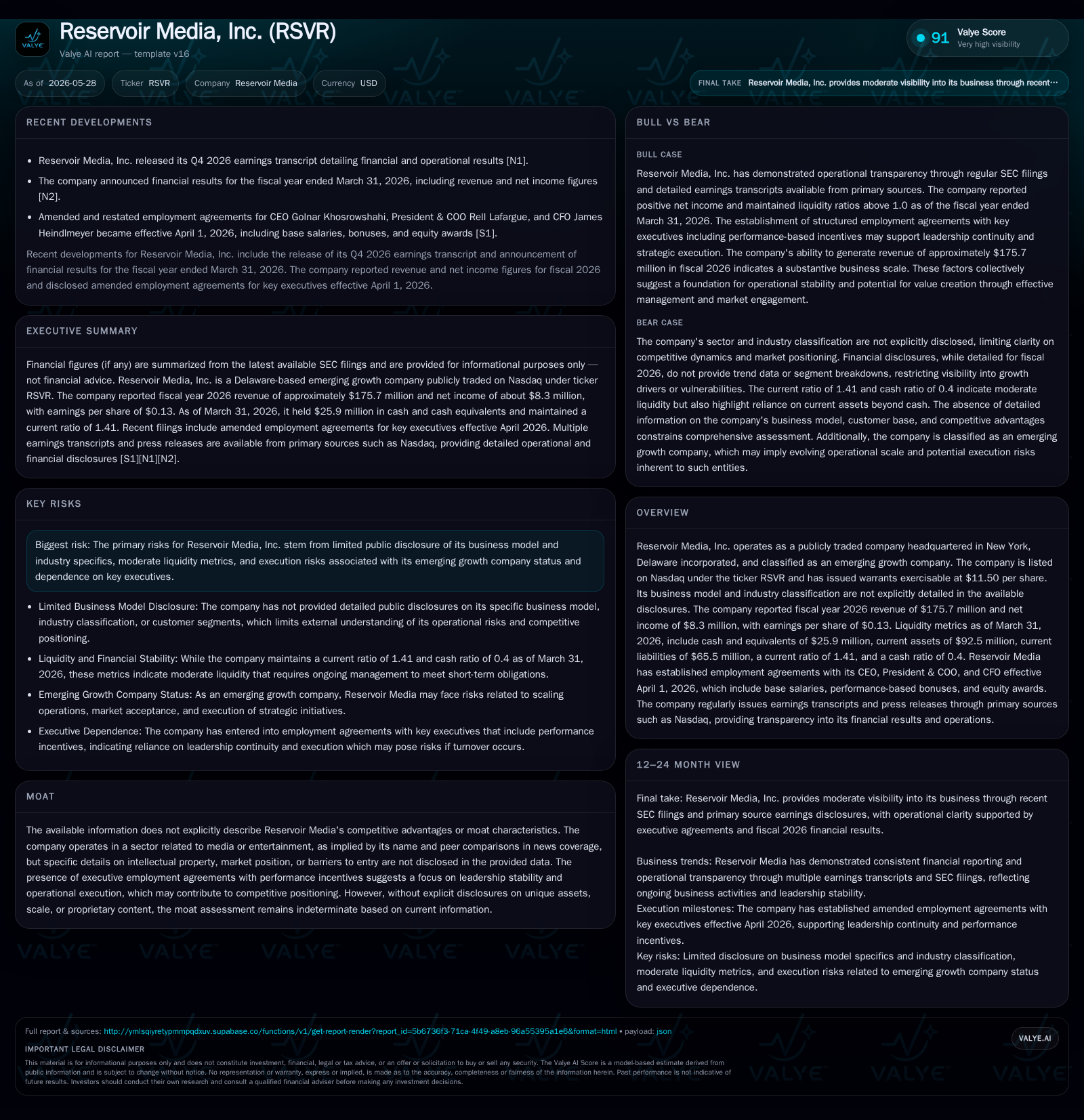
In its latest 8-K filing dated May 28, 2026, Reservoir Media disclosed consolidated revenue of $175.7 million for fiscal year 2026 and net income of $8.3 million, marking a notable operating milestone. New three-year employment agreements established in early 2026 for the CEO, President & COO, and CFO underscore management’s focus on long-term operational execution and incentivize performance. The company's business model centers on monetizing music rights through licensing and royalties, positioning it within a competitive but dynamic media rights industry. Going forward, growth depends on expanding content catalogs and capitalizing on digital distribution opportunities while managing leverage and execution risks inherent to its emerging growth status.
Q4 and Fiscal Year 2026 Operating Update
Reservoir Media’s most recent Form 8-K filing dated May 28, 2026 ([S3]) anchors this analysis with the company's full fiscal year results ended March 31, 2026. The company reported consolidated revenue of approximately $175.7 million and net income of $8.3 million, equivalent to earnings per share of $0.13. According to external commentary ([N2]), these results beat analyst expectations, indicating operational strength within an evolving media environment.
Liquidity as of quarter-end showed cash and equivalents at just under $26 million alongside current assets of roughly $92.5 million against current liabilities near $65.5 million—a current ratio of about 1.41 signals manageable short-term liquidity ([F1]). However, total debt remains substantial at about $459 million with net debt around $433 million after cash adjustments ([F1]), highlighting leverage as a structural consideration going forward.
Importantly, Reservoir formalized employment agreements in early March 2026 that became effective April 1 for its CEO Golnar Khosrowshahi, President & COO Rell Lafargue, and CFO James Heindlmeyer ([S12], [S13]). These contracts incorporate competitive base salaries ($600K for CEO/President & COO; $425K for CFO) plus performance-based bonuses linked to company milestones and significant equity awards vesting immediately upon grant—signaling strong alignment toward operational execution.
Reservoir Media’s Business Model and Revenue Drivers
Though specific segment disclosures are limited ([S1]), Reservoir Media operates broadly within the music rights management sphere as inferred by its name and industry peer context. Its revenue likely derives from licensing fees charged to end users—such as streaming services, broadcasters, advertisers—and royalty income from music publishing rights.
The monetization engine revolves around controlling intellectual property catalogs comprising compositions and recordings that produce ongoing usage royalties internationally. Licensing agreements typically involve negotiated fees varying by platform type (e.g., interactive streaming vs traditional radio) and contract terms affecting revenue recognition timing.
Revenue growth is generally driven by expanding content portfolio breadth through acquisitions or signings (adding licensed works), volume growth from increased user engagement on digital platforms globally, pricing adjustments tied to market power or regulatory shifts, and improved collection technologies enhancing royalty accuracy ([S1]).
Margins can benefit from scale economies as fixed legal and administrative costs spread over a larger royalty base; however, fluctuations in contract terms or changes in royalty distribution frameworks (e.g., legislative reforms) can create episodic effects.
Industry Structure and Competitive Positioning
Reservoir operates in a moderately concentrated industry where large diversified conglomerates (e.g., Universal Music Group) coexist with smaller specialized aggregators focusing on niche catalogs or territories ([S1]). Competitive advantage hinges heavily on the size and uniqueness of owned content catalogs which command pricing power via exclusivity or cultural relevance.
Digital transformation has disrupted traditional channels by amplifying streaming's share yet introducing complexities such as multi-territory licensing compliance and technological demands for transparent royalty tracking—areas where incumbents with scale excel while smaller players face integration challenges. Regulatory developments concerning copyright enforcement also influence operating levers.
Switching costs exist but vary by license type; major licensees may prefer consolidated rights holders to reduce transactional complexity while smaller platforms might shop among providers for cost efficiency. This dynamic creates both opportunity and pressure depending on catalog distinctiveness.
While Reservoir’s emerging growth designation highlights its developmental stage ([S3]), the recent executive contracts underscore board confidence in management’s ability to navigate this competitive terrain thoughtfully.
Growth Drivers: Content Rights Expansion and Digital Monetization
The primary growth vectors reside in (i) incremental catalog acquisitions that expand repertoire comprehensiveness enabling cross-platform licensing deals; (ii) rising global consumption of streamed audio/visual content stimulating demand for upstream licenses; (iii) enhanced royalty administration technologies improving collection efficiency unlocking previously underreported revenue sources ([S1], [S3]).
Performance-based compensation incentives embedded in recent leadership agreements suggest an emphasis on deal flow acceleration combined with operational scale-ups ([S12], [S13]). Market tailwinds such as increasing digital subscription penetration also support longer-term structural expansion beyond cyclical noise.
Risks and Execution Challenges in an Emerging Growth Framework
Despite encouraging performance trends, Reservoir faces multiple material risks including:
- High leverage relative to liquidity resources can constrain financial flexibility especially if free cash generation proves volatile amid investment phases ([F1]).
- Organizational reliance on a small executive team accentuates execution risk; any leadership disruptions could materially impair strategy implementation despite contractual retention efforts ([S3]).
- Cybersecurity threats highlighted in risk disclosures carry potential reputational damage as well as operational interruptions given sensitive proprietary rights data involved ([S1]).
- Limited disclosure regarding explicit moat characteristics denies clarity around sustained competitive advantages rendering profitability vulnerable to shifts in industry dynamics or pricing pressures ([S1]).
These challenges underline the importance of diligent stewardship over licensing portfolios and financial prudence given ongoing debt service needs.
Key Developments in Executive Leadership Alignment
The March 2026 re-execution of employment agreements for CEO Golnar Khosrowshahi, President & COO Rell Lafargue, and CFO James Heindlmeyer institutes three-year terms with automatic renewals for two additional years pending Board approval ([S12], [S13]). Compensation packages combine fixed salaries growing annually at 3%, target cash bonuses tied to pre-agreed performance metrics equaling up to 100% of salary for the CEO/President & COO and up to 50% for CFO, along with substantial equity awards vesting immediately ensuring direct equity participation.
This framework embodies a governance philosophy focused on retaining top talent while aligning rewards directly with corporate growth objectives—a critical factor in creative rights industries where intellectual property stewardship demands continuity.
Looking Ahead: Milestones and Monitoring Points for Investors
Investors should prioritize the following indicators over coming quarters:
- Sustained revenue growth trajectory post-fiscal year results reflecting successful licensing deal closures or catalog acquisitions ([N2], [S3]).
- Pipeline updates concerning new content partnerships or acquisitions broadening market presence.
- Progress on cash flow optimization targeting improved liquidity ratios given leveraged capital structure.
- Attainment of leadership incentive milestones providing insight into management confidence levels regarding strategic goals.[S3]
- Any regulatory developments impacting copyright enforcement frameworks potentially reshaping competitive economics.[S1]
Close attention to these markers will help contextualize Reservoir’s path toward scaled profitability within a transforming media ecosystem.
Brief Financial Summary to Support Operational Analysis
Fiscal year ended March 31, 2026 financial data shows total revenue at $175.7 million with operating income near $38.2 million contributing to net income of approximately $8.3 million ([F1]). Cash reserves were around $25.9 million set against current liabilities just over $65.5 million yielding a current ratio of roughly 1.41 indicating sufficient near-term coverage capacity.[F1]
However, total debt stood at nearly $458.8 million leading to a net debt position close to $433 million after adjusting for cash holdings—a leverage posture that necessitates careful balance sheet management amid continued portfolio investments [F1]
No dividends were declared or paid during the year due to constraints within their senior credit facility.[S1] Capital allocation strategies prioritize reinvestment into business development initiatives aimed at sustaining expansion momentum.
This analysis consolidates publicly filed SEC documents including the latest quarterly (10-Q), annual (10-K), event-driven filings (8-K), supported by supplementary market commentary without speculative assumptions beyond verified evidentiary grounding. No investment advice is intended or provided herein.
Disclaimer: This is research-only, informational analysis and not investment advice. It may include AI-generated interpretation and general industry context. Always verify important details using primary sources.

Comments