
PagerDuty Advances AI-Powered Operations Cloud with Leadership Transition and Flexible Pricing
New CEO appointment coincides with Q1 profit swing and expanded usage-based models enhancing PagerDuty’s enterprise growth trajectory.
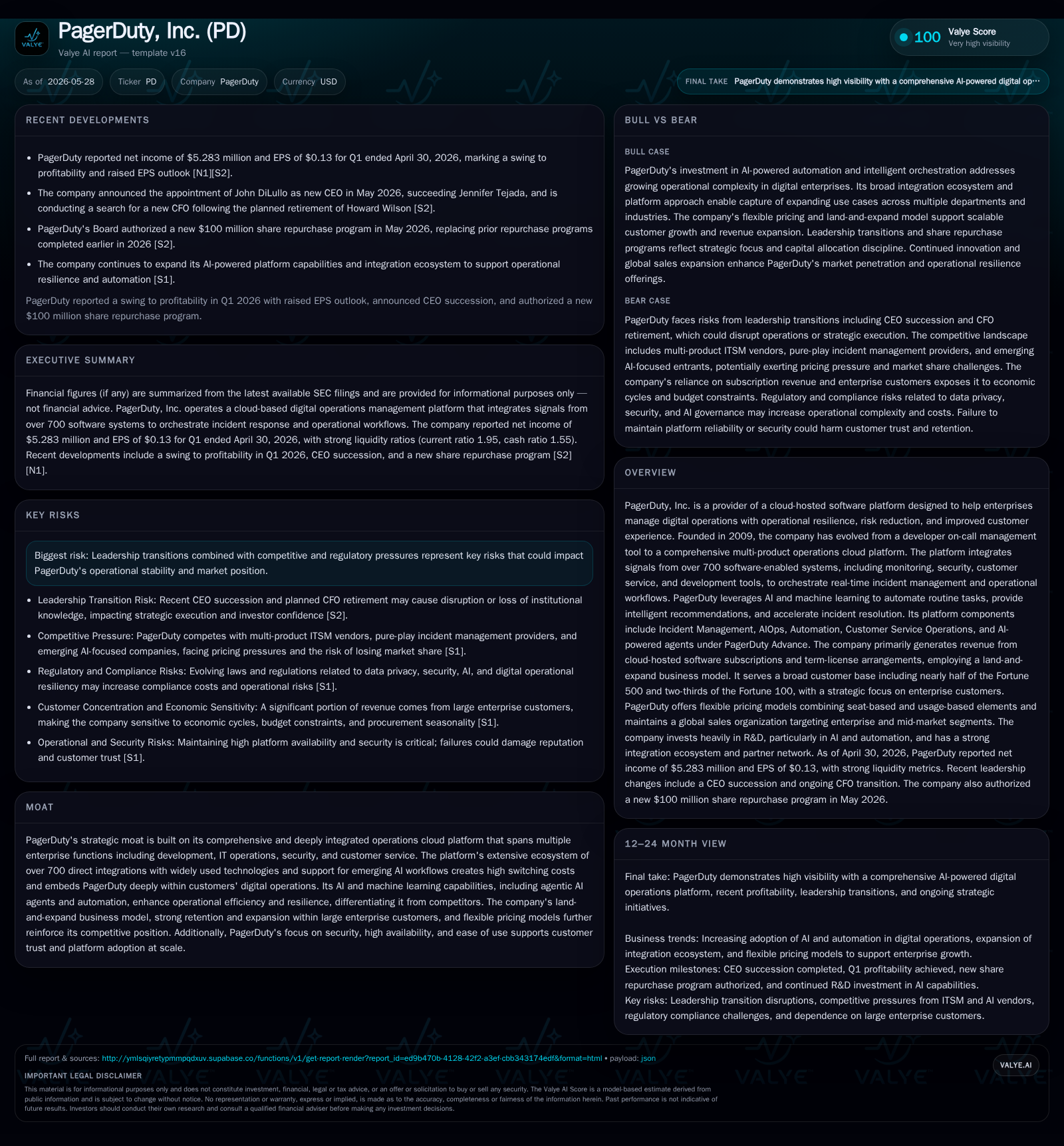
PagerDuty’s latest quarter marks a milestone with a return to profitability and strategic steps toward AI-driven operational resilience. The company is executing on its land-and-expand model through an expansive multi-product platform integrated across more than 700 systems. Leadership changes include a new CEO succession aimed at sustaining growth momentum while evolving pricing from seat-based to flexible usage models. Risks center on management transitions, regulatory compliance, and competitive dynamics in the fast-evolving digital operations management space.
Recent Operating Update
PagerDuty reported financial results for the quarter ended April 30, 2026 (Q1 fiscal 2027) demonstrating a profitable quarter that reversed prior losses and prompted an increase in EPS outlook [S2][S3]. This positive turn reflects operational leverage gained through higher product adoption, particularly within large enterprise customers. Concurrently, in May 2026, PagerDuty announced a leadership transition with John DiLullo appointed as CEO succeeding Jennifer Tejada while searching continues for a new Chief Financial Officer following Howard Wilson's planned retirement [S2]. These changes carry operational risk but also signal the company's commitment to sustained growth and strategic continuity.
Additionally, PagerDuty's Board authorized a new $100 million stock repurchase program replacing prior completed authorizations underscoring confidence in its financial position [S8]
Business Model
PagerDuty operates a cloud-hosted SaaS platform known as the PagerDuty Operations Cloud designed to enhance digital operations lifecycle management. Its revenue generation primarily centers on subscription fees from tiers of incident management plans – ranging from free for small teams up to comprehensive Enterprise offerings – augmented by term-license arrangements [S1][S6][S7][S11][S21]. The company has evolved from initial developer on-call scheduling tools into a multi-product operations platform integrating Incident Management, AIOps (artificial intelligence operations), Automation capabilities, Customer Service Operations (CSOps), and PagerDuty Advance featuring agentic AI agents supporting diverse operational workflows.
Revenue mechanics involve charging on a per-user basis combined with innovative usage-based pricing through platform credits that customers redeem for human responder time, AI agent activity, or automation tasks [S7][S11][S21]. This hybrid model reduces friction in upselling and renewals by offering flexibility tailored to actual consumption patterns rather than fixed-seat licenses alone
PagerDuty targets enterprises heavily but also covers mid-market and SMB segments via differentiated sales motions: white-glove direct sales engage Fortune 2000 clients with senior IT and business leaders while programmatic AI-driven marketing and self-service support smaller customers [S6][S7][S11]. Customer success efforts foster expansion by encouraging deeper penetration across departments, additional products adoption, higher plan tiers upgrades, and geographic proliferation.
Industry Structure and Competitive Position
PagerDuty occupies a leading position within the digital operations management sector (also termed cloud incident response or digital operations orchestration). The industry is characterized by growing demand driven by complexity in multi-cloud environments, increasing reliance on SaaS applications, heightened emphasis on operational resilience due to brand reputation risks from downtime, and accelerating AI adoption.
A distinct strategic moat is PagerDuty's vast integration ecosystem surpassing 700 direct integrations encompassing monitoring tools (e.g., Prometheus), cloud providers (e.g., AWS), collaboration platforms (e.g., Slack), ITSM systems (e.g., ServiceNow), security products (e.g., CrowdStrike), development pipelines (DevOps tools), and customer service applications [S1][S26]. This breadth enables seamless intake and correlation of heterogeneous signals essential for proactive incident detection and response orchestration without costly context switching.
The firm differentiates itself further through advanced AI implementations: generative AI underpins agentic workflows automating routine tasks such as alert triage and context enrichment via specialized agents like SRE Agent or Shift Agent [S1][S26]. This focus sets PagerDuty apart from peers relying predominantly on static rule-based orchestration or legacy alerting tools.
Competitively, firms like Splunk On-Call (formerly VictorOps), ServiceNow ITOM & CSDM modules, Datadog Incident Management, and BigPanda operate partially overlapping spaces. However, PagerDuty's consolidated cloud-native platform approach combined with flexible pricing models targets broad organizational constituencies beyond IT alone – spanning security ops and customer experience teams – reinforcing its embeddedness inside enterprises [S11]. Its FedRAMP Low authorization also opens doors into regulated public sector markets [S15].
Growth Drivers
- AI-Driven Product Portfolio Expansion: Continued investment in generative AI capabilities that automate incident lifecycle tasks accelerates product differentiation. The agentic AI agents increase customer ROI by reducing manual labor costs while speeding mean-time-to-resolution.
- Land-and-Expand Sales Motions: Proven ability to increase wallet share within existing accounts by onboarding additional teams/use cases fuels organic growth organically.[S6][S7]
- Flexible Consumption Pricing: Transition from rigid seat-based license fees toward platform usage credits aligns spend more closely with operational activity levels enabling adoption at scale and reducing renewal friction.[S7]
- International Market Expansion: EMEA, Asia Pacific regions account for growing non-US revenue proportion (~29% FY2026) supported by partner ecosystems amplifying reach outside North America.[S15]
- Public Sector Growth: FedRAMP Low authorization unlocks federal contracts offering higher margins with long-term relationships.[S15]
- Cloud Infrastructure Evolution & R&D: Investment in scalable cloud infrastructure enhances platform availability vital for always-on mission-critical use cases.[S26]
- Customer Success Initiatives: Strong engagement through professional services, training certifications, renewal management ensures high retention rates.[S15]
Risks / Watchpoints / Growth Constraints
The principal risks stem from:
- Leadership Transitions: CEO succession may disrupt strategic execution; CFO search presents governance continuity challenges impacting financial planning.[S2]
- Regulatory & Compliance Pressures: Escalating global data privacy laws (GDPR variants, CCPA), cyber security mandates demand ongoing investments; failures could result in penalties or reputational harm.[S17][S24][S25]
- Competitive Intensity: Rapid innovation cycles in AIOps/automation plus cloud-native competitors exert pricing pressure; potential erosion if innovation pace lags.
- Customer Retention & Expansion: Renewal rates tied closely to perceived value delivery; macroeconomic uncertainties may constrain corporate IT budgets slowing expansion acceleration.
- Integration Complexity: Maintaining compatibility across a sprawling integration matrix requires sustained engineering focus; failures could degrade customer satisfaction.
- Platform Availability & Security Incidents: Any downtime or breaches could materially impact trust given critical nature of incident response software.[S28]
What to Watch Next
Key milestones and indicators include:
- Success in appointing a permanent Chief Financial Officer to reinforce leadership stability.
- Further quarterly financial updates showing continued operating leverage translating into consistent profitability beyond Q1 uptick.
- Adoption rates of new AI agent features driving measurable decreases in incident resolution times documented by case studies.
- Subscription metric trends including new net adds in enterprise segment versus churn rates.
- Expansion progress in international markets especially EMEA/Asia supported by channel partners.
- Impact of flexible usage-based pricing on average contract values and renewal durations.
- Updates on compliance initiatives related to data privacy laws and FedRAMP certification status developments.
Financial Profile Snapshot
As of April 30, 2026, PagerDuty maintains $208.9 million in cash & equivalents against current liabilities of $287 million yielding a healthy current ratio near 1.95 indicating sound short-term liquidity [F1]. Total debt figures are less current but previously noted around $287 million suggest moderate leverage offset significantly by cash holdings resulting in net debt approximately $78.6 million [F1]. The turnaround to positive operating income was evident in earnings through January 31 indicating improved margin structure backed by recurring subscription economics [F1]. The company’s commitment to R&D investment alongside disciplined sales spending positions it well for scaling while managing expenses prudently.
This analysis synthesizes publicly available company filings as of May 28, 2026. It does not constitute investment advice or research views. Readers should consider multiple factors including broader market conditions when forming their own views about PagerDuty’s prospects.
Disclaimer: This is research-only, informational analysis and not investment advice. It may include AI-generated interpretation and general industry context. Always verify important details using primary sources.

Comments