
SentinelOne Strengthens AI-Driven Cybersecurity with Expanded Channel Reach
SentinelOne’s Q1 fiscal 2027 results show accelerating revenue growth and narrowing losses, powered by AI platform enhancements and broader partner engagement.
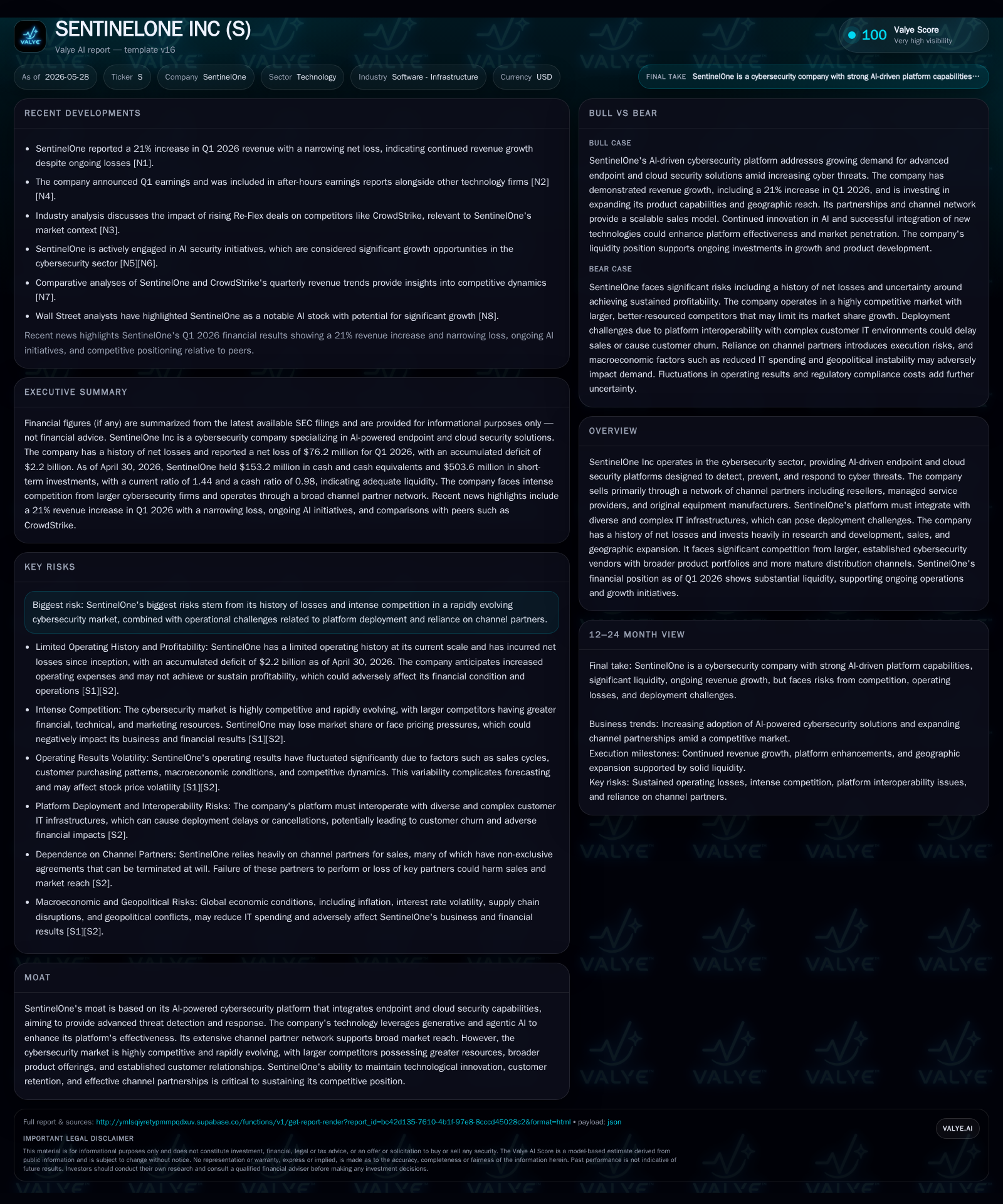
In its latest quarterly filing, SentinelOne reported a 21% revenue increase alongside a significant reduction in net loss, signaling early progress toward operational resilience. The company’s business model centers on subscription-based AI-enabled endpoint and cloud security solutions delivered primarily through a diverse indirect sales network. Facing intense competition from larger, established cybersecurity vendors, SentinelOne leverages generative and agentic AI to differentiate its platform while expanding channel partnerships to fuel growth. Key risks include ongoing operating losses, deployment complexity in heterogeneous IT environments, and reliance on channel execution. Liquidity remains sufficient to support ongoing R&D and sales initiatives.
Latest Quarterly Operating Update: Indicators of Momentum
SentinelOne’s May 28, 2026 10-Q report unveiled a robust operational quarter that underscores positive momentum amid a challenging cybersecurity market environment [S2]. The company posted revenue growth of 21% year-over-year driven by continued adoption of its AI-enhanced endpoint and cloud security solutions. This acceleration coincided with a narrowing of net losses—a meaningful signal that management’s efficiency initiatives and investment prioritization are bearing fruit [N2]. Importantly, the company announced a restructuring plan aimed at streamlining operations by reducing ~8% of workforce, with an expected one-time charge of approximately $25 million largely tied to severance costs [S3][S23].
This disciplined cost management alongside concentrated investments in high-yielding areas such as AI threat detection algorithms and cloud security services highlights SentinelOne’s focus on scalable growth in a capital-intensive space. The refreshed quarterly data also revealed an uptick in channel partner contributions—a critical vector for broadening market penetration given the underlying product complexity and extensive integration demands placed on enterprise IT teams [N1][S2].
Business Model & Technology Differentiation: AI at the Core
SentinelOne’s revenue model is principally subscription-based, derived from its platform offering which integrates endpoint protection with cloud-native security capabilities [S1]. Customers pay recurring fees for access to the platform’s comprehensive threat detection, prevention, and automated response features. This SaaS framework supports predictable revenue flows contingent upon customer retention, contract renewals, and seat expansions.
Strategically, the company's moat revolves around leveraging advanced generative and agentic AI technologies embedded within its cybersecurity platform to heighten detection accuracy while enabling faster response times against evolving threats [S1]. This AI foundation differentiates SentinelOne from legacy antivirus or rule-based solutions by delivering proactive threat hunting capabilities that adapt dynamically.
However, deploying such complex cybersecurity technology requires deep integration within heterogeneous IT environments. This necessitates close collaboration with a wide network of channel partners—resellers, managed service providers (MSPs), and original equipment manufacturers (OEMs)—to tailor solutions for diverse customer needs. While this indirect sales model expands reach globally, it introduces execution variability dependent on partner effectiveness and alignment [S1]. Moreover, platform upgrades or new feature rollouts must be carefully managed to minimize customer disruption given the critical nature of enterprise security operations.
Industry Structure and Competitive Dynamics in Cybersecurity
The global cybersecurity market is characterized by rapid technological change coupled with intense competition from entrenched leaders possessing expansive product suites and well-established distribution channels. SentinelOne competes against sizable rivals who often bundle endpoint security within broader suites encompassing network protection, identity management, or cloud security services [S12][S19].
This competitive pressure constrains pricing power and necessitates continuous innovation to maintain differentiation. Furthermore, long enterprise sales cycles—reflecting risk-averse IT purchasing decisions—and rising sophistication of cyber threats compel vendors like SentinelOne to invest heavily into R&D while expanding ecosystem partnerships.
Supply-side challenges include scalability of security platforms to accommodate large-scale deployments without latency or performance degradation across multi-cloud infrastructures. Additionally, customers increasingly demand seamless interoperability with existing tools—introducing integration complexities that can delay adoption timelines or elevate churn risk if unmet effectively [S12][S19]
SentinelOne’s competitive resilience hence hinges on sustaining technology leadership via cutting-edge AI algorithms while simultaneously deepening channel engagement to ensure deployment success across complex environments.
Growth Drivers: Channel Expansion and AI Innovation
Looking ahead, SentinelOne’s trajectory is underpinned by two principal growth levers: enlarging its indirect sales footprint through expanded reseller/MSP/OEM relationships and advancing its generative/agentic AI capabilities within the platform.
Recent filings indicate notable investments to empower channel partners with enhanced enablement tools and co-selling arrangements aimed at accelerating pipeline generation worldwide [S2][S3]. Such expansion increases total addressable market accessibility particularly in regions or verticals where direct sales coverage is limited.
Concurrently, product development priorities emphasize integrating next-generation AI features that improve malware detection accuracy while lowering false positives—a key metric influencing user trust and retention [N1][N11]. Enhanced automation capabilities also reduce operational overhead for customers allowing tighter integration into SOC workflows.
In addition to organic growth drivers, SentinelOne has pursued targeted acquisitions (e.g., Prompt focusing on generative AI security) which bolster both technology stack breadth and data pipeline robustness essential for threat intelligence [S24]. Cross-selling into installed base customers leveraging newly acquired tech assets offers incremental expansion opportunities.
Geographic diversification further complements these factors as cybersecurity spend accelerates outside core U.S markets amid increasing regulation and digitization trends globally.
Risks and Execution Challenges: Competition and Deployment Complexity
Despite progress, SentinelOne faces several risks impacting growth sustainability. Persistent operating losses despite revenue gains underscore ongoing profitability hurdles given heavy R&D/sales spending required to innovate and gain share in an evolving threat landscape [S2][F1]
The reliance on channel partners presents execution risk; inconsistent partner performance or conflict could impair go-to-market agility affecting bookings cadence or renewal rates [S4][S5]. Moreover, the intricate nature of integrating new cybersecurity software into varied customer IT ecosystems can result in deployment delays or cancellations adversely impacting financial metrics [S1][S4].
Regulatory compliance also poses challenges—as global data privacy laws proliferate with differing scopes across jurisdictions SentinelOne must continuously adapt policies to avoid legal exposure or reputational damage stemming from any breach incidents involving its platform or third-party vendors [S21][S22]. Litigation risks—including securities class actions—and costs associated with maintaining public company compliance add additional pressure layers.
Competitive intensity may escalate via consolidation among peers or aggressive pricing/bundling tactics from larger incumbents limiting margin expansion potential over the medium term [S19][S27]. The fast pace of technological change means failure to keep pace with emerging attack vectors or advance AI capabilities could erode differentiation over time.
Catalysts to Monitor: Customer Metrics and Platform Adoption Signals
Key future milestones will offer insights into scaling success. These include measurable acceleration in Annual Recurring Revenue (ARR) growth—capturing new logo acquisition plus upsell within installed base—and improvements in net retention ratios reflecting customer satisfaction with ongoing platform value delivery [N11][S2]
Monitoring churn trends especially among large enterprise clients will provide early warnings about deployment friction or competitive incursions. Additionally, announcements regarding rollout timelines for advanced AI-driven features or strategic partnership expansions may serve as signals for inflection points in market penetration velocity.
Enhanced channel engagement effectiveness evident through increased deal registrations or expanded reseller footprint metrics will also be relevant indicators as SentintelOne seeks to augment both scale and geographic reach with indirect channels supporting mass adoption globally [N11][S3].
Operational transparency around integration wins post acquisitions such as Prompt or Observo will further inform whether M&A initiatives translate into tangible product roadmap acceleration.
Financial Snapshot: Liquidity Supports Strategic Investments
SentinelOne entered Q1 fiscal 2027 with solid liquidity foundations—holding cash & equivalents totaling approximately $153 million as of April 30, 2026—and maintaining a current ratio above 1.4 demonstrates prudent working capital management supporting ongoing operations without reliance on external debt financing [F1]
The absence of debt offers financial flexibility crucial for continuing heavy R&D investment cycles mandated by the rapid innovation needed in cybersecurity product development [F1][S2]. Operating losses have narrowed but remain substantial reflecting reinvestment choices prioritizing platform advancement over near-term profitability targets
Investors should note that these conditions enable SentinelOne to execute on strategic initiatives including selective acquisitions while incrementally advancing toward sustainable profitable growth outcomes without immediate financial strain.
This analysis is intended solely for informational purposes rooted in publicly available quantitative disclosures from SEC filings dated May 28, 2026, supplemented by recent industry contextual insights. It does not constitute investment advice or research views.
Disclaimer: This is research-only, informational analysis and not investment advice. It may include AI-generated interpretation and general industry context. Always verify important details using primary sources.

Comments