
Launch Two Acquisition Corp.: NuCube Energy Deal Sets the Clock on Financing, Redemption, and Execution Risk
Execution will hinge on capital structure, PIPE appetite, and the quality of the target’s business model.
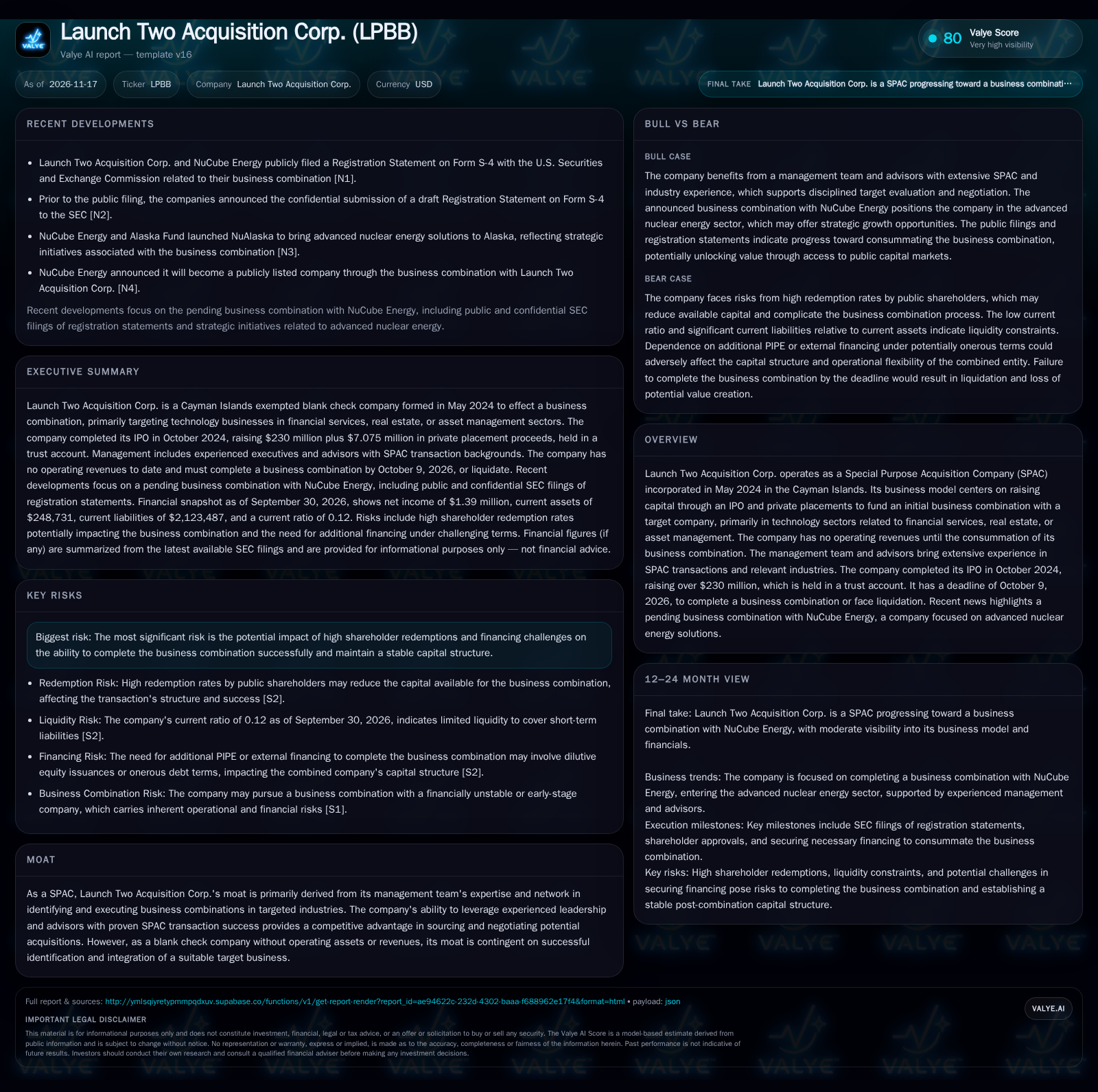
Launch Two Acquisition Corp. (LPBB), a SPAC with $230 million in trust, is pursuing a business combination with NuCube Energy. As of September 30, 2026, LPBB has no operating revenues, current assets of $249k, and current liabilities over $2.1 million, resulting in a current ratio of just 0.12. With an October 2026 deadline to close the deal, the company faces significant redemption risk and may require additional PIPE financing under challenging terms. The quality of the NuCube Energy business and the deal’s capital structure will likely determine value creation or dilution for public shareholders.
Launch Two Acquisition Corp. sits at a pivotal moment: with its $230 million trust account, the SPAC is moving to merge with NuCube Energy, a deal now in the SEC review phase. However, the company’s sharply negative working capital, looming October 2026 liquidation deadline, and the sector’s notorious redemption risk mean that success will depend not only on the merits of the target business but also on the team’s ability to secure favorable capital, manage deal structure, and convince shareholders to stay for the ride. The next year will test both the resilience of the SPAC model and the execution skills of LPBB’s management.
SPAC Financial Position and NuCube Deal: The Facts That Shape the Next Move
Launch Two Acquisition Corp. completed its IPO in October 2024, raising $230 million in gross proceeds, with a further $7.075 million from a private placement of warrants. All proceeds are held in a trust account, in line with typical SPAC structures. The company reported a current ratio of 0.12 for the period. [S2]
The company has generated no operating revenues and does not expect to until consummation of a business combination. The clock is ticking: LPBB must complete its initial business combination by October 9, 2026, or liquidate and return trust funds to shareholders [S1] [S2].
On the deal front, LPBB and NuCube Energy have publicly filed their S-4 Registration Statement with the SEC, formalizing the pending merger and moving the process into the regulatory review phase [N1] [N2]. NuCube has announced its intention to become a public company through this transaction [N4].
These facts set up a classic SPAC inflection point: a defined cash pool, a pending deal, a near-term deadline, and the looming risk of shareholder redemptions that could dramatically alter the capital available to close and scale the target business.
How the Economics of the SPAC Structure Shape Shareholder Outcomes
SPACs like LPBB are structured as cash shells: they raise capital in trust and seek a target to merge with, typically within two years. The trust is invested in low-risk securities, and the SPAC earns little to no operating income until a deal closes. The economics hinge on three drivers: (1) how much trust capital survives redemptions, (2) the cost and structure of any supplemental financing (such as PIPEs), and (3) the quality and scalability of the acquired business.
Redemptions are a structural feature: public shareholders can opt to redeem their shares for a pro rata share of the trust at the time of the merger vote. In high-redemption environments, as seen across the SPAC sector post-2022, the actual equity capital delivered to the target can be far less than the headline trust size. This forces SPACs to seek PIPE (private investment in public equity) financing, often under dilutive or expensive terms, or to renegotiate deal terms, sometimes shrinking the target’s growth runway.
These obligations are typically repaid from the trust at closing or absorbed by the combined company.
If the NuCube deal succeeds and redemptions are managed, the economics pivot to the target’s business model: for NuCube, that will depend on capital intensity, margin structure, and the ability to deploy trust and PIPE proceeds into profitable growth. For public SPAC investors, returns will be driven by dilution, post-merger trading liquidity, and the alignment of management incentives with long-term value creation.
SPAC Sourcing Leverage and the Race for Quality Targets
The competitive edge for LPBB resides in its management team’s track record in technology, financial services, and prior SPAC transactions. In a crowded SPAC landscape, the ability to source, diligence, and negotiate attractive deals is not trivial: the best targets often command premium terms, while weaker prospects may be the fallback for SPACs racing against the clock.
SPACs compete not only with each other but with traditional IPOs, direct listings, and private capital for the most promising companies. In recent years, high redemption rates and PIPE fatigue have made it harder for SPACs to deliver certainty of capital and favorable terms to targets, often tilting bargaining power toward the target or leading to renegotiated deal structures.
For LPBB, the pending NuCube transaction will test whether its sector focus (technology, financial services, real estate, or asset management) and advisory network can deliver a target with credible growth prospects and post-merger public market appeal. The presence of experienced advisors may help in structuring a deal that balances dilution, post-merger float, and the incentive alignment needed to retain key talent at the target.
What Success Looks Like: Low Redemptions, Attractive Capital, and a Scalable NuCube Platform
The most favorable pathway for LPBB is one where the merger with NuCube Energy closes with minimal redemptions, preserving most of the $230 million trust. If PIPE investors participate on reasonable terms, the combined company could launch with ample capital to fund NuCube’s growth plan, attract institutional investor interest, and support a healthy public float.
A successful outcome would likely require NuCube to present a compelling business model with clear growth prospects, credible financial projections, and a capital-light or scalable platform in the energy sector. If the management team can structure incentives to retain NuCube’s leadership and align interests, post-merger performance could outpace typical de-SPAC debuts.
Confirmation would come from SEC approval of the S-4, a low redemption rate at the merger vote (well below sector averages), strong PIPE participation, and robust post-close trading volume and price stability. Early evidence of NuCube’s commercial traction or signed customer contracts would further validate the upside thesis.
Conversely, the scenario would be falsified if redemptions are extreme, PIPE terms are punitive, or NuCube’s business model is revealed to be highly capital-intensive with limited near-term revenue visibility.
Navigating a Typical SPAC Outcome: Moderate Redemptions and a Structurally Diluted Capital Stack
The most plausible outcome for LPBB is a merger with NuCube that proceeds amid moderate to high redemptions—consistent with post-2022 SPAC deal trends. In this scenario, a significant portion of public shares are redeemed, shrinking the cash delivered to NuCube and forcing reliance on PIPE or alternative financing. The resulting capital stack may be more dilutive than initially anticipated, with post-merger float and liquidity potentially constrained.
This pathway assumes the deal closes before the October 2026 deadline, but the combined company launches with less capital than headline figures suggest. NuCube’s business model may face pressure to demonstrate rapid commercial traction to offset dilution and justify the public market valuation.
Confirmation would include the S-4 being declared effective, shareholder approval at the merger vote, reported redemption rates in line with sector averages (often 50% or higher), PIPE financing on market or slightly dilutive terms, and the combined company trading near or slightly below trust value post-close.
This scenario would be falsified by a collapsed deal (failure to close before the deadline), redemption rates so high as to trigger liquidation, or PIPE financing failing to materialize.
Deal Disintegration: High Redemptions, PIPE Shortfall, and Liquidation Risk
The adverse scenario involves a confluence of high redemptions (potentially over 80%), a lack of sufficient PIPE or alternative financing, and failure to renegotiate terms with NuCube. In this event, the trust is substantially depleted, leaving too little capital to satisfy the target’s requirements or to meet closing conditions.
If the merger cannot close by October 9, 2026, LPBB would be forced to liquidate and return trust funds to shareholders, with public investors receiving their pro rata share but losing any upside optionality. The sponsor and management team would see their founder equity and warrants expire worthless.
This scenario could be confirmed by SEC filings showing extreme redemption rates, PIPE financing terms that are highly dilutive or fail to close, or an official announcement of deal termination or liquidation. Early warning signs would include delays in the S-4 process, negative market reaction to the deal announcement, or public statements from NuCube or LPBB expressing difficulty securing capital.
The scenario would be invalidated if the team successfully renegotiates the transaction, secures sufficient external capital, or pivots to a new target within the remaining window.
Milestones and Metrics That Will Determine the Value of the NuCube SPAC Transaction
Redemption rate at the merger vote: A low or moderate redemption percentage would support a robust capital base for the combined entity; a high rate would signal deal fragility and potential dilution.
PIPE or alternative financing terms and participation: The amount, pricing, and investor mix of supplemental capital will directly affect post-merger dilution and growth runway.
Timing and outcome of S-4 effectiveness: SEC clearance and any regulatory comments or delays will impact deal certainty and timeline.
NuCube Energy’s disclosed financials, customer pipeline, and capital needs (if disclosed): These will determine whether the business can scale with the available capital and justify public market valuation.
Post-merger share float and trading liquidity: A healthy float and volume are critical for price discovery and investor confidence after the combination.
Sponsor and management equity participation post-close: Alignment of incentives, via rollover equity or vesting founder shares, would help retain talent and focus on long-term value.
Status of working capital loans and sponsor funding: Repayment terms and any conversion to equity could affect the capital stack of the combined company.
Any public guidance or commentary from NuCube or LPBB on anticipated commercial milestones, regulatory hurdles, or capital expenditure plans would help test the thesis.
Disclaimer: This is research-only, informational analysis and not investment advice. It may include AI-generated interpretation and general industry context. Always verify important details using primary sources.

Comments