
Larimar Therapeutics: Platform Leverage, Regulatory Uncertainty, and the Stakes of First-Mover Ambition in Rare Disease
With its BLA for nomlabofusp submitted and a global Phase 3 trial on deck, Larimar Therapeutics stands at a pivotal crossroads—balancing the promise of its CPP technology and lead candidate in Friedreich’s ataxia against unresolved regulatory, safety, and manufacturing risks.
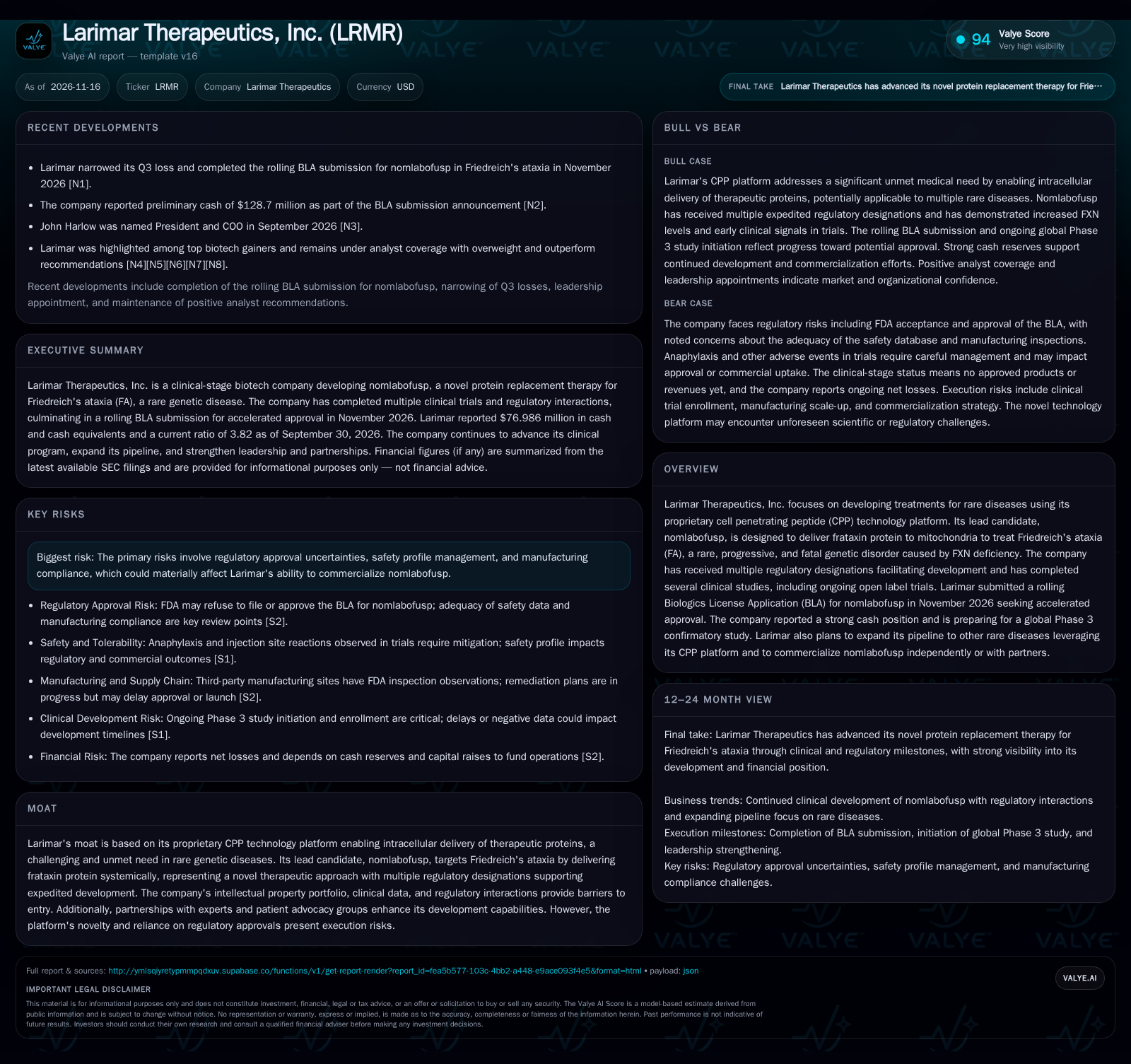
Larimar Therapeutics has completed its BLA submission for nomlabofusp, a novel therapy for Friedreich’s ataxia, and is preparing for a global Phase 3 trial. The company’s proprietary CPP platform underpins its rare disease pipeline ambitions. While cash reserves are substantial, regulatory approval, safety profile management, and manufacturing compliance remain critical hurdles for translating clinical progress into commercial value. The next 12-24 months will test whether Larimar’s first-mover advantage can be converted into a durable franchise.
Larimar Therapeutics has advanced its lead program, nomlabofusp, through key clinical and regulatory milestones, culminating in a completed BLA submission for Friedreich’s ataxia in late 2026. With multiple expedited FDA and EMA designations and a global Phase 3 trial in the works, Larimar is positioning itself as a potential first-mover in systemic frataxin replacement. The coming year will be definitive in determining whether Larimar’s platform and lead asset can open the door to a broader rare disease franchise or if execution and regulatory complexity will delay or derail commercial realization.
Regulatory Milestones and Capital Position Define Larimar’s Near-Term Trajectory
Larimar completed a rolling Biologics License Application (BLA) for nomlabofusp in November 2026, seeking accelerated approval for the treatment of Friedreich’s ataxia (FA), a rare and fatal neurodegenerative disorder [N1] [N2] [S2]. This marks the company’s most advanced regulatory milestone to date and positions nomlabofusp as a potential first-in-class systemic therapy for FA. The BLA is supported by multiple expedited regulatory designations—including Orphan Drug, Fast Track, Pediatric Rare Disease, and Breakthrough Therapy from the FDA, as well as Orphan Drug and PRIME access from the EMA—highlighting both the unmet need and the regulatory focus on this indication [S1].
Larimar reported $76.986 million in cash and cash equivalents as of September 30, 2026, with preliminary cash of approximately $128.7 million reported in connection with the BLA submission [N2] [S2]. This provides a material, though finite, financial runway as the company prepares to launch a global Phase 3 confirmatory trial for nomlabofusp with planned sites across the US, EU, UK, Canada, and Australia in 2026 [S1].
However, the FDA’s review will center on the adequacy of the nomlabofusp safety database and recent manufacturing inspection issues, including a Form 483 issued to a fill and finish partner [S2]. These regulatory and operational hurdles will be pivotal in determining the pace and outcome of potential approval.
How Larimar’s Economics Could Play Out: Rare Disease Pricing, Platform Leverage, and Capital Needs
Larimar’s business model is predicated on the economics of rare disease therapeutics, where small patient populations can support premium pricing if clinical value and payer access are established. In Friedreich’s ataxia, the lack of effective disease-modifying therapies creates the potential for high unmet-need pricing, provided safety and efficacy are validated. However, the company’s current economics remain pre-commercial: net losses continue, and all spending is funded by cash reserves and periodic capital raises [S2].
If nomlabofusp is approved, initial revenues would likely be constrained by the slow build typical of rare disease launches: patient identification, genetic confirmation, and specialist channel engagement. High fixed costs in launch, medical affairs, and manufacturing scale-up could create negative operating leverage until a critical mass of patients is reached. On the variable side, the cost of goods for a recombinant protein could be substantial, especially given the need for rigorous quality controls after recent manufacturing observations.
Larimar’s platform ambitions—expanding the CPP technology to other rare diseases—could eventually introduce operating leverage if follow-on assets share infrastructure, but this is contingent on successful execution with nomlabofusp. Ongoing R&D and potential post-marketing requirements would sustain high capital needs, making future dilution or partnerships likely unless a rapid revenue inflection is achieved.
Assessing Larimar’s Defenses: Platform Differentiation, Barriers, and the Competitive Landscape
Larimar’s core competitive proposition is its proprietary cell penetrating peptide (CPP) platform, enabling intracellular delivery of therapeutic proteins—a technical challenge that has limited progress in many rare genetic diseases [S1]. For Friedreich’s ataxia, nomlabofusp is positioned as the first systemic frataxin replacement, targeting the root cause of disease. Multiple expedited regulatory designations and early clinical signals suggest a first-mover advantage.
However, the competitive moat is not absolute. Other therapeutic modalities—such as gene therapy, small molecules, and antisense oligonucleotides—are in development by both established rare disease players and emerging biotechs. These could offer alternative mechanisms with different risk/benefit profiles. Barriers to entry for direct protein replacement include the complexity of intracellular delivery, manufacturing, and immunogenicity management, but follow-on competitors could leverage advances in delivery science or improved protein engineering.
Larimar’s intellectual property, clinical data, and regulatory relationships provide temporal barriers, but the ultimate defensibility will depend on whether the company can translate platform technology into durable clinical and commercial success before competitors close the gap.
From Regulatory Green Light to Rare Disease Franchise: What a Win Could Look Like
A favorable scenario for Larimar unfolds if the FDA accepts the BLA and grants accelerated approval for nomlabofusp based on FXN concentration as a surrogate endpoint, with post-marketing commitments focused on confirmatory clinical data [N2] [S2]. Early commercial uptake could be supported by strong advocacy group engagement, rapid patient identification in specialty centers, and premium pricing reflecting the lack of alternatives.
If the safety profile is manageable—i.e., anaphylaxis and injection site reactions are mitigated through modified dosing and risk management plans—payer and prescriber adoption may accelerate. Manufacturing issues are resolved without significant delays, allowing timely product launch. This success would validate the CPP platform, enabling Larimar to advance additional rare disease programs, potentially leveraging existing infrastructure and partnerships for pipeline expansion.
Evidence that would confirm this scenario includes FDA acceptance and rapid approval of the BLA, positive post-marketing safety/efficacy data, successful manufacturing remediation, new pipeline announcements, and early revenue traction in the FA market.
Executing Through Complexity: The Most Likely Mid-Term Outcome
The most plausible near-term outcome is a protracted regulatory review for nomlabofusp, with the FDA requiring additional safety data or clarifications before granting approval. Manufacturing remediation efforts may delay launch timelines, but not result in outright rejection. Larimar initiates its global Phase 3 trial as planned, but patient enrollment and operational execution require sustained focus and resources.
Commercialization, if achieved, is gradual: initial uptake is modest as clinicians and payers monitor real-world safety and efficacy. The company continues to post net losses as fixed costs for launch and ongoing R&D outpace early revenues. Partnerships or additional financings may be needed to support operations through the post-approval evidence development phase and to advance pipeline candidates.
This scenario would be confirmed by a delayed but ultimately positive regulatory outcome, incremental revenue growth, ongoing operating losses, and measured progress in pipeline development and Phase 3 trial enrollment.
When Platform Ambition Meets Regulatory and Operational Friction
Larimar’s downside risk is centered on regulatory or operational setbacks. If the FDA finds the safety database inadequate or manufacturing issues unresolved, the BLA could face a complete response letter or require substantial additional work, delaying or derailing commercial launch. Persistent or severe safety signals—such as unmanageable anaphylaxis—could also undermine approvability or restrict the indicated population.
Operationally, failure to remediate manufacturing observations or to scale production to regulatory standards could create bottlenecks, trigger additional regulatory scrutiny, or erode trust with partners and patient communities. Prolonged delays would deplete cash reserves, forcing dilutive capital raises or strategic pivots. The inability to demonstrate platform value in a first indication would set back pipeline ambitions and could result in loss of investor and partner confidence.
Signs of this scenario would include FDA rejection or extended review cycles, public disclosure of unresolved safety/manufacturing deficiencies, cash burn without offsetting revenue, or pipeline deprioritization.
Milestones That Will Determine Whether Larimar’s Platform Can Deliver on Its Promise
FDA acceptance and timeline for decision on the nomlabofusp BLA, including any requests for additional data or clarification [N2] [S2].
Resolution and public disclosure of manufacturing inspection findings, including progress on Form 483 remediation and any supply chain adjustments [S2].
Safety outcomes from ongoing and future clinical trials, particularly rates of anaphylaxis and injection site reactions under modified dosing regimens [S1].
Initiation and enrollment pace of the global Phase 3 confirmatory trial, with updates on site activation and patient accrual [S1].
Net cash burn rate and updates on cash runway, including any new equity or debt financings or partnership agreements [S2].
Early commercial launch metrics for nomlabofusp, if approved: patient starts, prescriber uptake, and payer coverage—if disclosed.
Announcements of pipeline expansion or new indications leveraging the CPP platform, which would signal platform scalability and sustained R&D momentum.
Changes in analyst coverage, leadership, or strategic partnerships that may affect market confidence or operational execution [N3] [N4] [N5] [N6] [N8].
Disclaimer: This is research-only, informational analysis and not investment advice. It may include AI-generated interpretation and general industry context. Always verify important details using primary sources.

Comments