
Lakeside Holding Strengthens Cross-Border Supply Chain Footprint with Latest Quarterly Reveal
The company’s May 2026 quarterly update affirms operational stability and continued growth in cross-border logistics between Asia and the U.S.
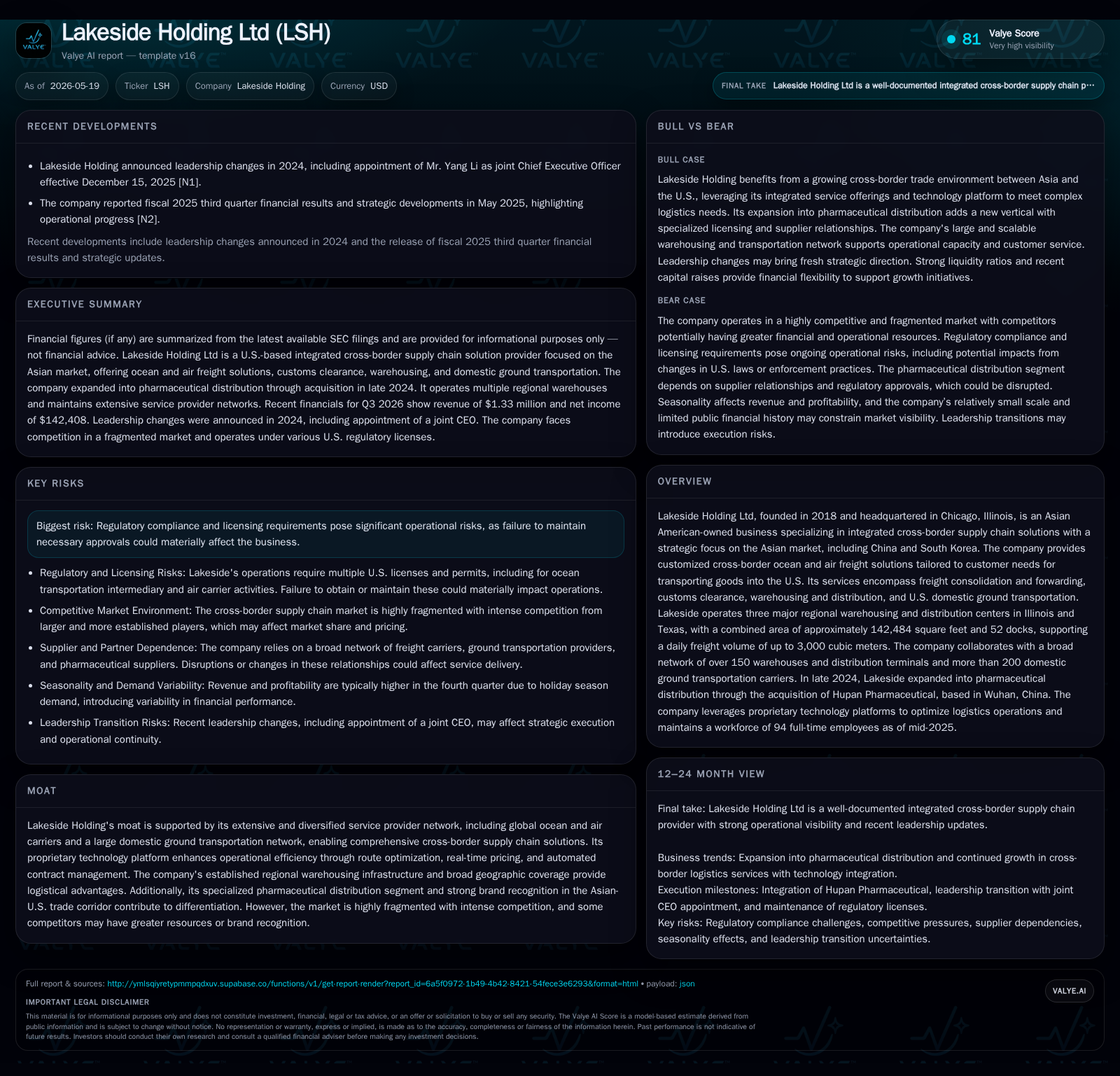
Lakeside Holding Ltd’s latest 10-Q filing details steady progress in its integrated cross-border supply chain services anchored in the Asia-U.S. corridor. The company’s strong warehousing throughput, extensive carrier partnerships, and expanding pharmaceutical distribution segment underscore its ability to address evolving customer needs. While operating in a highly fragmented and competitive market, Lakeside leverages proprietary technology and regional fulfillment hubs to differentiate its service offerings. Regulatory compliance in pharmaceutical logistics remains a critical risk, but a solid financial position with healthy liquidity supports ongoing growth initiatives.
Latest Quarterly Developments and Operational Highlights
Lakeside Holding’s most recent quarterly filing dated May 19, 2026 (10-Q) provides confirmation of its ongoing logistical capabilities without notable disruptions or adverse regulatory events [S2]. While no dramatic operating shifts were explicitly reported this quarter, underlying capacity metrics remain consistent with previous disclosures. The company's regional warehousing centers in Illinois and Texas continue to manage an aggregate daily freight floor load of up to 3,000 cubic meters—a key operational metric signaling strong throughput capacity [S1]. This throughput consistency suggests resilient volume demand amid evolving market conditions. Additionally, as of June 30, 2025, the firm reported having supported customs clearance for cross-border freight valued at over $54 million assessed worth [S1], highlighting substantial transactional activity typical for America-Asia trade corridors.
Business Model and Service Portfolio: Integrating the Cross-Border Supply Chain
Lakeside Holding operates as a specialized integrated supply chain solutions provider focused primarily on shipments originating from major Asian markets such as China and South Korea inbound to the U.S. Its revenue mechanism is anchored on multiple interdependent services: cross-border ocean freight consolidation conducted both as a licensed non-vessel operating common carrier (NVOCC) and indirect air carrier; customs brokerage services facilitating clearance compliance; U.S.-based warehousing and fulfillment capabilities located near principal international airports; plus an expansive domestic ground transportation network collaborating with over 200 providers encompassing about 60,000 drivers nationwide [S1], [S12].
Revenue derives largely from fees charged for freight forwarding services—volume driven by customer orders requiring importation—and supplementary charges related to customs clearance documentation, storage duration within regional warehouses totaling approximately 142,484 square feet across three centers with strategic adjacency to O'Hare International Airport (Illinois) and Dallas Fort Worth International Airport (Texas) [S1], [S16]. These centers operate as critical nodes enabling just-in-time delivery models by offering palletizing, packaging, transloading, and distribution services.
Beyond traditional logistics offerings, Lakeside expanded into pharmaceutical distribution through its fully owned subsidiary Hupan Pharmaceutical headquartered in Wuhan since late 2024 [S1]. This segment sources approximately 6.5 million units annually from around seven suppliers to approximately 47 customers. Major products focus on infusion fluids—a niche requiring strict regulatory adherence including acquisition of a Pharmaceutical Operation License governed by Chinese authorities [S16], [S24].
A cornerstone of its business advantage is the American Bear Logistics Data Tool Management Platform—a proprietary cloud-hosted system enabling real-time pricing automation, route planning optimization for both ocean/air freight and ground transport legs, plus contract management capabilities that enhance operational efficiency while reducing manual processing errors [S27]. This technology edge aligns with industry trends emphasizing digital transformation among third-party logistics providers (3PLs).
Competitive Position and Industry Environment in Asia-U.S. Trade Logistics
The marketplace for integrated cross-border supply chain providers is notably fragmented with high competition intensity driven by numerous small-to-mid-sized players alongside global incumbents [S9]. Success factors include the quality of client relationships built on reliability; breadth of multimodal transportation modes offered; investment in sophisticated tech infrastructure; plus depth of expertise particularly in complex regulations tied to cross-border shipments.
Lakeside's competitive strengths stem from its large network partnerships including nearly all major ocean carriers servicing Asia routes and comprehensive U.S. domestic trucking alliances spread across over 150 warehouse terminals nationwide ensuring geographic reach [S12], [S16]. Its mid-sized scale permits nimble customization yet limits scale economies enjoyed by larger competitors with more extensive capital resources or brand longevity. The company's brand recognition within Asian-American trade lanes supports customer acquisition principally among e-commerce platforms and manufacturers focusing on consumer goods imports [S9].
Growth Drivers: Demand Expansion, Technological Edge, and Pharmaceutical Segment
Key growth catalysts are anchored primarily by increasing adoption of integrated freight solutions bridging Asia-U.S. trade flows amid rising e-commerce penetration in both retail and social commerce sectors—segments generating steady volume increases requiring reliable cross-border logistics consolidation [S1], analysis.
Seasonality materially influences performance: fourth-quarter revenues typically surpass other quarters due to holiday-driven import peaks demanding higher supply chain throughput—an established pattern though future repeats are not guaranteed [S1]. Complementing volume growth is revenue diversification from pharmaceutical distribution via Hupan Pharmaceutical which introduces higher-margin specialty product flows while deepening exposure to healthcare verticals through brand promotion partnerships.
Technological scalability also propels growth potential as the American Bear Platform enables rapid cost control improvements through automation while supporting expansion without proportionate headcount scaling [S27]. This positions Lakeside favorably against peers still reliant on manual quoting or legacy tracking systems.
Risks and Constraints: Regulatory Compliance and Market Fragmentation
A dominant risk factor lies in maintaining necessary regulatory licenses essential across various jurisdictions. Particularly critical is sustaining compliance under Chinese pharmaceutical operation laws mandating valid Pharmaceutical Operation Licenses subject to inspections by national medical product administrations—any lapse could cause operational disruptions affecting the nascent pharma segment's contribution significantly [S24]. Equally relevant for core freight forwarding functions are FMC licensing requirements for NVOCC operations impacting ocean freight activities alongside TSA mandates governing airfreight security protocols US-wide [S19], analysis.
Moreover, the fragmented nature of third-party logistics fosters intense price competition limiting pricing power despite service quality differentiation attempts. Larger competitors wielding superior capital or global brand equity may outpace investments or capture share faster particularly where customers seek one-stop consolidated solutions spanning multiple geographies beyond Lakeside’s current regional hubs.
Key Milestones to Monitor: Customer Expansion, Capacity Utilization, and Regulatory Updates
Investors should track quarterly customs clearance volumes exceeding $54 million assessed value benchmark last reported mid-2025 as an indicator of escalating transaction scale. Warehouse throughput metrics targeting consistent handling near maximum daily floor load capacities (~3k cubic meters) at Illinois/Texas centers will reveal operational leverage status potentially translating into margin improvements or bottlenecks [S1], analysis.
Progress reports on pharmaceutical-related regulatory inspections or license renewals issued by Chinese authorities will be telling regarding sustainability of that segment’s contribution owing to its regulatory sensitivity. Additionally, any announced expansions of service provider networks or new technology platform upgrades would signal strategic accelerants.
Concise Financial Snapshot: Liquidity, Leverage and Capital Structure
As per the latest available financial snapshot ending March 31, 2026 ([F1]), Lakeside Holding posted $1.3 million in cash & cash equivalents with negligible total debt around $85K resulting in a net cash position exceeding $1.2 million. This conservative capital structure reinforces balance sheet flexibility conducive for incremental investments into technology platforms or warehouse enhancements absent new debt issuances.
This analysis is based exclusively on publicly filed documents without any investment advice or forward-looking research views.
Disclaimer: This is research-only, informational analysis and not investment advice. It may include AI-generated interpretation and general industry context. Always verify important details using primary sources.

Comments