
LVPAI GROUP Ltd’s Strategic Challenges Amid Regulatory and Operational Inertia
LVPAI GROUP Ltd remains a non-operating holding company focused on completing a China-based business combination, facing significant regulatory and capital constraints.
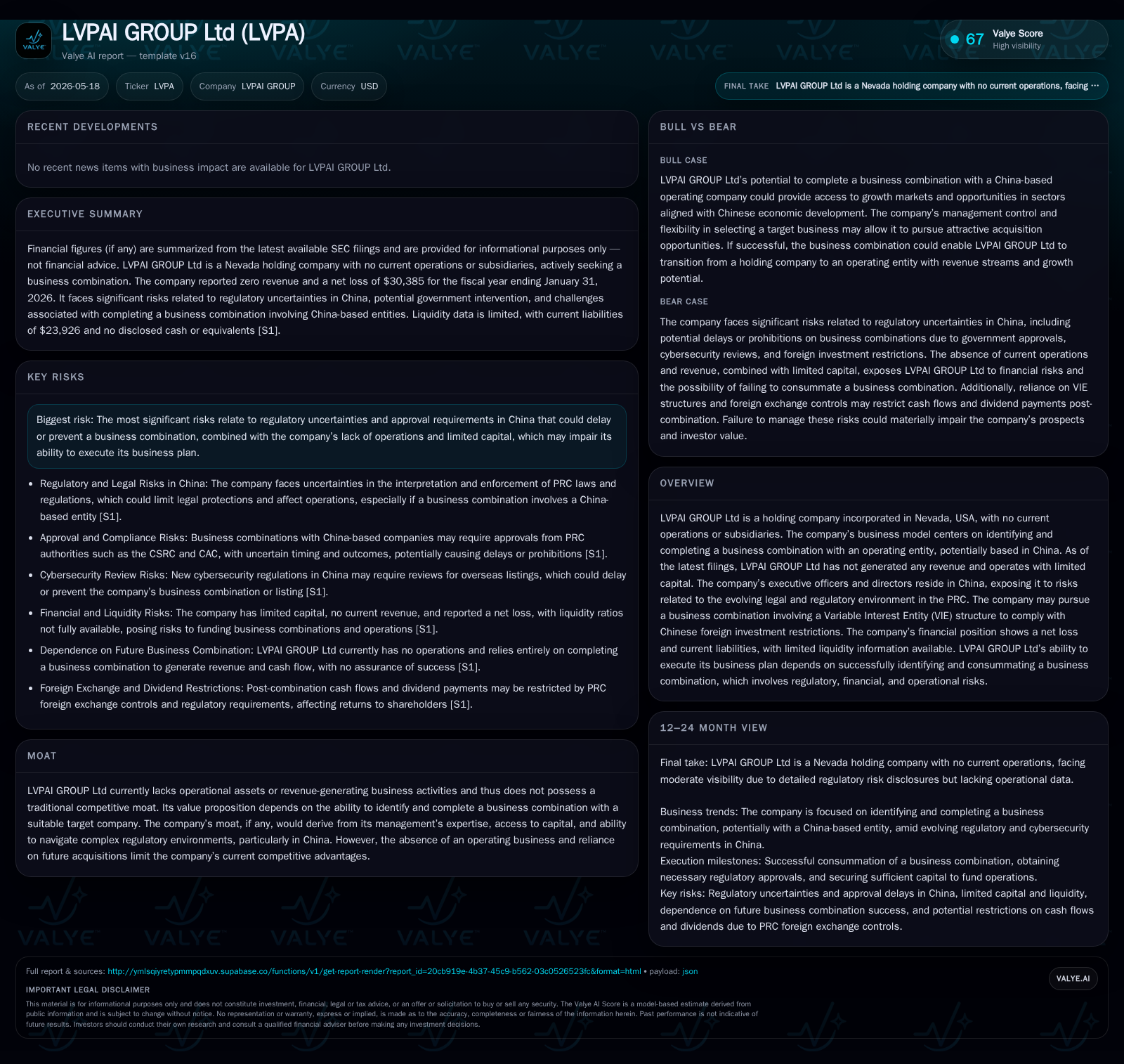
LVPAI GROUP Ltd’s latest quarterly filing through January 31, 2026, confirms its status as a shell company with no revenue and net operating losses. The company’s growth depends entirely on executing a business combination with a Chinese operating entity, likely structured via a Variable Interest Entity to navigate foreign investment restrictions. Regulatory uncertainties in China, including cybersecurity reviews and anti-monopoly enforcement, elevate execution risks. Insider share transfers in early 2026 suggest management efforts to optimize shareholder structure amid constrained liquidity and absence of operational assets.
Latest Quarterly Operating Update and Insider Activity
LVPAI GROUP Ltd's most recent quarterly filing dated February 4, 2026 ([S2]) reconfirms its status as a non-operating shell company. The firm reported no revenues and recorded an operating loss of approximately $30,385 for the quarter ended January 31, 2026 ([F1]). Its balance sheet reflects total debt near $64,607 as of January 31, 2023 ([F1]), alongside current liabilities measured previously. This financial position underscores limited resources available for pursuing business combinations or operational expansion.
In parallel, insider activity was notable: CEO Chen Yuanhang transferred roughly 40 million shares in a private stock purchase agreement during January 2026 for about $143,211 ([S3]). This transaction suggests management efforts to reorganize shareholder composition potentially ahead of anticipated corporate initiatives. However, absent operational progress or revenue generation, such moves highlight reliance on leadership-driven strategic actions.
Business Model: A Holding Company Dependent on Acquisition Execution
As described in the latest annual report ([S1]), LVPAI functions exclusively as a Nevada-incorporated holding company without subsidiaries or direct operations. The company's core strategy centers on identifying and consummating a business combination with an operating entity—most plausibly based in China—given its current lack of revenue-generating activities.
Due to PRC foreign investment restrictions in certain sectors, LVPA anticipates structuring any target acquisition through a Variable Interest Entity (VIE) arrangement. This approach enables indirect control over Chinese businesses while technically adhering to regulatory limits on foreign ownership. Consequently, LVPA does not possess traditional competitive advantages tied to products or services but relies entirely on deal-making capabilities.
Value creation for LVPA is thus contingent upon closing an acquisition that can generate sustainable cash flow post-combination. Until then, the company's status remains speculative and dependent on management expertise navigating complex cross-border transactions.
Regulatory Environment: Heightened Risks from Evolving PRC Oversight
LVPA faces significant regulatory risks rooted in China's evolving legal landscape governing overseas listings and foreign investments ([S1], [S4], [S7], [S8]). Key challenges include:
- Cybersecurity review protocols imposed by Chinese regulators for companies handling sensitive data may delay or block approvals if concerns arise ([S27]).
- Intensified anti-monopoly enforcement carries penalties up to ten percent of sales revenue for unlawful market concentration practices ([S4], [S7]).
- Ministry of Commerce (MOFCOM) approval procedures for mergers involving foreign investors are increasingly stringent and time-consuming due to national security reviews ([S14], [S20]).
These frameworks grant PRC authorities broad discretion to intervene unexpectedly at various stages of cross-border transactions involving Chinese entities—even after initial approvals—introducing uncertainty over deal timing and completion. Furthermore, official guidance regarding the application of these rules to VIE structures remains fluid.
Industry Context: VIE Structures and Cross-Border Acquisition Challenges
Variable Interest Entities are commonly used by offshore-listed Chinese companies to circumvent direct ownership restrictions across regulated industries such as technology. While VIEs facilitate access to international capital markets, they introduce contractual complexity and enforceability uncertainty compared with direct equity ownership.
LVPA aligns with companies resembling special purpose acquisition vehicles targeting Chinese businesses; these entities depend primarily on successful deal closure rather than standalone operations. Relative to larger peers possessing greater capital resources or established deal pipelines, LVPA’s scale limitations and concentrated ownership amplify risks amid tightening regulatory scrutiny.
Growth Drivers: Business Combination Execution as the Sole Catalyst
LVPA's growth hinges entirely on consummating a business combination with an operating company able to deliver post-transaction revenues within China’s regulatory framework ([S9], [S16]). Favorable market conditions—such as clearer regulatory guidance around VIEs—and enhanced economic fundamentals would accelerate target identification and negotiation success.
Management's ability to leverage networks within China's ecosystem is critical amidst competitive pressures from other sponsors pursuing similar acquisitions. Additionally, sufficient capital availability is essential not only for completing acquisitions but for supporting integration post-combination.
Progress toward formal agreements or letters of intent would materially improve visibility into LVPA's transition toward operational relevance.
Risks and Constraints: Liquidity Pressures and Legal Uncertainty
Challenges tempering optimism include persistent quarterly losses ($30k), outstanding debt ($64k) without disclosed refinancing plans ([F1]), and absence of revenue streams. These factors underscore liquidity constraints that could impair deal-making capacity.
The unpredictable PRC regulatory environment compounds risks; delays or denials from MOFCOM, cybersecurity agencies, or anti-monopoly authorities could indefinitely stall transaction prospects despite management efforts ([S25], [S26]). Moreover, governance risks arise from CEO Chen Yuanhang's majority ownership concentrating decision-making control ([S9], [S28]).
Broader macroeconomic uncertainties also affect appetite for complex cross-border deals involving emerging-market entities under intensified scrutiny.
Monitoring Points: Indicators of Strategic Progress
Key developments warranting investor attention include:
- Disclosures regarding engagement with acquisition targets or ongoing negotiations.
- Feedback from PRC regulators concerning combined entity approvals or conditions.
- Capital raising activities enhancing financial capacity for transactions.
- Changes in PRC regulations clarifying cybersecurity review processes or foreign investment restrictions.
- Insider share transactions indicating shifts in shareholder alignment ahead of deals. Tracking these indicators will inform assessments of LVPA's ability to evolve beyond shell status toward sustainable operations.
Financial Position Summary
LVPA remains an early-stage entity with constrained financial resources ([F1], [S2]). The latest quarter shows zero revenue coupled with recurring losses near $30k; total debt stands at approximately $64k from early 2023 without clear refinancing disclosures; current liabilities persist though at smaller scales ([F1]). The limited capital base accentuates dependency on external funding not only for acquisition financing but also covering administrative expenses during prolonged search phases. Post-combination dividend flows via VIE agreements remain speculative ([S12]), sustaining typical existential pressures faced by microcap shells engaged in complex cross-border M&A under volatile regulatory regimes.
This analysis synthesizes filings through mid-2026 focusing primarily on recent quarterly updates supplemented by annual disclosures to provide an integrated view of LVPAI GROUP Ltd's operational context and strategic outlook without offering investment advice.
Disclaimer: This is research-only, informational analysis and not investment advice. It may include AI-generated interpretation and general industry context. Always verify important details using primary sources.

Comments