
Lexeo Therapeutics: Clinical Milestones, Strategic Expansion, and the High-Stakes Race for Gene Therapy Validation
Lexeo Therapeutics is advancing a gene therapy pipeline targeting Friedreich Ataxia and cardiac diseases, underpinned by reported liquidity position and strategic partnerships. The company faces the classic challenge of converting scientific promise into clinical and commercial validation as pivotal data readouts approach in 2027.
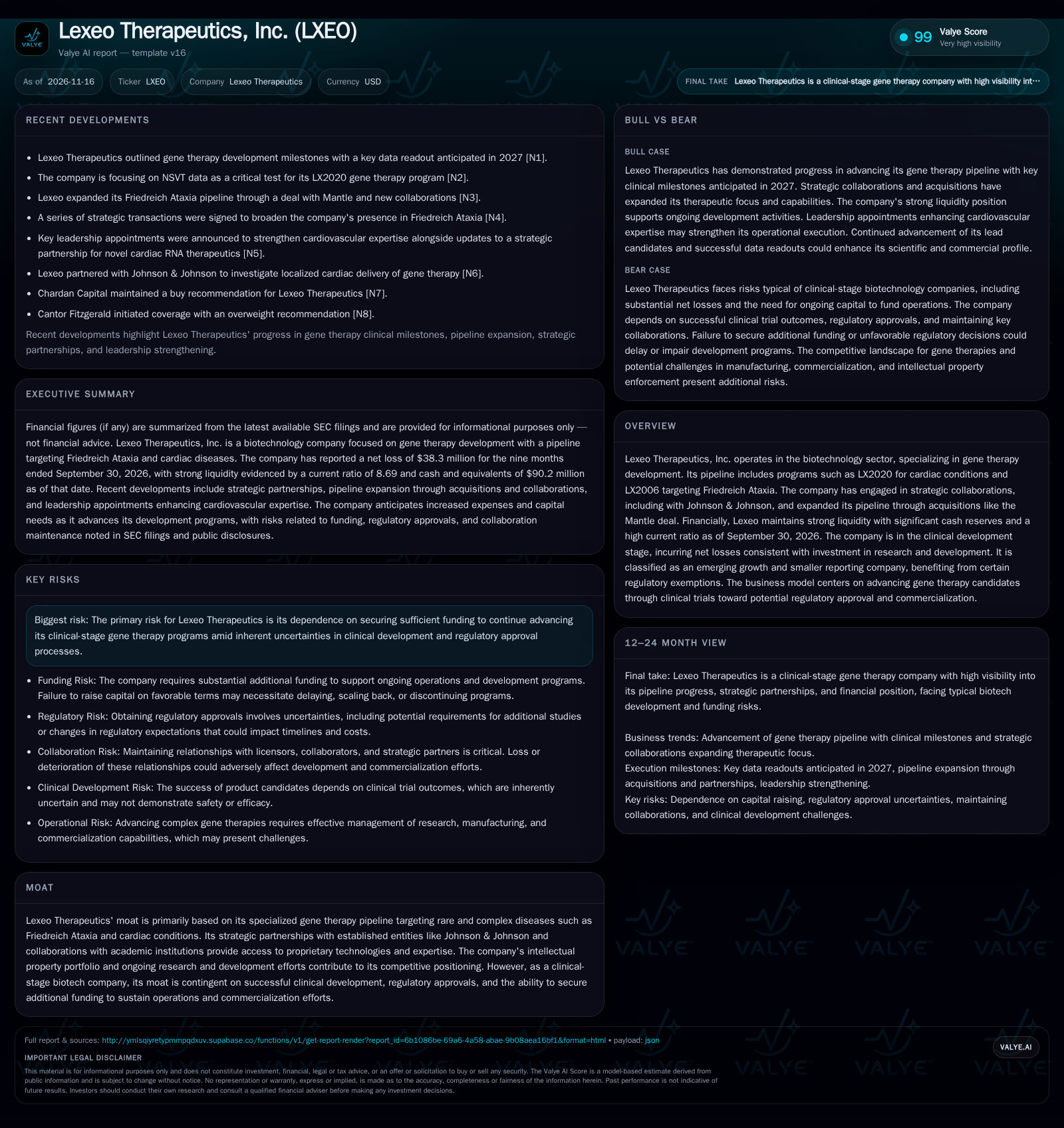
Lexeo Therapeutics is a clinical-stage biotech with an expanding gene therapy pipeline, robust cash reserves, and collaborations with major players like Johnson & Johnson. With key clinical readouts expected in 2027, the company’s near-term trajectory hinges on successful trial outcomes, continued funding access, and the ability to translate partnerships and pipeline breadth into durable competitive advantage. Risks include capital needs, clinical uncertainty, and execution demands typical of the sector. [S2] [N1] [N3] [N6]
Lexeo Therapeutics stands at a pivotal juncture in its evolution as a clinical-stage gene therapy company. With a pipeline targeting high-need indications like Friedreich Ataxia and cardiac diseases, the company’s progress is marked by substantial liquidity, aggressive R&D investment, and a series of recent deals that expand both its technological platform and disease focus. Strategic alliances—including a notable partnership with Johnson & Johnson—signal external validation and provide access to advanced delivery technologies. Yet, as with all early-stage biotech ventures, Lexeo’s ability to create lasting value will depend on successfully navigating clinical, regulatory, and funding hurdles as the company approaches multiple key data readouts in 2027. [S2] [N1] [N3] [N6]
Recent Pipeline Expansion and Financial Position Set the Stage for Clinical Milestones
Lexeo Therapeutics’ operational focus has intensified around its LX2020 and LX2006 gene therapy programs, which are targeting cardiac conditions and Friedreich Ataxia, respectively. The company anticipates pivotal clinical data readouts in 2027, marking a critical inflection point for its development trajectory. Recent strategic moves include the expansion of the Friedreich Ataxia pipeline through the Mantle deal and other collaborations, broadening the scope of Lexeo’s therapeutic ambitions. The net loss of $38.3 million for the first nine months of 2026 highlights continued high burn typical of clinical-stage biotech, with management explicitly anticipating increased expenses and capital requirements as programs advance. [S2] [N1] [N3] [N4] [N6]
R&D-Driven Model: Capital Intensity, Value Inflection, and the Path to Monetization
Lexeo’s economics are fundamentally shaped by the biotechnology model: high upfront R&D spend, prolonged periods of negative cash flow, and the potential for outsized value creation upon successful clinical validation and regulatory approval. The company’s $67.3 million negative operating cash flow for the first nine months of 2026 reflects this capital-intensive approach. Revenue is not expected until at least one pipeline candidate achieves approval and commercial launch—a milestone that typically triggers a dramatic swing in operating leverage for successful biotech firms.
Pricing power in gene therapy can be substantial due to the curative intent and orphan drug designation often associated with rare diseases like Friedreich Ataxia. If Lexeo’s programs demonstrate compelling clinical benefit, premium pricing and reimbursement are plausible, especially in indications with limited alternatives. However, this is counterbalanced by high manufacturing costs, complex regulatory pathways, and the need for substantial commercialization infrastructure—either built internally or accessed via partnerships.
Lexeo’s ability to extract favorable economics from its partnerships, such as the Johnson & Johnson deal, will depend on the structure of these agreements—whether they involve milestone payments, royalties, or co-commercialization. Without explicit disclosure, the potential for meaningful non-dilutive funding or revenue streams from such partnerships remains an open question.
Positioning in a Crowded Gene Therapy Landscape: Partnerships, Pipeline Breadth, and Differentiation Challenges
Lexeo operates in a fiercely competitive segment of biotechnology, where numerous public and private companies are racing to develop gene therapies for rare neuromuscular and cardiac conditions. Its moat is anchored in a differentiated pipeline, intellectual property, and strategic partnerships with major industry players and academic collaborators. The recent expansion of the Friedreich Ataxia pipeline through deals like Mantle and the high-profile Johnson & Johnson partnership may provide both technical validation and access to advanced delivery modalities.
Nevertheless, barriers to durable competitive advantage remain substantial. The gene therapy field is characterized by rapid innovation, with new delivery vectors, editing technologies, and manufacturing platforms emerging regularly. Larger, better-capitalized competitors may have an edge in clinical execution, regulatory navigation, and commercial reach. Lexeo’s ability to maintain and deepen its partnerships, secure orphan or breakthrough designations, and generate robust clinical data will be critical to carving out sustainable differentiation. Intellectual property protection and freedom to operate—especially in crowded indications—are also ongoing concerns for all players in this space.
Breakthrough Clinical Data Unlocks Value and Strategic Options
The most favorable scenario for Lexeo is predicated on one or more of its lead gene therapy programs delivering compelling efficacy and safety data in 2027. Positive readouts from the LX2020 and LX2006 programs could catalyze a sequence of value-creating events: accelerated regulatory pathways, orphan drug exclusivity, enhanced bargaining power with potential commercial partners, and the ability to raise capital on favorable terms.
Such clinical success could also attract acquisition interest from larger biotech or pharmaceutical companies seeking to bolster their rare disease or gene therapy portfolios. Confirmation of the upside scenario would be evident through achievement of key clinical endpoints, regulatory fast-track designations, expanded partnership agreements with upfront payments or milestones, and visible investor interest in subsequent financing rounds. Conversely, failure to demonstrate clear clinical benefit or safety would quickly undermine this bullish pathway.
Clinical Progression with Incremental De-Risking and Ongoing Funding Needs
The most plausible trajectory for Lexeo is a measured progression through its 2027 clinical milestones, with a mix of encouraging and ambiguous data. The company may achieve incremental de-risking of its programs—such as demonstrating biological activity or safety—but fall short of unequivocal proof of efficacy in the initial readouts. In this scenario, Lexeo would continue to invest heavily in R&D, possibly leveraging its partnerships for technical expertise and non-dilutive funding, while seeking additional capital through equity or structured deals.
Falsification would occur if the company either rapidly accelerates to commercial-stage economics or, conversely, runs into insurmountable clinical or funding setbacks.
Clinical Setbacks or Funding Shortfalls Disrupt Development Trajectory
The primary risk for Lexeo is a scenario in which one or more lead programs generate negative or inconclusive clinical results, eroding investor and partner confidence. Given the high capital intensity and long timelines of gene therapy development, an adverse data readout in 2027 could make it difficult for Lexeo to raise additional funding on acceptable terms, forcing the company to delay, scale back, or discontinue key programs.
Loss of critical partnerships—should data fail to meet partner expectations—or regulatory setbacks could further compound challenges. Confirmation of this bearish scenario would include negative clinical news, withdrawal or renegotiation of partnerships, a pronounced increase in cash burn without commensurate funding inflows, or explicit statements from management about pipeline reprioritization or cost-cutting measures.
Milestones and External Factors That Will Define Lexeo’s Next Chapter
Progress toward the 2027 clinical data readouts for LX2020 and LX2006, including interim updates or top-line results.
Details (if disclosed) regarding the structure and economics of the Johnson & Johnson partnership and other collaborations, such as milestone payments, royalties, or co-development terms.
Cash burn rate relative to pipeline progression; a useful metric would be quarterly operating cash flow and runway projections under different development scenarios.
Ability to access capital markets or secure non-dilutive funding ahead of major clinical milestones.
Regulatory interactions, including orphan drug/fast-track designations or feedback on trial design and endpoints.
Updates on pipeline expansion activities, especially additional deals or in-licensing that further diversify or de-risk the portfolio.
Turnover or strengthening of leadership, particularly in clinical, regulatory, or commercial functions as the company approaches pivotal inflection points.
Any indication of competitor readouts, approvals, or setbacks in Friedreich Ataxia or related cardiac gene therapy markets that could alter Lexeo’s opportunity set.
Disclaimer: This is research-only, informational analysis and not investment advice. It may include AI-generated interpretation and general industry context. Always verify important details using primary sources.

Comments