
Massimo Group Advances Utility Powersports with AI Integration and Leadership Change
Massimo Group’s latest quarterly filing reflects strategic shifts including new CEO appointment and AI-driven product innovation.
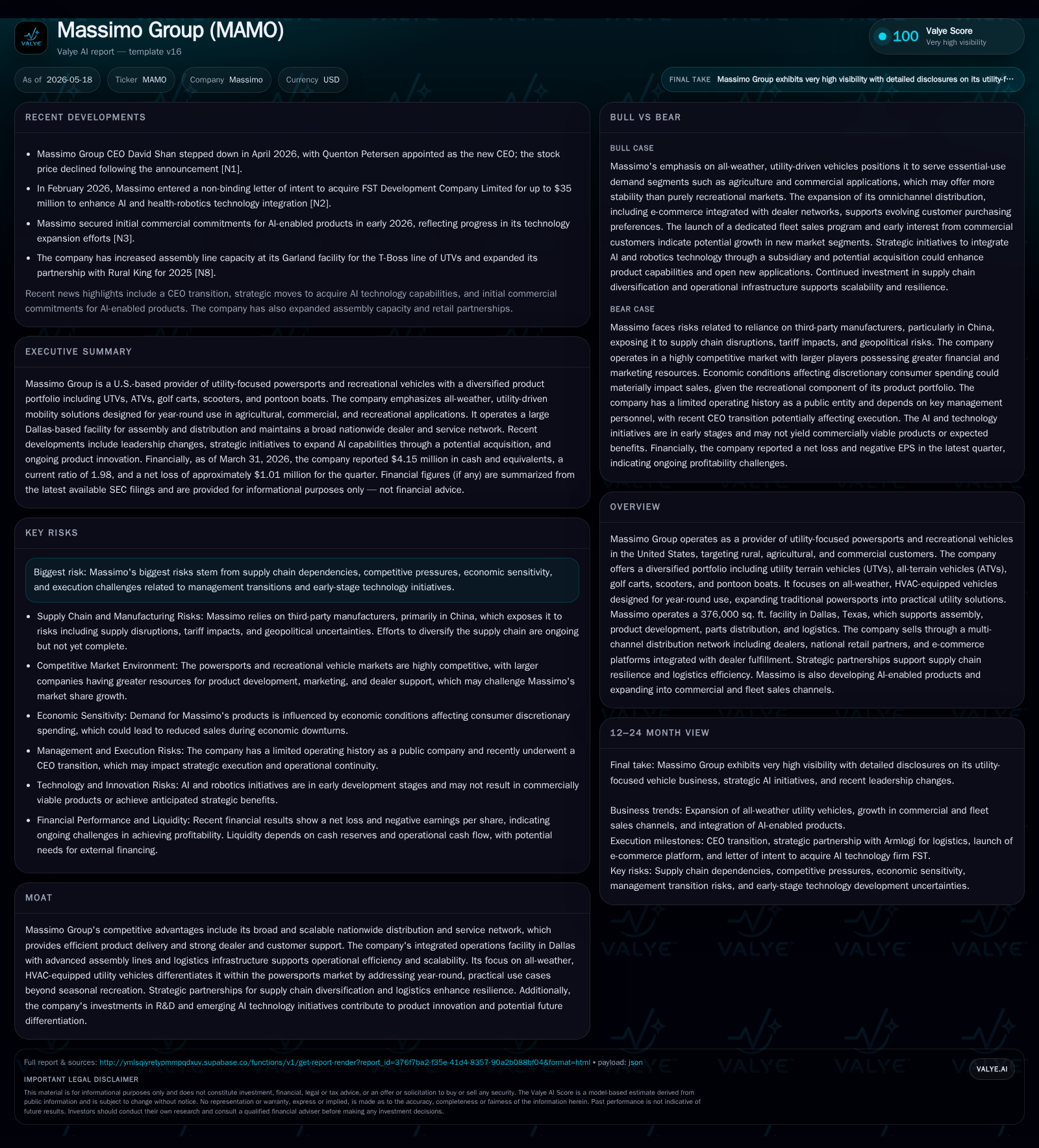
Massimo Group, a U.S. provider of utility-focused powersports and recreational vehicles, reported ongoing progress in expanding all-weather utility vehicle offerings and strengthening its nationwide dealer and service network in the latest quarter. The company announced a CEO transition with Quenton Petersen replacing David Shan, who remains as executive chairman, signaling continuity amid leadership change. Massimo is pursuing growth by integrating AI capabilities through an intended acquisition, targeting enhanced product differentiation and operational efficiencies. Despite competitive pressures and supply chain risks, Massimo’s scalable distribution, HVAC-equipped vehicles, and R&D investments underpin its strategic positioning in rural and commercial markets.
Recent Operating Update
Massimo Group's latest quarterly report filed on May 15, 2026 ([S2]) indicates stability with no material adjustments to previously disclosed risk factors. The filing comes on the heels of a significant leadership change: founder and long-serving CEO David Shan stepped down from the CEO role on April 14, 2026 but retains his position as executive chairman ([S3]). The new CEO, Quenton Petersen, assumes operational leadership without immediate changes to compensation or related party concerns. This transition suggests a strategic realignment while preserving institutional knowledge at the board level.
The company also recently announced in February 2026 a non-binding letter of intent to acquire FST Development Company Limited ([S4], [S6]). This acquisition targets AI-driven intelligent hardware and system-level solutions to embed advanced technologies like machine vision and sensor integration into Massimo’s powersports and marine products. Such technological integration is nascent but underlines Massimo's ambitions beyond traditional utility mobility.
Business Model
Massimo Group operates primarily in the utility-focused segment of the powersports market within the United States. It manufactures, imports, and distributes vehicles such as utility terrain vehicles (UTVs), all-terrain vehicles (ATVs), golf carts, scooters, and pontoon boats ([S1]). The company's revenue mechanics are predicated on selling these vehicles primarily to rural, agricultural, commercial customers through an extensive multi-channel distribution network encompassing independent dealers, national retail partners—most notably Tractor Supply Co.—and direct e-commerce sales integrated tightly with dealer fulfillment.
Customers pay for durable vehicles designed with practical utility in mind rather than only recreational use. Pricing largely depends on model configurations (like HVAC-equipped vehicles) which enable all-weather usage enhancing addressable market size especially in agriculture or industrial applications. Volume depends on market demand cycles tied to discretionary spending but buoyed by essential-use cases. Mix benefits accrue as Massimo introduces newer enclosed models like Sentinel 570/770 series.
Margins potentially improve via value-added features such as electric vehicle chargers and expanded marine electric offerings. Additionally, aftermarket parts sales supported by rapid fulfillment capabilities from a dedicated parts facility augment recurring revenue potential.
The company's manufacturing model leverages asset efficiency by combining internal assembly lines (including robotic lines) at the Dallas facility with third-party suppliers predominantly located in China ([S1], [S14]). Massimo relies heavily on close supplier collaboration for product design input while keeping capital expenditure relatively restrained compared to vertically integrated OEMs.
Industry Structure and Competitive Position
The powersports industry features dominant incumbents like Polaris, Bombardier Recreational Products (BRP), Honda, and Yamaha ([S22]). These competitors benefit from deeper financial resources enabling heavier investment in marketing, R&D, proprietary intellectual property portfolios, and dealer incentives.
Massimo's niches are differentiated by its focus on all-weather capability via fully enclosed HVAC-equipped vehicles tailored for year-round practical use rather than purely seasonal recreation ([S24]). Its facility scale supports efficient logistics including over 30 loading docks servicing national distribution needs.
A key moat lies in its broad service network: over 600 motor vehicle service providers plus approximately 5,500 marine third-party providers nationwide bolster customer retention through comprehensive maintenance support ([S1]). The omnichannel sales strategy incorporates an e-commerce platform launched in partnership with Ekho Dealer that seamlessly integrates with physical dealers facilitating online browsing through final dealer fulfillment—a notable innovation addressing contemporary consumer buying preferences.
Supply chain resilience is addressed by diversifying suppliers outside China when possible; however reliance remains substantial on offshore manufacturing exposing risk tied to tariff volatility or geopolitical tensions ([S28]).
Growth Drivers
All-Weather Product Expansion: Rolling out additional HVAC-equipped UTV models extends durable usage across climatic regions supporting steady demand among farming/commercial segments.
Dealer Network Scale: Deepening relationships with dealership partners coupled with marketing programs aimed at inventory management enhances product sell-through efficiency.
Omnichannel Sales Platform: Integration of e-commerce capabilities allows capturing shifting consumer behavior towards digital-first purchases without undermining traditional dealer routes.
AI Technology Integration: The targeted acquisition of FST Development Company Limited signals potential new avenues for smart controls, connectivity features within vehicle platforms plus expansion into health robotics which might create differentiated high-value product segments down the line.
Service & Parts Infrastructure: A rapid parts fulfillment operation supports aftermarket revenue growth which typically enjoys higher margin profiles compared to new vehicle sales.
International Market Entry: Initial European market penetration through independent distributors suggests early-stage global scaling opportunities albeit currently limited in scope ([S1]).
Risks / Watchpoints / Growth Constraints
- Supply Chain Risk: High dependence on Chinese suppliers entails risks relating to tariffs, currency fluctuations (USD/CNY), political uncertainties, and logistical disruptions ([S1], [S28]).
- Product Liability & Litigation Exposure: Material pending lawsuits claim defects spanning steering mechanisms to batteries influencing safety perceptions potentially impacting brand reputation ([S7], [S19]).
- Competitive Pressure: The markets served face intense competition from large multinational firms capable of aggressive pricing strategies or rapid product innovation ([S22], [S25]).
- Economic Sensitivity: Customer spending linked partly to cyclical rural/agricultural economics could induce demand volatility during downturns (,[S5]).
- Execution Risk Around Technology Integration: Early-stage AI health robotics projects may not deliver anticipated benefits or encounter integration hurdles stipulating careful management oversight ([S21],[S4],[S6]).
- Leadership Transition Uncertainty: While the outgoing CEO remains involved at the board level, execution effectiveness under new CEO Petersen represents a critical governance watchpoint ([N1],[S3]).
- Regulatory Environment: Compliance with evolving emissions standards (EPA/CARB) plus product safety regulations requires ongoing investment which may pressure margins or delay new launches ([S27],[S7]).
- Capital Access: No explicit recent financing constraints disclosed yet any need for external funding entails dilution or restrictive covenants risk given company scale ([S12]).
What to Watch Next
- Progress of the AI technology acquisition including definitive agreement execution timelines following the non-binding letter of intent announced February 2026 ([S4],[S6]).
- New model launches expanding the Sentinel HVAC-equipped UTV lineup aimed at increasing all-weather addressable market share.
- Dealer network expansion metrics including new retail partnerships beyond Tractor Supply Co., dealer inventory turnover rates, and e-commerce conversion statistics.
- Developments in pending litigation outcomes especially the Zhejiang Qunying case scheduled for trial March 2026 that could affect legal contingencies ([S19],[S1]).
- Updates from management reflecting strategic priorities under CEO Petersen relevant to operational improvements or capital allocation decisions.
- Quarterly financial performance for signs of margin improvement driven by mix shift toward higher-value products or aftermarket spares growth.
- Responses to competitor innovations particularly from Polaris or Honda advancing electric or smart vehicle offerings impacting competitive dynamics.
Financial Profile Summary
As of the close of Q1 2026 (March 31), Massimo Group held $4.15 million in cash & equivalents against best available total debt balance near $2.67 million as of mid-2024 snapshot estimates—resulting in an approximate negative net debt position around $1.5 million [F1]. Current assets stood at $32.9 million versus current liabilities of $16.6 million yielding a robust current ratio near 1.98 [F1]. This liquidity profile suggests adequate short-term financial flexibility although lack of updated debt figures post mid-2024 limits precision assessment.
This analysis synthesizes recent regulatory filings and company disclosures without providing investment advice or price projections. It is intended as an informed industry perspective incorporating validated data points from SEC submissions combined with domain expertise reflecting current trends within powersports mobility sectors.
Disclaimer: This is research-only, informational analysis and not investment advice. It may include AI-generated interpretation and general industry context. Always verify important details using primary sources.

Comments