
3 E Network Technology: Data Center Ambition, Capital Pressures, and the Path to Commercial Validation
3 E Network Technology Group Ltd is positioning itself as an AI data center innovator with recent product launches and infrastructure expansion in Finland, but ongoing net losses and Nasdaq compliance issues highlight the urgency of scaling revenue and demonstrating a sustainable business model.
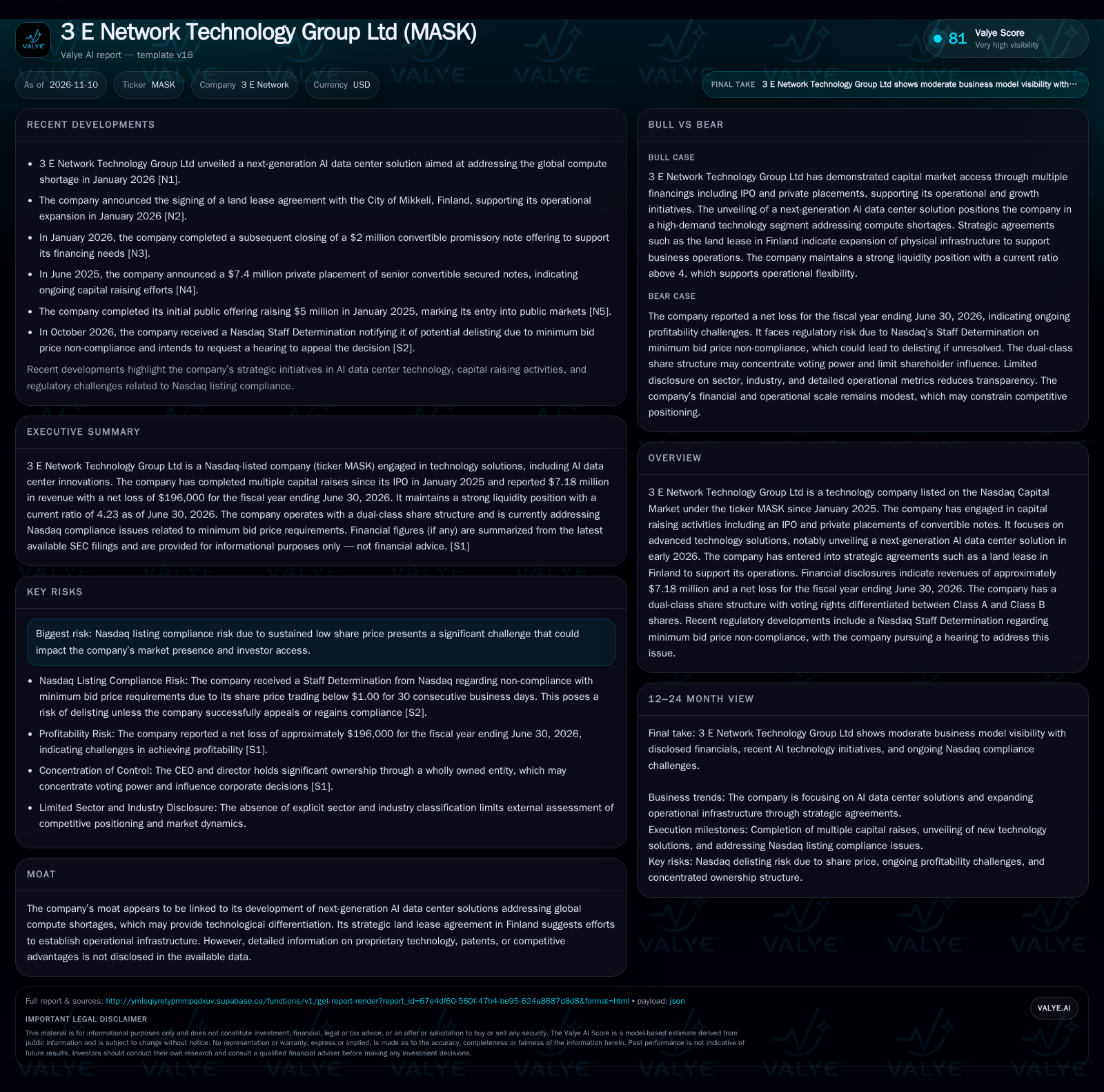
3 E Network Technology Group Ltd (Nasdaq: MASK) has launched a next-generation AI data center solution and secured a land lease in Finland to support its expansion. Despite $7.18 million in annual revenue, the company reported a net loss and faces Nasdaq delisting risk due to sustained low share price. Multiple capital raises since IPO reflect ongoing funding needs as the company seeks to execute on its AI infrastructure vision. [S1] [N1] [N2] [N3] [S2]
3 E Network Technology Group Ltd is attempting to carve out a role in the fast-evolving AI infrastructure market, with a focus on next-generation data center solutions aimed at alleviating global compute shortages. Its recent land lease in Finland and multiple capital raises signal both ambition and the ongoing need for financial support. However, the company’s modest revenue base, persistent net losses, and the threat of Nasdaq delisting due to a depressed share price raise pressing questions about its ability to scale, achieve profitability, and cement a defensible market position.
Recent Moves Define Strategic Priorities and Funding Realities
3 E Network Technology Group Ltd has made several material moves in 2026 that frame its current business context. In January, the company unveiled a next-generation AI data center solution, aiming to address the acute global shortage of compute resources driven by AI and high-performance workloads [N1]. To support this ambition, it secured a land lease in Mikkeli, Finland, indicating a push to establish or expand its physical infrastructure footprint in a region known for its data center-friendly climate and access to renewable energy [N2]. On the financial side, 3 E Network has continued to rely on external capital, raising $2 million through a convertible promissory note in January 2026, following a $7.4 million private placement in June 2025 and a $5 million IPO in January 2025 [N3] [N4] [N5]. As of June 30, 2026, the company reported $7.18 million in revenue but remains unprofitable, with a net loss of $196,000 [S1]. Regulatory risk has also become acute, as the company received a Nasdaq Staff Determination in October 2026 for non-compliance with minimum bid price requirements and now faces the prospect of delisting unless it can appeal or regain compliance [S2].
AI Data Center Economics: Scaling Ambition vs. Capital Intensity
The economics of AI data centers are shaped by a mix of high upfront capital requirements, significant ongoing operating costs, and the potential for high-margin, recurring revenue streams if infrastructure is efficiently utilized. For 3 E Network, the unveiling of a next-gen AI data center solution suggests an attempt to enter a market where demand for compute capacity is surging, especially from AI model training and inference workloads. However, the company’s reported $7.18 million in annual revenue and modest net loss imply that it has yet to achieve scale or operating leverage [S1].
AI data centers typically generate revenue through colocation, cloud services, or selling dedicated compute to enterprise or hyperscale customers. Without details on commercial structure—whether revenue is driven by long-term contracts, usage-based billing, or bespoke solution sales—it is unclear how recurring or predictable 3 E Network’s revenue is. The land lease in Finland may lower energy and cooling costs, but significant capital will likely be required for buildout, hardware procurement, and network integration. The company’s repeated capital raises since IPO underscore the funding intensity of this business, and suggest that further external financing may be needed until cash flow from operations can cover growth and maintenance capex.
Positioning Against Global and Regional Data Center Players
3 E Network is entering a fiercely competitive landscape dominated by established global hyperscalers, regional colocation providers, and a wave of specialized AI infrastructure startups. Entrants in this market compete on reliability, energy efficiency, network connectivity, and increasingly on access to advanced AI accelerators and custom silicon. The company’s next-gen positioning could offer differentiation if its technology delivers superior performance, energy efficiency, or cost advantages, but no details have been disclosed regarding proprietary technology, patents, or unique commercial relationships.
Finland’s data center ecosystem is attractive due to low ambient temperatures, renewable energy availability, and supportive regulatory frameworks. However, these advantages are accessible to all market participants, and the company’s modest scale may be a constraint when bidding for large enterprise or cloud contracts. The dual-class share structure, with control concentrated among insiders, could support long-term strategy but may also deter some institutional investors seeking governance alignment. Without evidence of deep customer relationships or defensible IP, 3 E Network’s competitive moat remains largely unproven.
Pathway to Scale: Commercial Traction and Infrastructure Execution
The most favorable scenario for 3 E Network would see its AI data center solution gain rapid commercial traction, leveraging the Finland facility to attract enterprise workloads or partnership deals with cloud or AI service providers. If the company can secure long-term contracts or recurring usage commitments, it could achieve higher utilization rates, unlocking significant operating leverage and improving margins. Successful deployment of the leased land and demonstration of a differentiated technical offering—such as lower total cost of ownership or superior AI workload performance—would support revenue growth and potentially restore investor confidence, helping the company regain Nasdaq compliance.
Confirmation of this scenario would come from disclosed customer wins, backlog growth, or partnerships with hyperscalers or major AI firms. Evidence of positive operating cash flow, margin expansion, or a shift from project-based to recurring revenue would also signal progress. Conversely, slow uptake, continued net losses, or lack of major customer announcements would falsify the upside case.
Gradual Revenue Expansion Amid Ongoing Funding Needs
The most plausible near-term trajectory is one of incremental revenue growth as 3 E Network seeks to commercialize its AI data center solution and build out its Finland operations. Given the company’s modest starting scale, it may initially attract smaller enterprise customers or pilot projects, leading to lumpy or project-driven revenue. The need for further capital raises is likely, as cash flow from operations may not be sufficient to fund expansion or absorb losses in the near term.
This scenario would be supported by moderate year-over-year revenue increases, continued net losses or only marginal progress toward break-even, and periodic announcements of new financings or infrastructure milestones. Failure to secure larger contracts, achieve sustained margin improvement, or demonstrate differentiated technology would reinforce the base case.
Delisting and Dilution Risks Escalate if Commercialization Lags
Should 3 E Network fail to gain commercial traction with its AI data center solution or face delays in deploying its Finland infrastructure, the company could experience deepening net losses and cash burn. If the minimum bid price is not restored, Nasdaq delisting could occur, reducing liquidity and investor access while potentially increasing the cost of future capital.
In this scenario, the company may be forced to raise additional funds at increasingly dilutive terms or curtail its expansion plans. Lack of customer wins, continued negative earnings per share, and persistent regulatory overhang would confirm the downside. The absence of disclosed partnerships or technology validation would further undermine the company’s ability to compete in a capital- and credibility-intensive sector.
Milestones and Metrics That Will Clarify 3 E Network’s Trajectory
Disclosure of new customer contracts, especially multi-year or recurring agreements, would help test the company’s ability to drive sustainable revenue.
Updates on the buildout, operational status, or utilization rates of the Finland data center facility would clarify infrastructure execution.
Evidence of margin improvement, positive operating cash flow, or progress toward profitability would indicate operating leverage.
Any announcements of partnerships with cloud providers, AI firms, or hyperscalers would support commercial validation.
Progress or resolution regarding Nasdaq minimum bid price compliance will determine ongoing public market access.
Additional capital raises or changes in capital structure, including terms and dilution, would signal funding needs and investor confidence.
Disclosure of technology benchmarks, patents, or IP filings would help assess the company’s competitive differentiation.
Disclaimer: This is research-only, informational analysis and not investment advice. It may include AI-generated interpretation and general industry context. Always verify important details using primary sources.

Comments