
Mountain Crest Acquisition Pursues Value-Unlocking Targets After Business Combination Setback
MCAG progresses toward finalizing a business combination with CUBEBIO amid liquidity constraints and regulatory challenges.
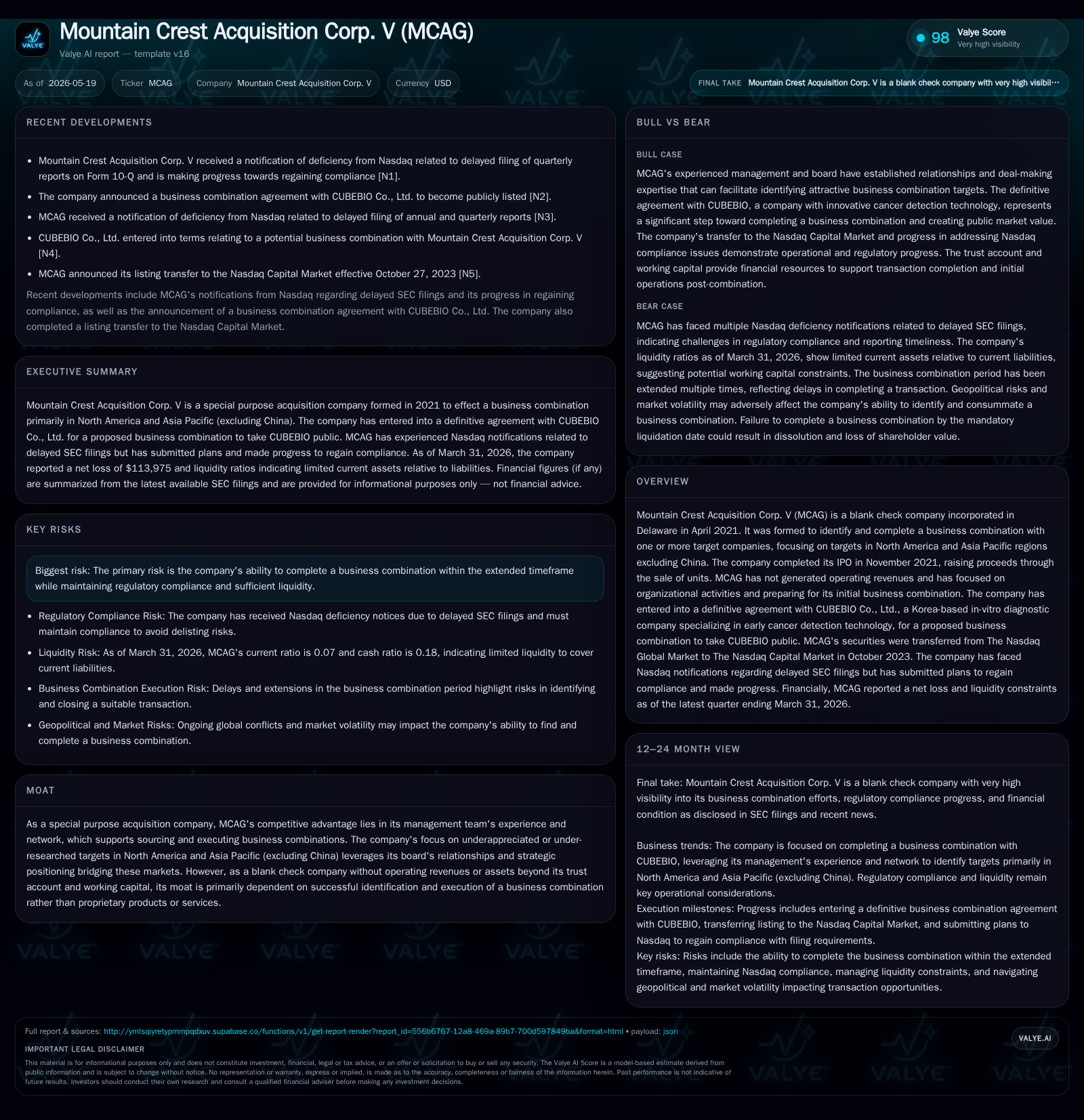
Mountain Crest Acquisition Corp. V (MCAG) remains focused on consummating its initial business combination, having shifted target focus from the terminated AUM Biosciences deal to a new proposed transaction with Korea-based CUBEBIO Co., Ltd. Despite limited liquidity and Nasdaq listing transitions, the management team leverages its sector-specific expertise and regional networks targeting undervalued companies in North America and Asia Pacific (excluding China). The company faces critical execution risks related to geopolitical instability, tight funding, and regulatory compliance deadlines but aims to unlock value through its disciplined acquisition strategy. Upcoming milestones center on closing the CUBEBIO deal and navigating shareholder approvals under extended timelines.
Latest Quarterly Operating Update: Progress and Challenges
Mountain Crest Acquisition Corp. V's latest quarterly filing dated May 15, 2026 [S2] reveals that the company has yet to generate any operating revenues, consistent with its status as a Special Purpose Acquisition Company (SPAC). The key operational focus remains the pursuit of an initial business combination within the predefined timeframe, now extended through November 16, 2026. The prior Business Combination Agreement with AUM Biosciences was formally terminated in June 2023 [S1], marking a setback for MCAG's timeline.
Significantly, the company has oriented efforts towards a new proposed business combination with CUBEBIO Co., Ltd., a Korea-based specialized in-vitro diagnostic firm focusing on early cancer detection technology [S1],. This shift highlights MCAG’s continued active search for value-accretive targets despite prior challenges.
Regulatory positioning remains fluid: MCAG transferred its securities listing from The Nasdaq Global Market to The Nasdaq Capital Market effective October 27, 2023 [S1]. This transition stems from compliance difficulties, including minimum market value of listed securities and publicly held shares requirements [S15], though subsequent notices indicate regained compliance at various points [S10], [S15]. These developments affect investor sentiment by underscoring ongoing risks of delisting or trading suspension.
Mountain Crest’s Business Model and Value Proposition as a SPAC
As a blank check company incorporated in Delaware in April 2021 [S1], Mountain Crest Acquisition Corp. V operates primarily as a vehicle formed to identify, finance, and consummate an initial business combination with one or more private companies. Its strategic focus is geographically confined to North America and Asia Pacific regions excluding China—and explicitly excludes entities principally operating within China or its special administrative regions such as Hong Kong or Macau. This bespoke regional limitation reflects management’s intent to leverage deep regional insights while sidestepping elevated regulatory complexities associated with mainland China operations [S1].
MCAG raises capital through IPO units that include common stock coupled with warrants or rights exercisable upon consummation of a business combination [S1]. The proceeds from these offerings are held in a trust account until deployment into an acquisition. As a SPAC without operating assets, MCAG's revenue model is contingent upon completing this merger or acquisition; only post-combination can revenue streams be generated through the target's operational performance.
The company's claim to competitive advantage rests in its management team's extensive experience across investment vehicles—spanning venture capital, private equity, hedge funds—and robust relationships within legal, accounting, and banking spheres facilitative for sourcing underappreciated or misvalued targets requiring complex due diligence [S1]. The approach prioritizes unlocking latent growth potential through strategic review of targets’ capital structures, earnings quality, governance standards, contractual obligations, and customer concentrations.
Industry Comparisons: SPAC Market and Peer Context
Within the vibrant SPAC ecosystem that peaked earlier in the decade but contracted due to regulatory tightening and market fatigue, MCAG exemplifies mid-tier sponsors who differentiate themselves via geographic specialization and niche sector targeting rather than broad thematic mandates. Its deliberate exclusion of Chinese-operated enterprises contrasts peers who have been more permissive but exposed to volatile cross-border regulations.
Listing on The Nasdaq Capital Market rather than the Global Market signals certain compliance nuances but preserves trading access under somewhat less stringent thresholds—a pragmatic accommodation given recent liquidity pressures and redemption dynamics documented in filings [S1],. Unlike larger sponsor teams controlling multiple concurrent vehicles or those backed by deep institutional balance sheets, MCAG relies on intermittent promissory notes from sponsors for working capital funding rather than continuous financing lines—an economic distinction that tempers runway flexibility.
This structural positioning calls for highly selective deal origination focused on targets that may have been overlooked by competing strategic buyers or other SPACs emphasizing scale over complexity.
Strategic Growth Drivers: Target Focus and Management Expertise
The centerpiece growth driver for MCAG is the pending business combination with CUBEBIO Co., Ltd, representing entry into the high-growth diagnostics sub-industry characterized by strong secular tailwinds driven by aging demographics and increasing demand for early disease detection technologies. This strategic sector selection bodes well for post-merger operational scalability assuming successful integration.
Management employs rigorous due diligence protocols centered on uncovering companies with identifiable expansion avenues through organic growth acceleration or accretive add-on acquisitions as well as evaluating profitability improvement opportunities via capital structure optimization [S1]. Emphasis is placed on validating governance frameworks and material contracts—critical factors given the cross-border nature of target operations which introduce layers of regulatory scrutiny.
The ability of MCAG’s experienced board members to tap their professional networks—including noteworthy connections across venture capital firms specializing in biotech innovation—enhances access to proprietary deal flow unlikely accessible by less connected sponsors.
Key Risks and Constraints: Liquidity, Timing, and Geopolitical Factors
These constraints heighten operational risk particularly if transaction completion delays further beyond mandated deadlines; failure to consummate a qualifying deal by November 16, 2026 will necessitate liquidation yielding only pro rata returns from trust accounts after creditor claims [S6],.
Externally driven geopolitical instabilities—including ongoing conflicts between Russia-Ukraine and escalating tensions in Middle East involving U.S., Israel, Iran—and resultant sanctions regimes have introduced market volatility disrupting normal flows of capital goods and commodities [S2]. Such macro disruptions compound uncertainties around deal pipeline robustness as international counterparties face heightened operational risks or defer strategic choices amid unpredictability.
Additionally, regulatory compliance pressures linked to Nasdaq listing rules demand continuous attention; previous notifications regarding minimum market capitalization thresholds and timely SEC filings resulted in share delisting threats prompting transfers between Nasdaq tiers—with substantial implications for investor confidence [S15], [S16].
What Investors Should Watch Next: Milestones and Transaction Execution
Critical near-term milestones that will influence stakeholder assessments include formalization of definitive documentation concerning the proposed transaction with CUBEBIO—progress beyond the non-binding term sheet announced April 2024 will be pivotal [S17]. Initiation of stockholder proxy solicitations offering approval opportunities or tender offer procedures will trigger redemption rights exercises providing tangible signals of market sentiment.
Given prior disruptions around scheduled stockholder meetings canceled following earlier termination of agreements (e.g., AUM Biosciences) [S8], setting firm dates for meetings reflecting candid communication around deal timelines will be important gauges of actual closing feasibility.
Additional monitoring points encompass announcements from Nasdaq regarding listing status amendments; substantial redeployment back onto regulated exchanges would allay historic concerns while further notifications might herald fresh compliance issues impacting trading liquidity.
Operational disclosures around sponsor loan drawdowns vis-à-vis cash burn rates for administrative expenses could offer insights into financial runway sufficiency ahead of transaction conclusion.
Financial Position Briefing: Liquidity Status and Capital Considerations
Available financial data underscores Mountain Crest’s constrained working capital profile requiring attentive management oversight. As of March 31, 2026,[F1] current assets stood at $138,557 versus markedly higher current liabilities approaching $1.88 million—a ratio suggestive of acute short-term stress. Earlier cash & equivalents balance cited at approximately $347k dated back to March 31, 2022 reflects historical context but does not alleviate recent pressures.[F1]
Sponsor-provided non-interest-bearing promissory notes amounting cumulatively up to $400k issued in late 2023 alongside additional working capital loans extend marginal relief but carry repayment contingent upon business combination success or proceeds remaining after wind-down.[S2],[S19],[S21]
Administrative overhead covering operational readiness including regulatory filings remain recurring outflows monitored closely by decision makers responsible for resource allocation within the trust account governance framework.[S22]
While these financings suffice short term given expected deal closure timeline extensions granted by stockholders,[S16] failure to secure sufficient additional funding or consummate an acquisition promptly would accelerate dissolution triggered by forced redemption provisions embedded within SPAC charters.
This analysis is based solely on publicly available information up to May 19, 2026. It does not constitute investment advice nor research view. Readers should consider company filings directly before making any decisions related to Mountain Crest Acquisition Corp. V securities.
Disclaimer: This is research-only, informational analysis and not investment advice. It may include AI-generated interpretation and general industry context. Always verify important details using primary sources.

Comments