
Mountain Crest Acquisition Corp. V: Timeline Pressure, Liquidity Strain, and the High-Stakes Search for a Viable Target
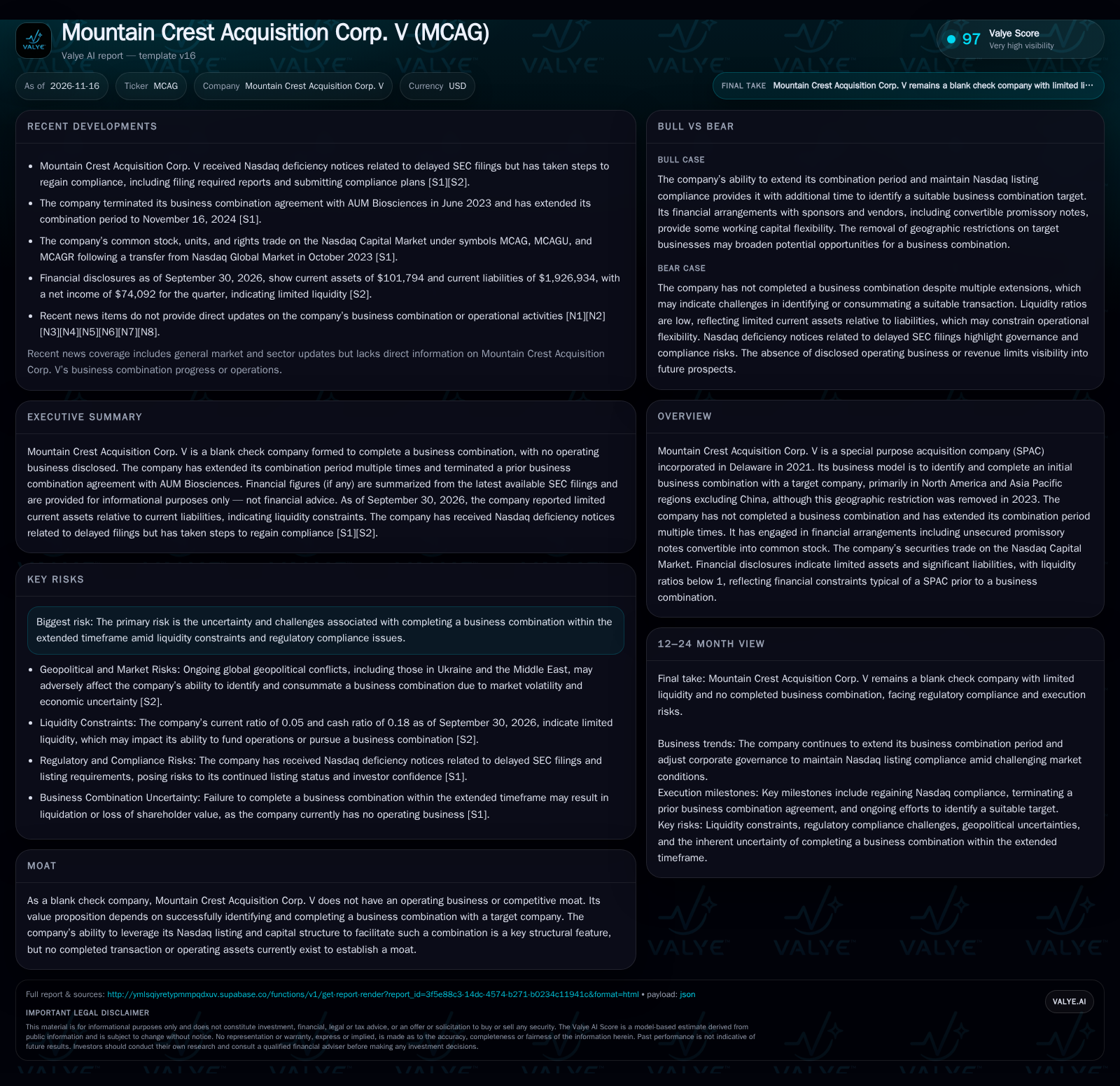
With repeated deadline extensions, ongoing liquidity concerns, and no operating business, Mountain Crest Acquisition Corp. V faces a narrowing window to secure a business combination before forced liquidation. The company’s ability to navigate compliance hurdles and attract a credible target will determine whether it delivers value—or winds down.
Mountain Crest Acquisition Corp. Its future hinges entirely on sourcing and closing a viable business combination before its November 2024 deadline. Absent a deal, shareholders risk value erosion through forced liquidation.
Mountain Crest Acquisition Corp. V exemplifies the late-stage SPAC dilemma: a ticking clock, constrained resources, and the existential need for a credible merger partner. After several extensions and a failed deal, the company is now under acute pressure to consummate a business combination before its November 2024 deadline. With current assets dwarfed by liabilities and regulatory compliance already a challenge, Mountain Crest’s next steps will determine whether it can escape forced liquidation and deliver value to shareholders—or see its capital structure unwind.
Deadline Extensions, Liquidity Squeeze, and Compliance Hurdles Define the Present
Mountain Crest Acquisition Corp. V remains a blank check company with no operating business and no completed business combination as of November 2026. The company has repeatedly extended its deadline, with the latest extension pushing the cutoff to November 16, 2024 [S1]. Current assets as of September 30, 2026, were just $101,794, while current liabilities totaled $1,926,934, resulting in a current ratio of 0.05 and a cash ratio of 0.18 [S2]. This signals severe liquidity constraints. Additionally, the company has received Nasdaq deficiency notices related to delayed SEC filings and listing requirements but has responded with remedial actions to regain compliance [S1] [S2]. The terminated deal with AUM Biosciences in June 2023 further underscores the difficulty of executing a successful transaction in the current environment [S1].
SPAC Economics: Incentives, Burn, and the All-or-Nothing Deal Structure
As a SPAC, Mountain Crest Acquisition Corp. V’s economic model is binary: either secure a business combination and transition to an operating company (potentially unlocking value for sponsors and public shareholders), or liquidate and return remaining funds to shareholders. The company currently generates no operating revenue and has only minimal non-operating income from interest on cash balances [S2]. Most cash outflows are driven by administrative costs, legal fees, and efforts to source and negotiate a deal.
The capital structure is typical for a SPAC: proceeds from the 2021 IPO and private placement units were initially held in trust, with only a small fraction available for operating expenses. Over time, redemptions and ongoing expenses have eroded the available cash. Recent unsecured promissory notes converted to equity signal attempts to preserve cash, but with liabilities far exceeding liquid assets, the company’s burn rate is a key vulnerability.
If a business combination is completed, sponsor economics can be highly favorable—often including promote shares and warrants—while public shareholders’ outcomes depend on the perceived value of the target and post-merger performance. If no deal is completed by the deadline, the trust account (net of redemptions and expenses) is returned to public shareholders, often at a loss relative to the initial investment.
SPACs in 2026: Crowded Field, Weakened Appeal, and the Race for Scarce Targets
Mountain Crest faces intense competition from other SPACs and traditional acquirers for a shrinking pool of attractive private companies willing to go public via merger. The post-2021 SPAC boom left many vehicles still seeking targets, while regulatory scrutiny and poor post-merger returns have made some potential targets wary of this route.
Its ability to offer a Nasdaq listing provides some appeal to private companies seeking U.S. capital market access. However, the company’s reported liquidity position and recent compliance issues may make it a less attractive partner compared to better-capitalized or more established SPAC sponsors. The termination of the AUM Biosciences deal illustrates the fragility of negotiations in this environment [S1].
Alternative routes such as direct listings, traditional IPOs, or private capital raises remain substitutes for potential targets. SPACs with stronger sponsor reputations, larger remaining trust balances, or sector specialization may have an edge in winning competitive processes.
A Successful Combination: What Would Have to Go Right
The most favorable outcome for Mountain Crest is successfully identifying and closing a business combination with a credible, growth-oriented private company before the November 2024 deadline. This would convert the SPAC into an operating business, preserve its Nasdaq listing, and potentially create upside for both sponsors and public shareholders.
Key drivers would include: (1) finding a target that values the speed, certainty, and structure a public SPAC can provide; (2) negotiating terms that balance sponsor economics with target management and public shareholder incentives; and (3) navigating regulatory and listing requirements without further compliance lapses.
Evidence confirming this scenario would include the announcement of a definitive business combination agreement with a reputable target, timely SEC filings, and the absence of material shareholder redemptions. Post-merger, early performance metrics such as revenue growth or positive cash flow from the acquired business would further validate the upside case.
Most Likely: Status Quo, Prolonged Search, and Rising Liquidation Risk
The most plausible path is continued efforts to identify a viable target, punctuated by ongoing administrative expenses and compliance work. Liquidity remains tight, and the risk of further regulatory notices or delisting does not dissipate. The company may announce exploratory discussions or letters of intent, but the probability of closing a quality deal declines as the deadline approaches.
Shareholder redemptions, limited trust assets, and sponsor fatigue could further erode the company’s ability to offer an appealing platform to targets. If no deal is announced and closed before November 2024, Mountain Crest would be forced to liquidate, returning the remaining trust balance to public shareholders—likely at a discount to both the original investment and current market prices.
Evidence confirming this scenario would include continued extensions, absence of definitive deal announcements, and further drawdowns on working capital or conversions of debt to equity to manage liquidity.
Forced Liquidation: The Consequences of a Failed Search
If Mountain Crest fails to secure and close a business combination by the November 2024 deadline, it will be required to liquidate. This would trigger the return of the remaining trust account funds to public shareholders, with sponsors and warrant holders likely wiped out.
In this scenario, the limited cash outside the trust account may be insufficient to cover all accrued liabilities, raising the risk of creditor claims or litigation. Nasdaq delisting could precede liquidation if further compliance issues arise.
Confirmation of this downside would be signaled by the absence of a deal announcement as the deadline nears, further Nasdaq deficiency notices, and communications regarding liquidation procedures or trust account distributions.
Milestones That Will Decide Mountain Crest’s Fate Over the Next Year
Announcement of a definitive business combination agreement with a credible private company would be the single most positive development.
If disclosed, the amount remaining in the trust account and the proportion of shares subject to redemption would help gauge shareholder confidence and available resources for a deal.
Timeliness and completeness of future SEC filings will indicate whether compliance risks are under control.
Any further Nasdaq deficiency notices or delisting warnings would signal rising regulatory risk.
Conversion of additional promissory notes to equity or new borrowings would shed light on ongoing liquidity management.
Sponsor actions—such as infusions of additional working capital or changes in sponsor control—could reveal confidence or stress.
Communications regarding deadline extensions, liquidation preparations, or shareholder meeting notices would help clarify the company’s likely trajectory.
Disclaimer: This is research-only, informational analysis and not investment advice. It may include AI-generated interpretation and general industry context. Always verify important details using primary sources.

Comments