
ModuLink Inc.: Modular Construction Ambitions, Technology Integration, and the Realities of Capital and Regulatory Risk
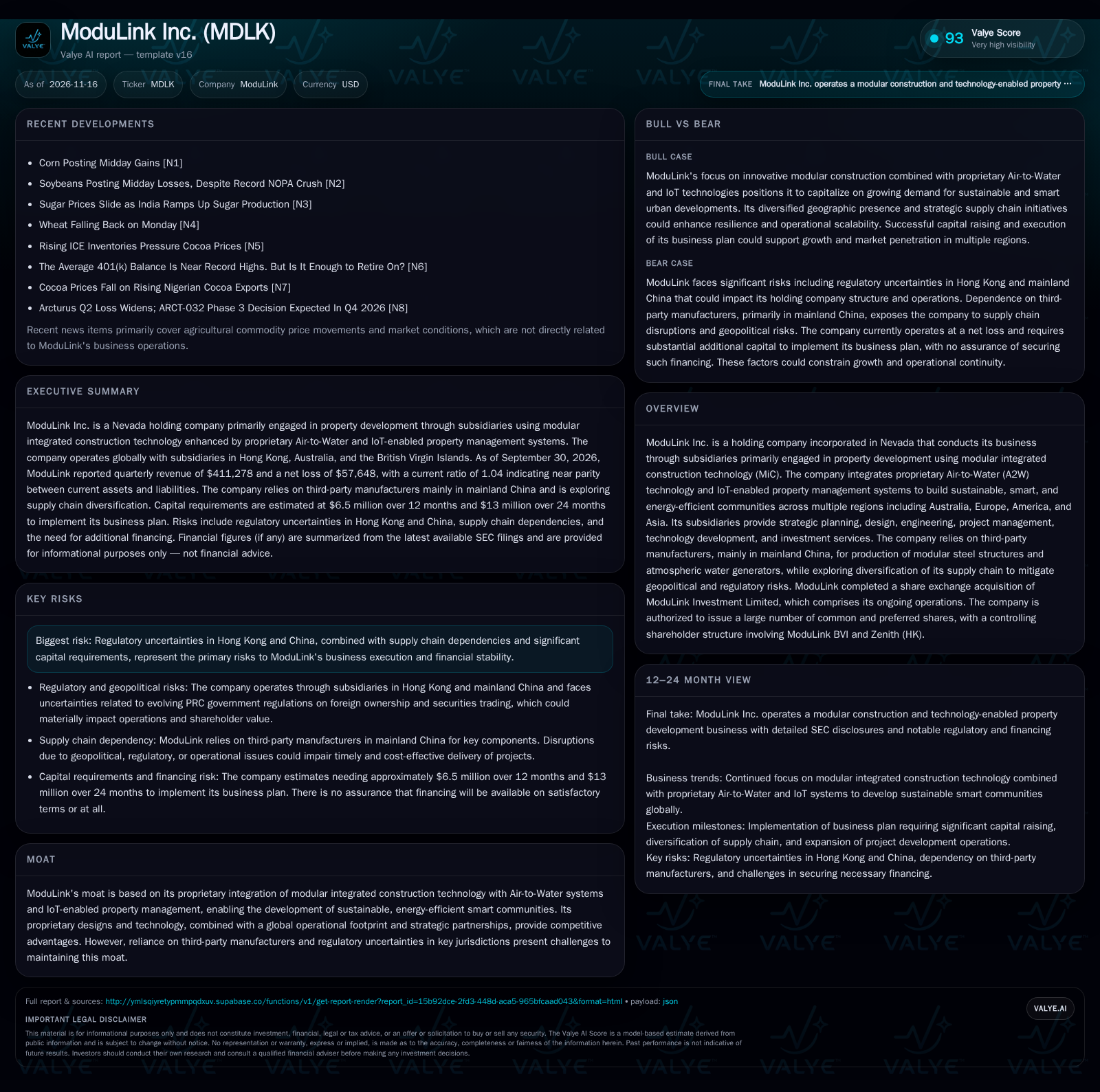
ModuLink Inc. blends modular construction with proprietary Air-to-Water and IoT technologies, aiming to address smart, sustainable community development across global markets. Recent margin improvements and a pivot toward service-based offerings highlight potential, but execution depends on financing, supply chain resilience, and navigating regulatory exposure in China and Hong Kong.
ModuLink Inc. develops smart, modular communities leveraging proprietary technologies and a network of subsidiaries across Asia and Australia. Margin improvements from AI healthcare solutions and a strategic shift toward less capital-intensive service projects signal operational adaptation, but the company faces acute capital needs and regulatory uncertainties. Its path forward rests on securing financing, diversifying its supply chain, and scaling technology-enabled offerings while managing complex cross-border risks. [S2]
ModuLink Inc. stands at the intersection of property development, modular construction innovation, and smart community technology. Its recent results reflect both the operational promise of integrating proprietary Air-to-Water and IoT systems into real estate projects and the ongoing tension between capital requirements and margin improvement. A notable increase in gross profit, driven by higher-margin AI healthcare solutions, signals some success in diversifying revenue streams. Yet, ModuLink’s dependency on external manufacturing and the need for substantial new capital raise fundamental questions about its scalability and resilience amid regulatory and geopolitical uncertainty.
Recent Margin Expansion and Service Shift Define ModuLink’s 2026 Position
ModuLink Inc. reported quarterly revenue of $411,278 and a net loss of $57,648 for the period ending September 30, 2026, with a current ratio of 1.04—indicating near-equal short-term assets and liabilities. The nine-month gross profit rose to $182,694, up from $134,484 in the prior year, primarily due to the acquisition and integration of ASA Robotics Limited, whose AI healthcare solutions contributed higher margins to the consolidated results. The company’s cost of revenue declined as it completed a major design and management services project in Hong Kong, underscoring a strategic tilt toward less capital-intensive, service-based contracts. Meanwhile, ModuLink faces a pressing need for approximately $6.5 million in new capital over the next 12 months to execute its business plan, with no guarantee of successful fundraising. [S2]
How ModuLink’s Hybrid Model Could Generate Value—And Where Fixed Costs Loom
ModuLink’s business model is anchored in modular integrated construction (MiC) and the integration of proprietary Air-to-Water (A2W) and IoT-enabled management systems. Revenue streams span from traditional property development to service-based design, engineering, and project management contracts, and extend into technology-driven offerings such as AI healthcare solutions. The pivot toward service contracts, notably the Hong Kong design management engagement, has the potential to improve working capital dynamics by reducing upfront capital outlays and exposure to project-specific construction risk.
However, the company’s reliance on third-party manufacturers for core physical components—primarily in mainland China—introduces fixed and variable cost structures that are difficult to control directly. This supplier dependency means gross margins may remain sensitive to input price volatility, capacity constraints, and geopolitical disruptions. The addition of higher-margin, software-driven healthcare and smart living offerings could support blended margin expansion if these solutions scale, but the capital intensity of new project development and the need for significant up-front investment in technology and market entry remain high.
Operating leverage could improve if ModuLink successfully transitions more business toward asset-light services and technology licensing. Yet, with general and administrative expenses exceeding gross profit and ongoing net losses, the company’s path to positive operating leverage is not assured without disciplined cost control and successful capital raises.
Assessing ModuLink’s Edge in Smart Modular Construction—Advantages and Vulnerabilities
ModuLink’s competitive premise rests on its proprietary blend of modular construction, Air-to-Water systems, and IoT-enabled property management. This integration could offer real differentiation in markets seeking sustainable, energy-efficient, and technology-rich communities. In theory, such a platform approach can increase switching costs for property owners and managers by embedding proprietary systems into building infrastructure, potentially leading to longer-term service and maintenance relationships.
However, the market for modular construction and smart property management is increasingly crowded, with competitors ranging from established construction and engineering firms to technology startups and regional property developers. Many of these rivals may have greater balance sheet strength, local regulatory expertise, and more diversified supply chains. ModuLink’s current reliance on manufacturing in mainland China is a double-edged sword—potentially lowering costs but exposing the company to geopolitical risk and supply chain fragility.
The move into AI healthcare solutions introduces new competitors from medtech and digital health, where barriers to entry can be high and customer adoption cycles long. The extent to which ModuLink’s proprietary technology translates into defensible margins, recurring revenue, or network effects remains to be demonstrated at commercial scale.
Technology-Enabled Offerings Gain Traction and Capital Inflow Unlocks Expansion
In a favorable scenario, ModuLink successfully raises the $6.5 million required for the next 12 months, allowing it to accelerate both property development and the rollout of smart service offerings. Expansion of AI healthcare and IoT platforms could lead to higher-margin, recurring revenues if adoption by residential and institutional clients takes hold. The company’s ongoing diversification of its manufacturing base—reducing reliance on mainland China—could insulate it from geopolitical shocks, while continued project wins in service-based contracts improve cash conversion cycles and reduce overall capital risk.
Evidence supporting this scenario would include: successful completion of new financing rounds on attractive terms; a growing backlog or pipeline of service and technology contracts; margin expansion driven by a greater revenue mix from software and AI-enabled solutions; and visible progress in establishing manufacturing partnerships outside China. Early customer renewals, reference deployments, and ecosystem partnerships would further strengthen the case for scalable, defensible growth.
Incremental Progress Amid Capital Constraints and Supply Chain Rebalancing
The most plausible pathway for ModuLink involves gradual project execution, punctuated by periodic capital raises and ongoing efforts to diversify the supply chain. Revenue growth could remain lumpy, reflecting the project-based nature of real estate and modular construction, with margin improvement hinging on the scale and commercial acceptance of new technology-enabled offerings. The company may need to prioritize less capital-intensive service contracts, delaying larger property development ambitions until financing stabilizes.
Key confirming evidence would be steady revenue contributions from both property and service contracts, stabilization or modest improvement in gross margins, and incremental progress in supply chain diversification. Falsification would come from an inability to raise new capital, stalled project pipelines, or margin compression due to supply disruptions or intensified competition.
Regulatory Shocks or Financing Failure Force Retrenchment or Restructuring
In an adverse scenario, ModuLink is unable to secure the $6.5 million in required capital, forcing it to significantly curtail operations or delay project execution. A regulatory intervention in Hong Kong or China—such as new restrictions on foreign ownership or cross-border cash flows—could further impair its holding company structure and access to operating cash. Supply chain disruptions, such as export controls or lockdowns in mainland China, could halt project deliveries or inflate costs, eroding gross margins and accelerating cash burn.
Persistent net losses without a clear path to margin improvement or funding would reinforce the risk of retrenchment or even restructuring.
Milestones That Will Clarify ModuLink’s Path to Sustainable Growth
Progress toward securing the targeted $6.5 million in new funding—timing, terms, and investor composition will all be telling. [S2]
The proportion of revenue and gross profit derived from higher-margin AI healthcare and IoT-enabled service offerings, if disclosed, would help test the scalability of the technology pivot.
Updates on supply chain diversification—specifically, the establishment of manufacturing partnerships outside mainland China and their impact on cost and delivery timelines.
Backlog or pipeline visibility for service-based contracts, particularly in new geographies or verticals, as an indicator of demand and business model resilience.
Evidence of customer adoption or retention for proprietary Air-to-Water and smart management systems, such as repeat business or multi-year service agreements, if disclosed.
Gross margin trends by business segment, if segmented disclosure is provided, to validate the margin thesis and exposure to input cost pressures.
Regulatory developments in Hong Kong or China that could affect holding company structure, capital flows, or project execution.
Quarterly cash flow from operations and changes in working capital requirements, to assess near-term liquidity and operational flexibility.
Disclaimer: This is research-only, informational analysis and not investment advice. It may include AI-generated interpretation and general industry context. Always verify important details using primary sources.

Comments