
MDWerks Advances Proprietary RF Technology with Whiskey-as-a-Service Expansion
MDWerks’ latest quarter highlights growth in its patented rapid aging tech through Whiskey-as-a-Service, alongside liquidity challenges.
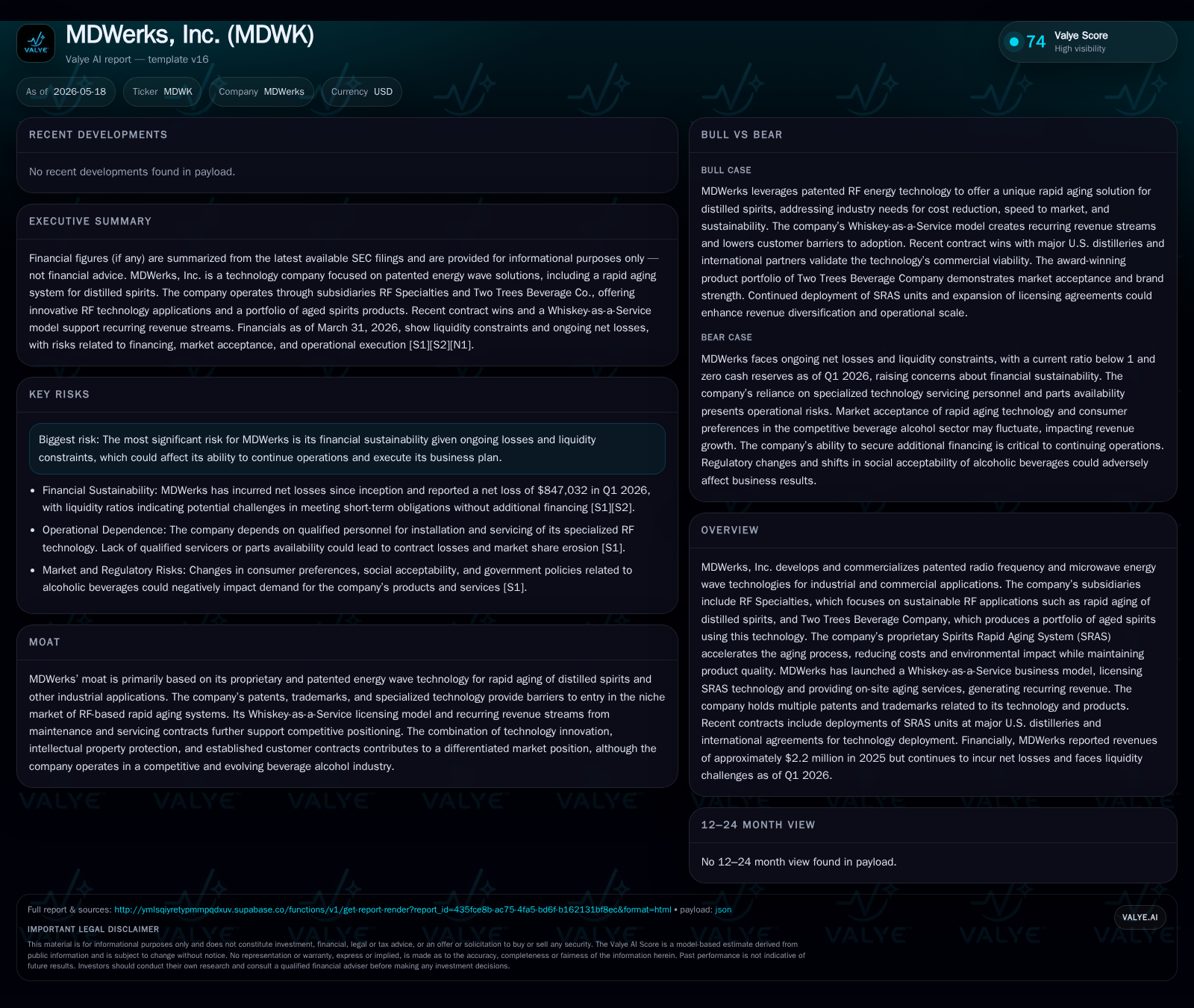
In its May 2026 quarter, MDWerks advanced commercial deployments of its patented Spirits Rapid Aging System (SRAS) and expanded its Whiskey-as-a-Service (WaaS) subscription licensing, securing multiple distillery contracts including international agreements. The company’s business model monetizes proprietary RF energy technology through technology licenses, recurring servicing fees, and production of aged spirits via subsidiaries. While innovative technology provides a differentiated position in the traditional beverage aging space, MDWerks faces significant liquidity constraints and operating losses that raise risks to scaling growth. Near-term catalysts include WaaS customer expansion and servicing capacity increases amid industry interest in sustainable and accelerated spirit maturation.
Latest Quarter Update and Why It Matters
MDWerks’ 10-Q filing dated May 15, 2026 reveals the company has pushed forward its commercialization of the Spirits Rapid Aging System (SRAS) through its signature Whiskey-as-a-Service (WaaS) business model [S2]. This model offers distillers access to the patented SRAS through technology licenses coupled with machine servicing contracts that generate recurring monthly revenues. Notably, recent developments include contract wins for deployment of SRAS units at major U.S. distilleries as well as an international agreement reported earlier this year [N1]. These agreements indicate growing market acceptance and provide greater near-term revenue visibility tied to the WaaS subscription structure.
This latest quarter positions MDWerks beyond pilot deployments into broader operational scaling. WaaS allows customers minimal upfront investment while the company secures longer-term predictable cash flows from licensing fees plus maintenance services executed by its subsidiary RF Specialties. The ongoing service obligation further creates switching costs that reinforce customer retention. Hence, this quarter's disclosures emphasize a key shift from technology development toward commercial deployment, marking a pivotal point for revenue growth trajectory.
MDWerks’ Business Model and Product Differentiation
At its core, MDWerks monetizes proprietary radio frequency (RF) and microwave energy wave technologies designed to enhance industrial processes via molecular targeting [S1]. A flagship application is the Spirits Rapid Aging System (SRAS), a patent-protected platform that accelerates distilled spirits aging by replicating barrel aging effects using targeted electromagnetic energy waves. Compared to traditional slow barrel aging costing significant time and energy resources, SRAS reduces both process duration and environmental footprint while maintaining flavor fidelity.
The company’s subsidiaries play strategic roles in this ecosystem: RF Specialties develops sustainable RF solutions and manufactures/services SRAS machinery, while Two Trees Beverage Company uses SRAS-based methods to produce over 50 SKUs of aged spirits, some winning industry awards [S1]. Two Trees acts as an internal proof-of-concept validating the commercial applicability of the technology within highly competitive craft spirits markets.
MDWerks’ Whiskey-as-a-Service framework further diversifies revenue streams by licensing access to SRAS units combined with ongoing machine maintenance contracts [S1]. This subscription-like modèle mitigates large capital expenditures for distillers seeking product innovation while locking in recurring license payments plus ancillary service revenues for MDWerks. The combination of intellectual property licensing plus managed services embeds customer switching costs due to specialized equipment servicing expertise required.
Industry Context: Competitive Landscape and Technological Barriers
The beverage alcohol industry’s traditional aging process is entrenched but ripe for innovation given premiumization trends demanding faster speed-to-market without quality dilution. MDWerks uniquely situates itself at the intersection of industrial radio frequency technology markets and beverage spirit maturation niches [S1]. Its molecular targeting approach using precise radio wave applications has few direct competitors due to the technical complexity involved.
Patents protect core SRAS technology components, erecting high barriers to entry particularly because sustained operational efficacy depends on skilled servicing personnel trained by their RF Specialties unit [S1]. This technical specialization creates inherent switching costs discouraging customers from defecting once embedded.
Nonetheless, risks persist from emerging alternative rapid aging methods or regulatory changes impacting beverage alcohol processing. Market dynamics also impose pressure as craft producers weigh adoption of unconventional aging techniques versus traditional brand heritage considerations.
Growth Drivers Supporting Demand and Adoption
Multiple factors underpin MDWerks’ growth prospects:
- Increasing Craft Spirit Innovation: The burgeoning craft segment seeks accelerated maturation methods to rapidly scale new products.
- Environmental Sustainability Trends: SRAS’s reduced energy consumption versus barrel-aging aligns with growing eco-conscious industrial mandates.
- Geographic Expansion: Recent international contracts broaden addressable markets beyond domestic U.S. distilleries [N1].
- Recurring Revenue Stability: WaaS licensing offers long-term predictable cash flow streams compared to one-off machinery sales [S2].
- Product Validation: Two Trees’ award-winning portfolio confirms consumer acceptance of rapid-aged spirits using proprietary technology [S1].
These drivers collectively support topping a virtuous cycle where additional license deployments enable economies of scale for machine manufacturing and servicing teams while fostering technological refinement.
Risks and Operational Constraints
Despite technological advances, MDWerks faces notable headwinds largely stemming from financial sustainability challenges:
- The company recorded net losses totaling approximately $3.8 million for fiscal year 2025 with an accumulated deficit exceeding $6 million [F1][S1].
- Liquidity concerns are acute: as of Q1 2026, current liabilities at roughly $2.75 million greatly outstrip current assets near $965 thousand resulting in a low current ratio of 0.35 [F1], underscoring short-term funding pressures.
- Net debt stood near $477 thousand constituting additional leverage against limited operational cash flows [F1].
- Execution risks hinge on maintaining a qualified technical workforce capable of installing and servicing complex SRAS machinery; shortages here could jeopardize contract fulfillment or client retention [S1].
- Broader market risks attach to evolving consumer preferences away from traditional or accelerated aging concepts along with potential adverse regulatory shifts regarding beverage alcohol processing standards.
An auditor’s going concern note highlights these vulnerabilities emphasizing the requirement for additional financing or cost restructuring to continue operations per established plans [S1].
Key Upcoming Milestones and What to Monitor Next
Investors and analysts should track several indicators to gauge MDWerks’ path forward:
- Rate and volume of new SRAS unit installations under WaaS agreements driving license fee revenue ramp [S2].
- Expansion velocity of WaaS subscriber base including international client onboarding milestones [N1][S2].
- Customer contract renewal rates indicating satisfaction levels around both product performance and servicing reliability.
- Progress in scaling internal servicing capacity critical to maintaining uptime commitments embedded within recurring revenue contracts.
- Announcements relating to financing rounds or credit facility enhancements addressing critical liquidity gaps highlighted at recent quarter-end.
- Regulatory developments affecting RF-based aging technologies or beverage alcohol product classifications could materially influence commercial prospects.
Meeting these milestones timely would reinforce confidence in commercial viability whereas any shortfalls might amplify financial stress risks.
Concise Financial Profile and Liquidity Analysis
MDWerks remains in a fragile financial position as reflected in its most recent SEC filings:
Annualized revenue remains modest relative to operating expenses; reported revenues were approximately $2.2 million for fiscal year 2025 with sustained operating losses around $3.7 million [F1][S1]. Balance sheet metrics at Q1 2026 reveal current liabilities outpacing assets by nearly threefold culminating in a liquidity crunch exemplified by a trailing-current ratio well below standard healthy thresholds at 0.35 [F1]. Net debt measured about $476 thousand compounds leverage concerns amidst stagnant cash balances historically measured at zero as per latest available data points [F1].
This analysis synthesizes information strictly drawn from recent SEC filings and verified news disclosures relating to MDWerks Inc., without investment research views or speculative statements.
Financial position in context
As of 2026-03-31, companyfacts shows $476841 of total debt [F1]. Companyfacts also indicates net debt of roughly $476841 for the latest available period [F1]. Current assets of $965410 and current liabilities of $3mm imply a current ratio near 0.35x for 2026-03-31 [F1].
Disclaimer: This is research-only, informational analysis and not investment advice. It may include AI-generated interpretation and general industry context. Always verify important details using primary sources.

Comments