
Mangoceuticals Confronts Nasdaq Compliance Deadline Amid Liquidity and Regulatory Challenges
The company's May 2026 quarterly filing highlights intensified pressure from Nasdaq's minimum bid price rule, liquidity constraints, and regulatory scrutiny over its compounding pharmaceutical business model.
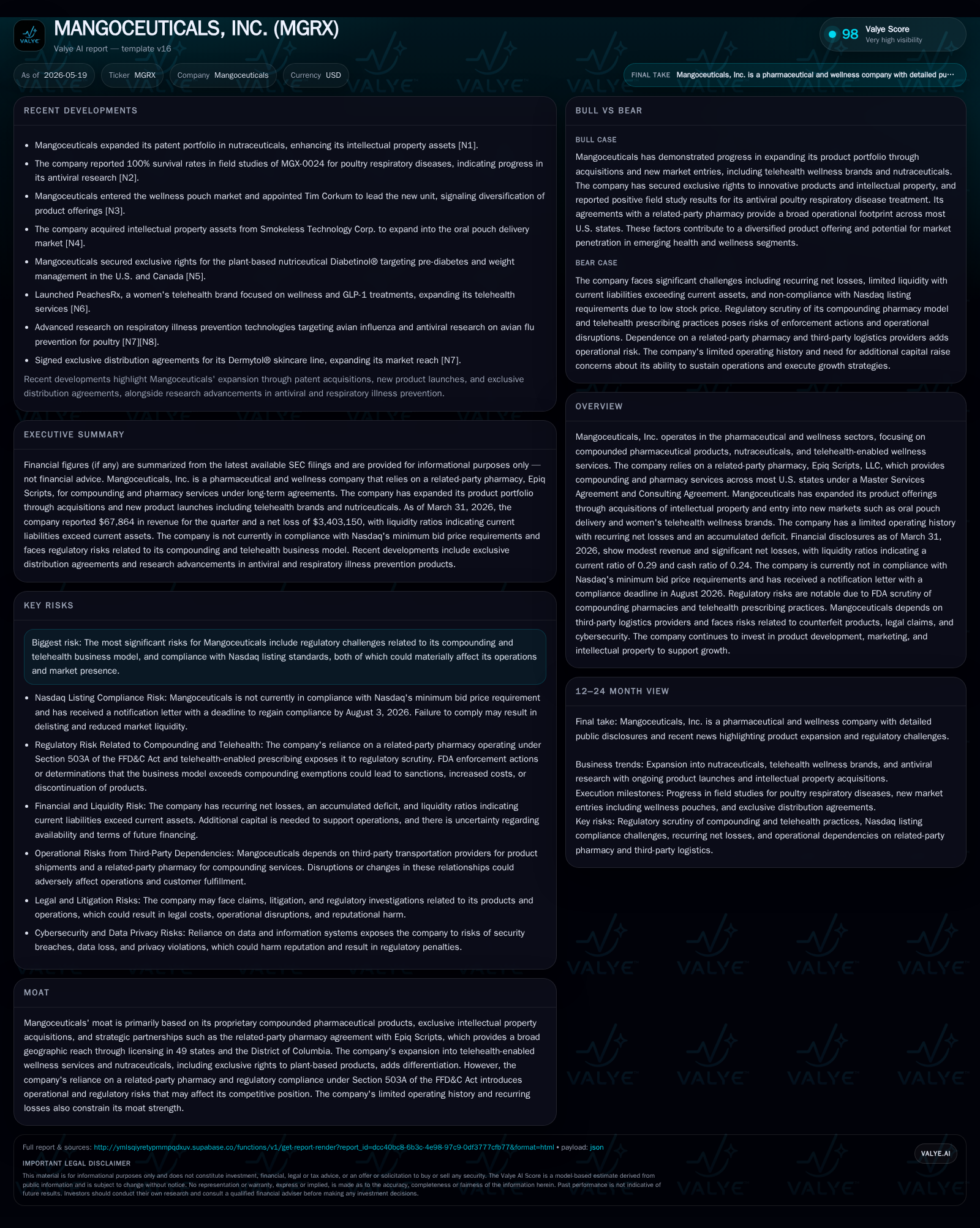
Mangoceuticals, Inc. disclosed in its latest 10-Q filing that it is at risk of Nasdaq delisting due to a sustained stock price below $1.00 per share, with an August 3, 2026 deadline to regain compliance. The company’s liquidity is constrained, with current assets of approximately $212K against liabilities exceeding $737K as of March 31, 2026. Its business hinges on compounded pharmaceuticals produced through a related-party arrangement with Epiq Scripts, LLC, operating under FDA Section 503A exemptions. Increasing FDA scrutiny of compounding practices and telehealth prescribing models raise regulatory risks. Growth initiatives include intellectual property acquisitions and telehealth-enabled wellness brands, but ongoing net losses and operational dependencies on related parties underscore financial and execution risks. Mangoceuticals must address near-term capital needs and regulatory compliance to sustain operations and market presence.
Latest Quarterly Operating Update: Nasdaq Compliance Risk and Liquidity Constraints
Mangoceuticals' May 19, 2026 quarterly filing ([S2]) reveals heightened challenges as the company faces Nasdaq’s notification of non-compliance with the minimum bid price requirement. Having traded below $1.00 per share for over thirty consecutive business days as of early February 2026, Mangoceuticals has until August 3, 2026 to restore compliance or risk delisting from the Nasdaq Capital Market. This situation threatens market liquidity and investor confidence.
Financially, the company exhibits strained liquidity at March 31, 2026 with current assets totaling approximately $212K against current liabilities exceeding $737K—yielding a critically low current ratio of 0.29 ([F1]). Cash and equivalents stood near $175K ([F1]), underscoring limited working capital availability to meet short-term obligations without additional financing or operational cash inflows.
No recent disclosures indicate new debt issuance or capital raises during this period. The company’s ongoing reliance on related-party transactions intensifies governance scrutiny during these financial pressures.
Business Model: Compounded Pharmaceuticals via Related-Party Pharmacy
Mangoceuticals primarily develops compounded pharmaceutical products through a Master Services Agreement with Epiq Scripts LLC—a related party owned in part by CEO Jacob Cohen ([S1]). Epiq Scripts maintains pharmacy licenses across all U.S. states except Alabama (, [S21]), enabling broad geographic reach for prescription fulfillment.
Its business focuses on producing patient-specific compounded medications under Section 503A of the Federal Food Drug & Cosmetic Act (FFD&C Act), leveraging niche demand unmet by mass-produced FDA-approved drugs. However, current revenue remains modest relative to operating losses ([F1]), reflecting early-stage commercialization during regulatory complexities.
Complementing this core are expansions into telehealth-enabled wellness services targeting women’s health and nutraceutical products based on plant-derived compounds (). Consulting agreements involving Epiq Scripts personnel facilitate research and development efforts for novel delivery formats such as oral pouches and synthetic blends; some consultants receive equity compensation contingent on product launch milestones ([S1], [S3]).
Industry Context: Regulatory Scrutiny and Competitive Challenges
Pharmaceutical compounding resides at an intersection between personalized pharmacy services and drug manufacturing regulation. Mangoceuticals’ model depends on navigating the fine line delineated by FDA guidelines for Section 503A exemptions.
Recent FDA enforcement has expanded beyond GLP-1-based therapies to scrutinize compounding pharmacies whose practices resemble drug manufacturing—particularly those using bulk substances without bona fide patient prescriptions or marketing compounded drugs as substitutes for approved treatments ([S12]). This elevates compliance risk for Mangoceuticals given its telehealth-enabled prescribing framework.
Competition is fragmented with no dominant players possessing scale comparable to national retail or mail-order pharmacies. Mangoceuticals differentiates through proprietary intellectual property acquisitions combined with telehealth integration but faces operational limits due to capacity constraints inherent in customized compounding.
Growth Drivers: Intellectual Property Expansion and Telehealth Integration
The company’s growth strategy hinges on acquiring novel intellectual property assets while expanding its telehealth-enabled wellness portfolio (, [S3]). Consultant equity incentives linked to successful product category launches align interests but require effective management execution ([S1]).
Emerging product lines such as oral pouch delivery systems target consumer-friendly drug formats with growth potential not widely addressed by competitors.
Licensing through Epiq Scripts’ multi-state pharmacy network provides operational flexibility pending licensure completion in Alabama ().
Successful marketing execution and regulatory adherence remain critical prerequisites for translating these initiatives into meaningful revenue increases amidst historically limited sales volumes.
Risks: Regulatory Uncertainties, Related-Party Dependencies, Listing Threats, and Financial Constraints
Regulatory risk is paramount; if the FDA determines Mangoceuticals’ compounding activities fall outside Section 503A exemptions or disallows telehealth prescribing practices used by the company, it could face forced cessation or costly restructuring of operations ([S12], [S13], [S19]).
The company’s reliance on related-party arrangements controlled by senior management introduces potential conflicts of interest and operational concentration risks ([S1], [S19]).
Nasdaq delisting risk due to persistent low stock price threatens capital access and investor confidence ([S2], [S26]).
Product liability exposure exists given use of unapproved compounded drugs including ingredients such as Sildenafil; adverse events could lead to litigation or recalls impacting reputation and financial condition ([S16]).
Operating losses nearing $20 million annually limit capacity for investment in marketing or R&D needed for sustainable growth; liquidity constraints compound these challenges ([F1]).
Key Milestones to Watch: Nasdaq Deadline, Product Launches, Cash Flow Management
The August 3, 2026 deadline for Nasdaq bid price compliance is a critical juncture determining continued listing status and trading liquidity ([S2]).
Product launch milestones tied to consultant equity vesting offer indicators of pipeline progress aligned with strategic growth objectives ([S1], [S3]).
Investors should monitor evolving FDA guidance concerning compounding pharmacy regulations and telehealth prescribing standards given their direct impact on Mangoceuticals’ business model.
Financial Snapshot: Modest Revenue Amid Substantial Losses and Tight Liquidity
As of March 31, 2026, cash balances stood at about $175K against current liabilities exceeding $737K resulting in a weak liquidity profile (current ratio: 0.29) that underscores urgent funding needs ([F1]).
Total debt remains relatively low at around $150K as last measured December 31, 2024 but no recent borrowing activity has been reported ([F1]), implying limited leverage capacity.
Overall financial results reinforce that despite innovative product initiatives anchored by intellectual property acquisition and telehealth synergies, Mangoceuticals faces pressing liquidity constraints alongside significant regulatory uncertainties that must be resolved imminently to sustain operations.
Disclaimer: This is research-only, informational analysis and not investment advice. It may include AI-generated interpretation and general industry context. Always verify important details using primary sources.

Comments