
Maitong Sunshine Cultivates Integrated Cultural Offerings Amid Competitive Pressures
MGSD advances its cultural tourism, product distribution, and arts exposition initiatives despite liquidity challenges and intense market competition.
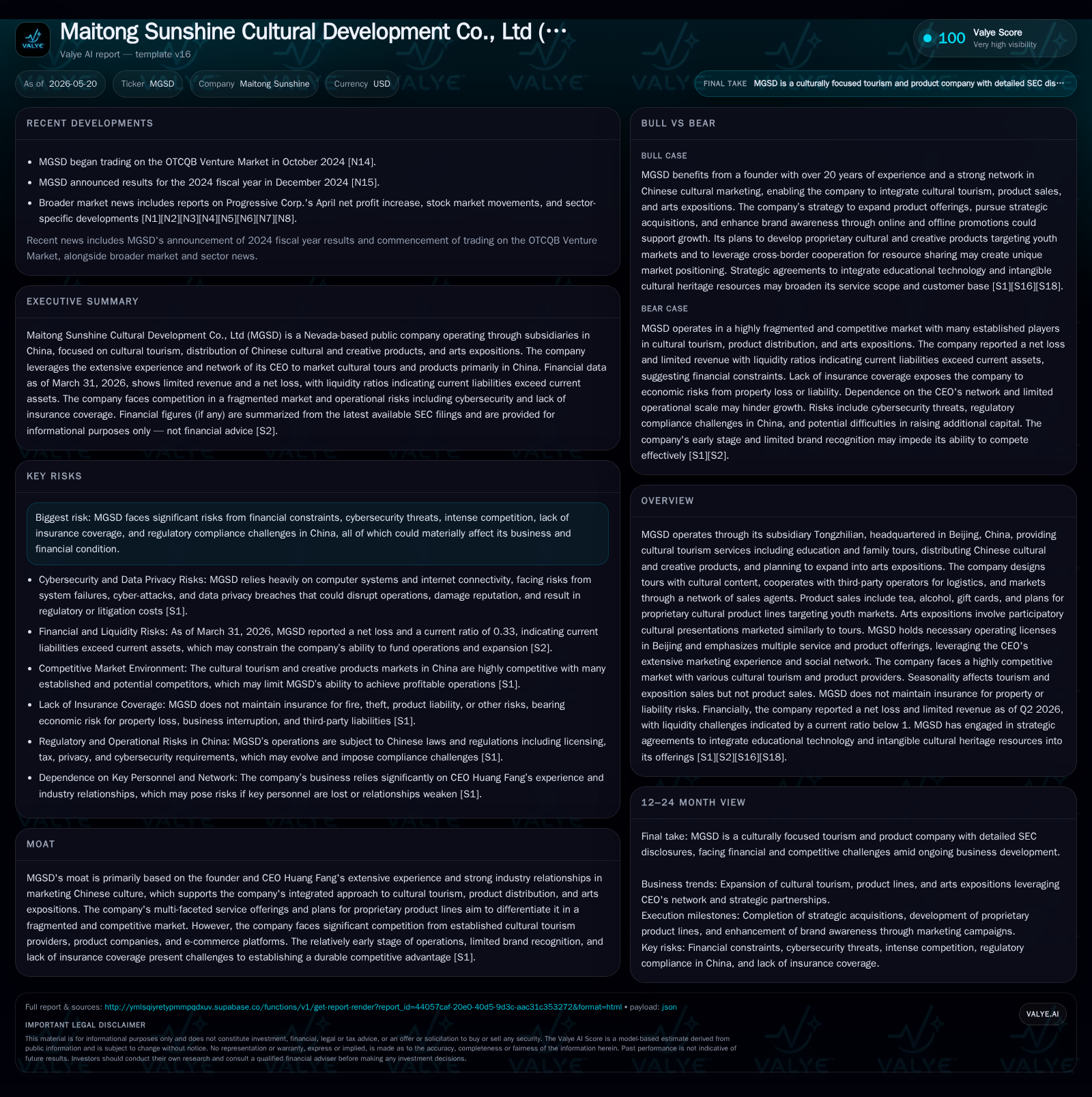
In its May 2026 quarterly filing, Maitong Sunshine Cultural Development Co., Ltd (MGSD) reported no material changes in risk factors but revealed ongoing liquidity strain with a current ratio of 0.33 as of March 31, 2026. Operating primarily through its Beijing subsidiary Tongzhilian, MGSD combines cultural tourism services with the distribution of Chinese cultural products and plans to expand into arts expositions. The business leverages CEO Huang Fang’s extensive marketing network to differentiate in a highly fragmented and competitive environment dominated by regional providers, franchise operators, and large e-commerce platforms. Growth strategies focus on expanding proprietary cultural product lines aimed at younger consumers, scaling tour offerings, and developing participatory arts expositions. Significant risks include cybersecurity threats, regulatory unpredictability in China, severe liquidity constraints, lack of insurance coverages, and fierce competition that could limit margin expansion.
Latest Quarterly Operating Update
Maitong Sunshine Cultural Development Co., Ltd (MGSD) filed its latest quarterly report (10-Q) on May 20, 2026 [S2]. The filing indicates compliance with SEC electronic filing requirements over the past year but reports no material changes in risk factors since the annual report dated January 9, 2026 [S1], [S18]. Financially, the company remains under significant liquidity pressure: as of March 31, 2026, cash and equivalents were just $1,710 while current liabilities stood at $431,810 versus current assets of $144,522—yielding a constrained current ratio of approximately 0.33 [F1]. This level suggests potential near-term working capital challenges that could impact operational flexibility unless addressed by financing or operational improvements.
There is no indication of litigation or regulatory actions adversely impacting MGSD currently [S4]. However, sustained liquidity strain raises concerns about ongoing business continuity without corrective measures.
Business Model and Service Portfolio
MGSD’s core operations are conducted via its wholly owned Beijing subsidiary Tongzhilian Cultural Development Co., Ltd. Tongzhilian’s business focuses on providing culturally themed tourism services including education-focused tours and family tours tailored around Chinese cultural heritage [S1], [S3]. These tours are characterized by detailed cultural content design led by Tongzhilian while relying on partnerships with third-party tour operators or travel agents for logistics such as accommodation and meals. Marketing is executed through a distributed network of sales agents carefully organized by MGSD’s staff using CEO Huang Fang’s deep contacts within China’s culture marketing sphere [S1], [S5]. This agent-based distribution leverages strong social relationships to drive customer engagement—a critical moat given the fragmented industry.
Beyond tours, Tongzhilian entered product distribution in late fiscal 2024 with offerings such as tea varieties (including specialty teas), Chinese alcoholic beverages aligned with cultural tastes, and gift cards redeemable for food items like crab and meat [S25]. These product lines serve dual functions: diversifying revenue streams beyond tourism services while facilitating brand recognition through tangible goods reflecting Chinese heritage.
Looking ahead in fiscal 2026, MGSD plans to launch proprietary designs for cultural and creative products targeted at youth demographics that incorporate contemporary icons overlaying traditional motifs—indicating an intent to establish recognizable owned brands alongside being a distributor [S25]. Furthermore, MGSD intends to expand into arts expositions characterized by participatory artistic activities like painting exhibitions coupled with interactive audience participation, dance competitions, choir contests, and variety shows [S25]. These events will be marketed through the same agent network ensuring cross-leveraging between service segments.
Competitive Environment and Industry Dynamics
The landscape for cultural tourism services in China is notably fragmented with players ranging from large franchise operators with national footprints down to numerous small regional or local independent providers present across nearly every city [S19]. Low barriers to entry mean intense price competition coexists with fragmentation of service quality levels.
Similarly competitive dynamics apply to the distribution market for Chinese cultural and creative products where traditional retailers coexist alongside expanding e-commerce platforms. MGSD faces competition not only from specialized cultural product firms but also broader art retailers and mass-market suppliers like stationery manufacturers who vie for consumer attention in home goods categories using regional or classical themes [S19].
Critical competitive differentiators revolve around:
- Product attractiveness and quality,
- Sales and marketing effectiveness,
- Pricing strategy,
- Brand awareness/reputation,
- Management experience.
In this environment without dominant scale advantages or established brand recognition yet MGSD aims to carve out positioning based on integrated service-product offerings combined with Huang Fang’s experienced network leveraging deep cultural marketing know-how, [S19].
Growth Drivers: Strategy and Market Opportunities
MGSD has outlined clear growth pillars supporting medium-term expansion:
Proprietary product development: Designing own lines of creative cultural products targeting younger consumers aims to build brands beyond reselling third-party products [S25]. Success here depends on effective design partnerships along with contract manufacturing scalability.
Service portfolio expansion: Growth plans include developing exclusive tours created entirely by Tongzhilian rather than just acting as designer/marketing partner to external operators. Expanded offerings seek more customer ownership of experiences enhancing margins. Additionally planned growth in arts expositions will add recurring event-driven revenues from participatory cultural showcases leveraging existing sales channels.
Cross-border cooperation: Strategic alliances bring access to complementary intangible cultural heritage resources such as Qiannan Yunxiang’s embroidery craftsmanship, silver jewelry making traditions, theatrical singing styles of ethnic groups alongside ecological tea gardens showcased in integrated themed tours. Such partnerships augment content differentiation capability considerably compared to commoditized weekend tour options [S11],.
This multi-pronged approach attempts revenue diversification from single-tour dependence toward richer experiential bundles combining education/culture/product engagement. However early stage projects like arts expositions require significant upfront investment relative to expected ramp timelines.
Risks and Operational Constraints
Several prominent risks cloud MGSD's outlook:
Liquidity risks: The notably weak current ratio (0.33) highlights vulnerability surrounding working capital adequacy for day-to-day obligations absent timely capital infusion or operational cash flow improvement [F1]. Chronic undercapitalization may impair supplier relations or agent incentives.
Cybersecurity exposures: Reliance on digital platforms for customer data processing combined with partnership dependencies exposes MGSD to cyber threats ranging from external attacks to internal control gaps. Failure here could disrupt operations materially damaging reputation while incurring regulatory penalties given evolving PRC data regulations [S8], [S27].
Regulatory uncertainty: Operating entirely within the PRC subjects MGSD to a complex regulatory landscape prone to abrupt government interventions especially in culturally sensitive or foreign-listed entities contexts. Laws governing tourism licenses, online data management and foreign investment require vigilant compliance efforts amid unpredictable policy shifts that may constrain business continuity or capital markets access [S7], [S14], [S16].
Lack of insurance coverage: MGSD discloses it currently carries no fire/theft/product liability insurance thereby exposing itself fully economically against property losses or third-party claims which could exacerbate operating losses during adverse events [S9].
Competitive margins: The crowded market means pricing power is limited; success depends highly on effective marketing personalization plus service-product innovation which remain unproven beyond CEO's individual influence factor decade-long experience, [S19]
Near-Term Watchpoints and Execution Milestones
Investor focus should track several upcoming developments:
Operating performance trends: Monitoring quarterly tour booking growth rates relative to prior periods will illuminate traction gained from proprietary versus partnered tours.
Product sales evolution: Adoption rates for newly launched proprietary branded goods alongside shifts in mix toward higher-margin items remain key leading indicators.
Arts exposition rollout: The pace at which participating venues are secured along with attendance figures from initial exhibitions will validate this newer revenue stream potential given required coordination efforts across stakeholders.
Capital structure adjustments: Evidence of successful capital raises or strategic acquisitions—e.g., integration progress on AI education tech firm Huayufeng if completed—would indicate enhanced resource availability addressing funding constraints critical for sustaining growth investments [S26].
Brand penetration metrics: Brand awareness improvements via offline/online marketing programs should be measurable potentially via qualitative feedback from sales agents or customer repeat rate metrics disclosed later.
Financial Profile Summary
MGSD reveals significant liquidity constraints as of Q1 FY2026 end: only $1,710 cash & equivalents against short-term liabilities over $431k resulting in a precarious current ratio near one-third (0.33) which denotes acute working capital shortages likely limiting operational flexibility absent refinancing support or accelerated cash flow generation from operations [F1], [S2].
This analysis utilizes MGSD's SEC disclosures primarily from the latest quarterly (May 2026) and annual (January 2026) filings supplemented by company facts data through Q1 FY2026 end. It evaluates business model nuances within the context of China’s competitive cultural tourism and creative product industries without speculative financial forecasting or investment advice.
Disclaimer: This is research-only, informational analysis and not investment advice. It may include AI-generated interpretation and general industry context. Always verify important details using primary sources.

Comments