
Marblegate Capital Corp Expands Fleet Amid Increased Long-Term Debt and Operational Integration
Latest quarter highlights the consolidation of Signal Taxi operations and material rise in fleet investments, underscoring growth ambitions in NYC's regulated taxi medallion market.
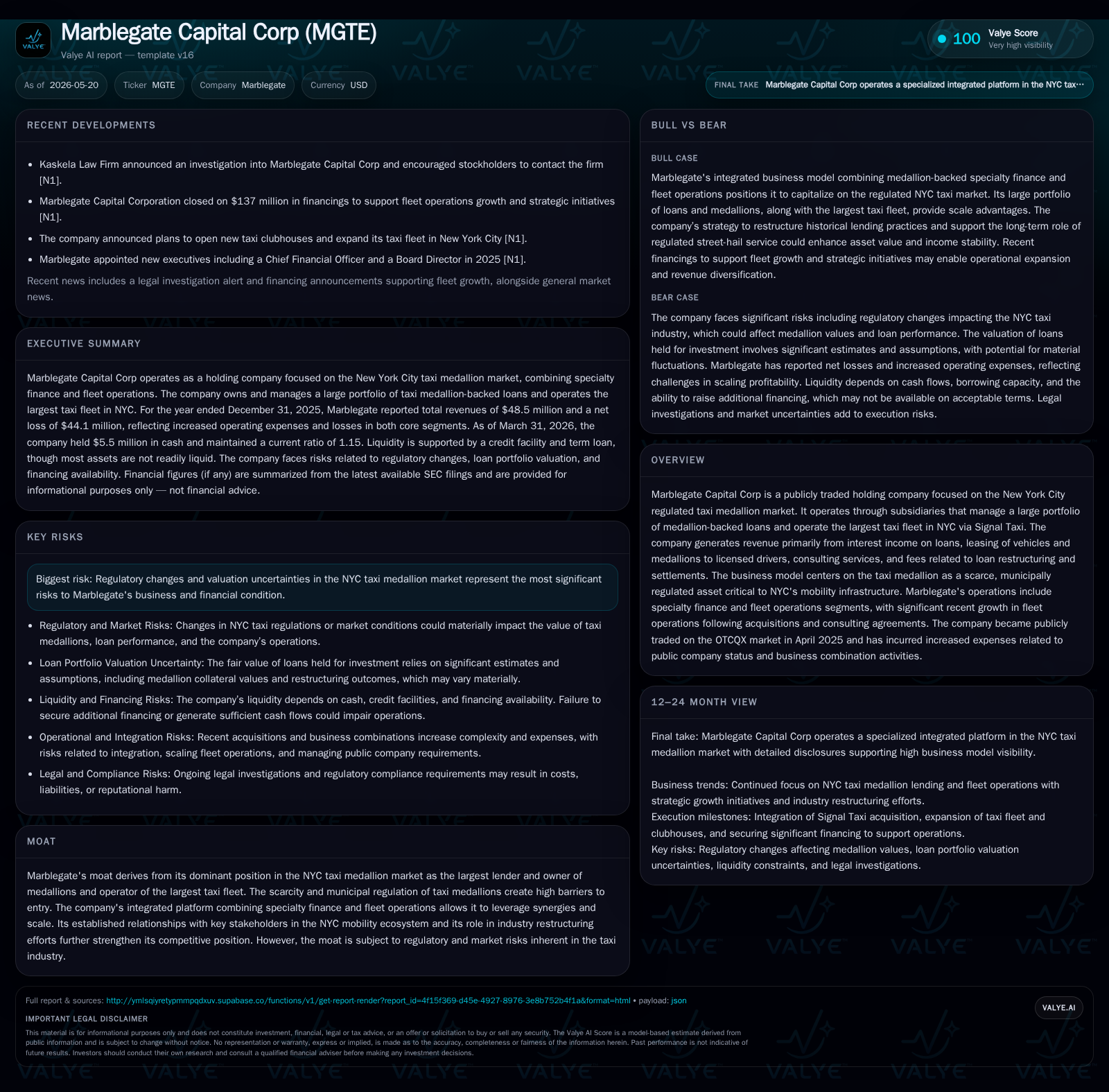
Marblegate Capital Corp reported a significant operational update in its latest quarter ending March 2026, marked by the acquisition and integration of Signal Taxi, which contributed to a sharp increase in taxi vehicles. This expansion has driven up capital expenditures and long-term borrowing but also presented a notable decline in cash from operations influenced by acquisition-related non-cash adjustments and lower interest income. Marblegate’s business model leverages its dominant position in New York City's highly regulated taxi medallion ecosystem, combining specialty finance with fleet operations. However, risks from regulatory shifts, asset valuation uncertainties, and reliance on third-party providers remain substantial. The company’s growth trajectory depends heavily on scaling fleet profitability and managing credit risk amid evolving industry dynamics.
Recent Operating Update
Marblegate Capital Corp’s latest quarterly filing dated May 14, 2026 [S2] paints a picture of active expansion within the New York City taxi medallion industry. The quarter included a pivotal acquisition: consolidation of Signal Taxi’s fleet operations. This integration triggered an $8 million non-cash derecognition related to deposit liabilities that significantly dampened net cash provided by operating activities—falling by 89% YoY to roughly $1.2 million. Interest income also declined by about $1.7 million during this period [S2], reflecting challenges within the lending portfolio.
Capital expenditures surged sharply as Marblegate invested nearly $38 million in purchasing new taxi vehicles—a strategic move to augment their fleet size during growing demand for managed taxi services. Additionally, the company acquired TML IV LLC assets for approximately $15.9 million [S4][S14], enhancing its specialty finance portfolio with additional medallion-backed loans.
To finance these sizable investments, Marblegate increased long-term borrowings by over $40 million during the quarter [S14]. The company now holds roughly $15.9 million in total debt as of March 31, 2026 [F1]. Liquidity remains supported with cash & equivalents at $5.5 million and a current ratio of approximately 1.15 [F1].
Business Model
Marblegate Capital operates as a publicly traded holding company centered on the regulated New York City taxi medallion market [S1]. Its core revenue streams arise from four main sources:
- Interest Income: Generated through loans secured by NYC taxi medallions made predominantly to individual owners/operators or investors who typically lack access to traditional financing.
- Leasing Income: From vehicles and medallions leased out to licensed drivers operating under their largest affiliated taxi fleet, Signal Taxi.
- Consulting Services & Fees: Related to loan restructuring arrangements and settlements designed to manage borrower defaults or delinquencies.
- Fleet Operations: Ownership and management of one of NYC’s largest taxi fleets through subsidiary operations.
The company’s specialty finance segment focuses on underwriting riskier borrowers—mostly small businesses or sole proprietors—with collateralized liens against scarce taxi medallions that are strictly limited by municipal regulation. This scarcity lends tangible asset backing but introduces valuation uncertainty heightened by ongoing regulatory scrutiny [S17][S27].
Integration between specialty finance and fleet operations allows Marblegate to create synergies: leveraging proprietary market insights from loan portfolios into operational decisions and fleet scale economies through dedicated service providers [S1]. However, this model also depends heavily on reliability and compliance from multiple third-party vendors managing vehicle garages, repairs, and fleet logistics—a potential operational risk given reduced direct control over such functions [S1].
Industry Structure & Competitive Position
The NYC taxi medallion industry is defined by extreme regulation limiting supply through fixed medallion issuance controlled municipally—this creates very high entry barriers for new competitors or lenders outside incumbent circles. Marblegate has positioned itself as the largest lender owning an expansive portfolio of medallion-backed loans alongside being the biggest fleet operator via Signal Taxi [S1].
This dual role establishes a competitive moat anchored in:
- Asset Scarcity: Medallions are municipal licenses with limited availability; their controlled issuance drives demand for secondary financing.
- Scale & Integration: Synergies from combining frontline fleet operations with credit risk management help optimize pricing and utilization.
- Industry Relationships: Established ties with regulators, brokers, drivers, and investors solidify Marblegate’s ecosystem influence.
Despite these strengths, broader pressures come from alternative mobility options (e.g., rideshare platforms), evolving urban transportation policies, and tightening small-business credit regulations impacting borrower profiles [S17]. Furthermore, specialized lending markets like this are inherently risky due to borrower concentration among individual operators without audited financials [S1].
Growth Drivers
Marblegate’s primary growth avenues align closely with expanding its integrated platform footprint:
- Fleet Scaling: Continued investment in new taxi vehicles expands revenue-generating assets for leasing operations; recent purchases near $38 million underscore intent to capture increasing market share in street-level taxi services.
- Loan Portfolio Expansion: Adding MRP+ loan collateralized assets into structured financing facilities increases borrowing capacity under secured revolving credit lines—a source for funding further fleet growth or acquisitions [S7][S8].
- Operating Efficiencies: Leveraging third-party specialists for maintenance and garage access while focusing internal resources on capital allocation may improve margins over time.
- Loan Restructuring & Consulting Fees: Managing delinquencies actively provides fee income streams amid borrower repayment challenges.
These drivers benefit from structural moats around medallion scarcity but depend heavily on maintaining robust collections infrastructure and mitigating default risks endemic in lending to small owner/operators without traditional credit profiles [S1]. Realizing profitable scale in fleet operations also requires mastering regulatory compliance and cost-efficient maintenance across a dispersed vehicle base.
Risks / Watchpoints / Growth Constraints
Significant risks temper Marblegate’s outlook:
- Regulatory Changes: New laws tightening small-business lending disclosures or altering medallion market rules could materially affect loan underwriting criteria or limit competitive practices [S17].
- Credit Quality & Loan Delinquencies: The borrower base largely consists of speculative risk profiles prone to default; any deterioration impacts collateral values severely given reliance on medallions as security [S1][S28].
- Cybersecurity Vulnerabilities: Reliance on IT systems across own operations plus third-party providers exposes the company to potential business disruptions or data breaches that could induce reputational damage or regulatory penalties [S1].
- Capital Structure Flexibility: Substantial indebtedness totaling approximately $15.9 million at end-Q1 2026 combined with restrictive covenants on debt ratios constrain financial maneuverability; breaches could trigger defaults accelerating repayment obligations [S6][S11][F1].
- Operational Control Risks: Dependence on external garage management and repair contractors reduces direct oversight; failure here could interrupt fleet availability or increase costs unexpectedly [S1].
Additionally, ongoing legal proceedings relating mostly to loan enforcement present contingent liabilities but none currently considered material [S17][S27]
Continued transparency around compliance with financial covenants tied to debt instruments will be essential amid rising leverage from recent financing activities.
Financial Profile Summary
At quarter end March 31, 2026, Marblegate held approximately $5.5 million in cash equivalents against total debt near $15.9 million resulting in a net debt position close to $10.4 million with a current ratio of about 1.15 indicating manageable near-term liquidity coverage [F1]. Operating income remains positive though modest at around $0.8 million based on prior annual reporting with recent net income impacted heavily by acquisition-related non-cash items leading to a reported net loss of approximately $44.9 million for fiscal year-end December 2025 [F1]. Significant capital spending drives investing cash outflows while financing activities reflect increasing borrowings aligned with asset expansion plans [S14][S26].
Long-term debt facility terms include borrowings secured against MRP+ loans placed into bankruptcy remote structures with priority liens alongside fixed-rate vehicle loans maturing in early 2029 subject to financial covenants geared towards maintaining minimum equity thresholds, debt service coverage ratios, and hedging requirements protecting interest rate exposures [S6][S12][S13]. Maintaining strict covenant compliance is critical given cross-default provisions potentially accelerating all outstanding obligations upon breach.[F1][S11][S16]
Disclaimer: This analysis is provided solely for informational purposes without any investment advice or research views. It reflects data available as of May 20, 2026.
Disclaimer: This is research-only, informational analysis and not investment advice. It may include AI-generated interpretation and general industry context. Always verify important details using primary sources.

Comments