
Metagenomi Strengthens Genome Editing Platform Amid Financial and Development Challenges
An emerging biotech specializing in genome editing scales R&D investments while contending with significant operating losses and capital requirements.
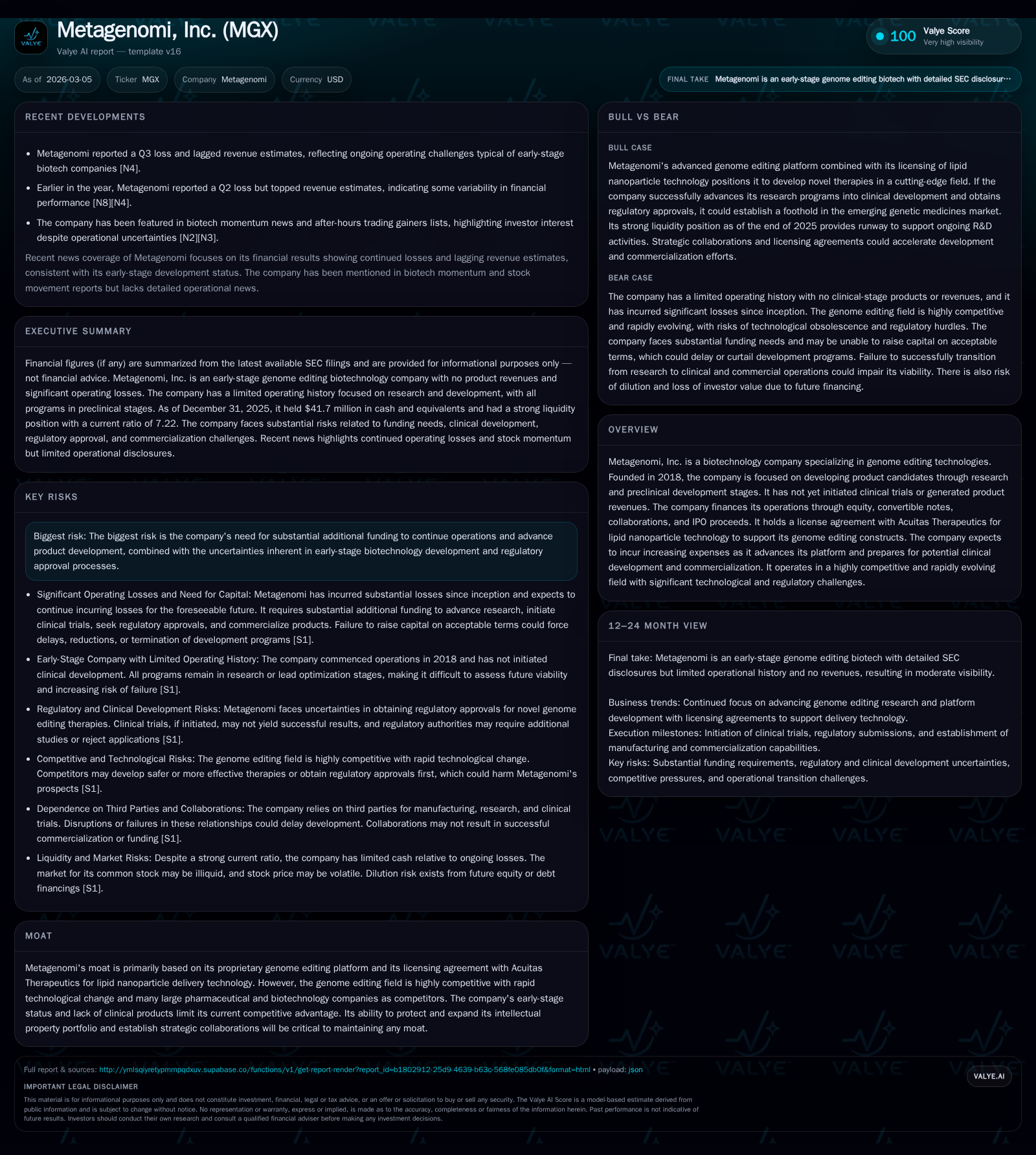
Metagenomi, Inc. is advancing its proprietary genome editing platform supported by a strategic lipid nanoparticle delivery license, focusing on preclinical product candidates without clinical-stage revenues. Operating losses deepened in 2025 alongside continued cash burn, though operating cash flow slightly improved due to cost management and streamlined capital expenditures. The company faces funding necessities to sustain research momentum amid regulatory complexities and intense competition. Key near-term milestones include regulatory filings that will signal the transition toward clinical development and commercial viability.
Financial Trajectory: Operating Losses and Capital Position Through 2025
Metagenomi's financial statements as of year-end 2025 reveal a company in an intense phase of research-driven investment without revenue generation from products. Operating income stood at a negative $96.0 million for FY2025, deepening by roughly 8% compared to a -$88.9 million loss in 2024 [F1]. Net income reflected a steeper deterioration with a -$87.9 million loss, worsening approximately 12.6% from the previous year’s -$78.1 million deficit [F1]. These widening losses primarily stem from escalating research and development expenses coupled with general administrative costs.
Operating cash flow (CFO), though still negative at -$88.9 million in 2025, improved by about 18.5% versus the prior fiscal year’s -$109 million outflow, indicating some effectiveness in managing operational expenses amidst scaling [F1]. Capital expenditures (Capex) decreased sharply by over 81%, falling from $3.1 million to just $0.57 million [F1]. This stark reduction aligns with Metagenomi’s focus on platform development concentrated on intangible assets such as intellectual property rather than physical facilities or equipment.
Liquidity remains solid with current assets totaling approximately $165.5 million against current liabilities of $23 million, producing an unusually strong current ratio of 7.22 as of December 31, 2025 [F1]. However, free cash flow continues in negative territory at about -$89.5 million (operating cash flow less capital expenditures), sustaining the firm’s dependence on external financing.
Historical performance (annual)
| FY | Net ($mm) | CFO ($mm) | OpInc ($mm) | Capex ($mm) | Net YoY |
|---|---|---|---|---|---|
| 2025 | -88 | -89 | -96 | 1 | -12.6% |
| 2024 | -78 | -109 | -89 | 3 |
Source: SEC companyfacts cache [F1].
Capital returns and efficiency (annual)
| FY | FCF ($mm) | ROE% |
|---|---|---|
| 2025 | -89 | -55.4 |
| 2024 | -112 | -33.2 |
Source: SEC companyfacts cache [F1].
Figures extracted from latest annual filing confirm expanding losses matched with concentrated expenditure on preclinical development rather than capex-intensive activities[F1].
Technological Foundation: Proprietary Genome Editing and Delivery Innovation
At the heart of Metagenomi's value proposition is its proprietary genome editing platform targeting precision gene modifications for therapeutic use [S1]. The company has secured a license agreement with Acuitas Therapeutics that provides access to advanced lipid nanoparticle (LNP) technology — a critical component for delivering genome editing constructs efficiently into cells in vivo [S1]. The synergy between their gene editing system and LNP delivery underpins their preclinical candidate pipeline development.
This integration addresses key challenges in safely delivering nucleic acid-based therapeutics systemically and positions Metagenomi competitively within genetic medicines.
Operational Expansion and R&D Investment Drivers
The surge in operating expenses corresponds closely with deliberate investments to recruit scientific talent across R&D functions as well as commercial operations groundwork preparatory to clinical advancement [S1]. Significant resources are also allocated towards maintaining intellectual property portfolios—including patent filings and legal defenses essential for competitive positioning.
Escalating research activities involve extensive laboratory experiments refining genome editing constructs and optimizing delivery mechanisms ahead of regulatory-enabling studies such as toxicology and pharmacodynamics evaluations customary before IND filings [S1]. This pattern reflects typical fixed-cost base buildup observed in early-stage biotech companies scaling preclinical pipelines.
Development Pipeline Status and Forward Looking Growth Catalysts
As disclosed through early 2026 [S3], Metagenomi remains entirely in preclinical development phases with no reported initiation of clinical trials. Future growth catalysts hinge heavily upon successful submission of Investigational New Drug applications enabling first-in-human trials—the traditional inflection point transitioning biotech firms into clinical stages.
Key indicators include formal communications regarding regulatory filings or approvals related to candidate advancement [S3], expansion of collaborative agreements leveraging platform capabilities, or demonstration of compelling safety/efficacy signals in advanced preclinical models.
Strategic Collaborations and Intellectual Property Considerations
The exclusive Acuitas license represents a strategic collaboration integral to Metagenomi’s technology stack [S1][S5][S6]. Maintaining such agreements is vital given their direct impact on therapeutic delivery feasibility—a known bottleneck in gene therapy fields.
However, intellectual property rights carry risks including potential patent infringement claims or validity challenges that could impose financial burdens or divert management focus [S8][S20][S29]. Disputes or conflicts with collaborators might disrupt development programs or limit commercial flexibility through restrictive exclusivity clauses or licensing terms [S5][S27].
Capital Structure, Funding Strategies, and Return Metrics
Metagenomi's capital structure includes proceeds raised via IPO liquidity events coupled with convertible promissory notes issued during financing rounds [S1]. In March 2025 they established a shelf registration allowing up to $250 million equity issuances plus an ATM sales agreement totaling $75 million capacity which remained unused through year-end 2025 [S1][F1].
At fiscal year-end 2025, the company held approximately $41.7 million in cash & equivalents against manageable short-term liabilities ($23M), but the burn rate indicates an imminent need for new financings before clinical validations materialize [F1]. Return metrics show a deeply negative return on equity near -55%, reflective of steep net losses relative to shareholders’ equity base around $158 million [F1]. No dividends or share repurchases have been made consistent with growth-stage biotech norms.
Risks From Funding Gaps, Regulatory Challenges, and Competitive Pressures
Risk disclosures highlight substantial uncertainties common among emerging genetic medicine developers including dependency on significant additional capital raises amidst volatile market conditions [S4–S9][S23].
Regulatory uncertainty remains high given novel technology modalities lacking extensive clinical precedent; FDA acceptance criteria around endpoints and safety margins may delay trial starts or approval timelines [S14–S16][S24].
Patent infringement claims or invalidation suits could lead to costly legal proceedings hindering freedom-to-operate or requiring onerous licenses impairing competitiveness [S20][S29]. Operational challenges such as supplier reliability issues or manufacturing validation delays also pose material threats [S7][S18]. Larger pharmaceutical competitors further intensify market pressures unless robust IP protection sustains differentiation.
Investment Outlook: Milestones to Watch and Potential Catalysts
With limited explicit company guidance beyond broad expense outlooks [S3], primary metrics warrant close monitoring:
- Timing of IND submissions signaling transition into clinical testing,
- Regulatory feedback potentially including requests for additional nonclinical studies or accelerated review designations,
- Expansion/diversification of partnerships enhancing technical capabilities or commercialization pathways,
- Progress in patent prosecution strengthening intellectual property barriers,
- Changes in cash runway projections indicating financing sufficiency or impending dilution.
Each milestone represents either potential risk mitigation fostering positive news flow or pivotal hurdles where delays may exacerbate valuation uncertainty typical at this stage.
This analysis draws exclusively upon disclosed financials and publicly available SEC documents up through early March 2026 without conjecture beyond presented data points. As characteristic for early-stage biotechs without commercial products or revenues realized yet, shareholders face heightened risk-reward tradeoffs pivoted on scientific validation progress combined with capital markets access dynamics.
Disclaimer: This is research-only, informational analysis and not investment advice. It may include AI-generated interpretation and general industry context. Always verify important details using primary sources.

Comments