
Merit Medical Systems' Earnings Resilience and Leadership Shift in 2025
Analyzing Merit Medical’s financial momentum and key leadership transition as pivotal influences on its future trajectory.
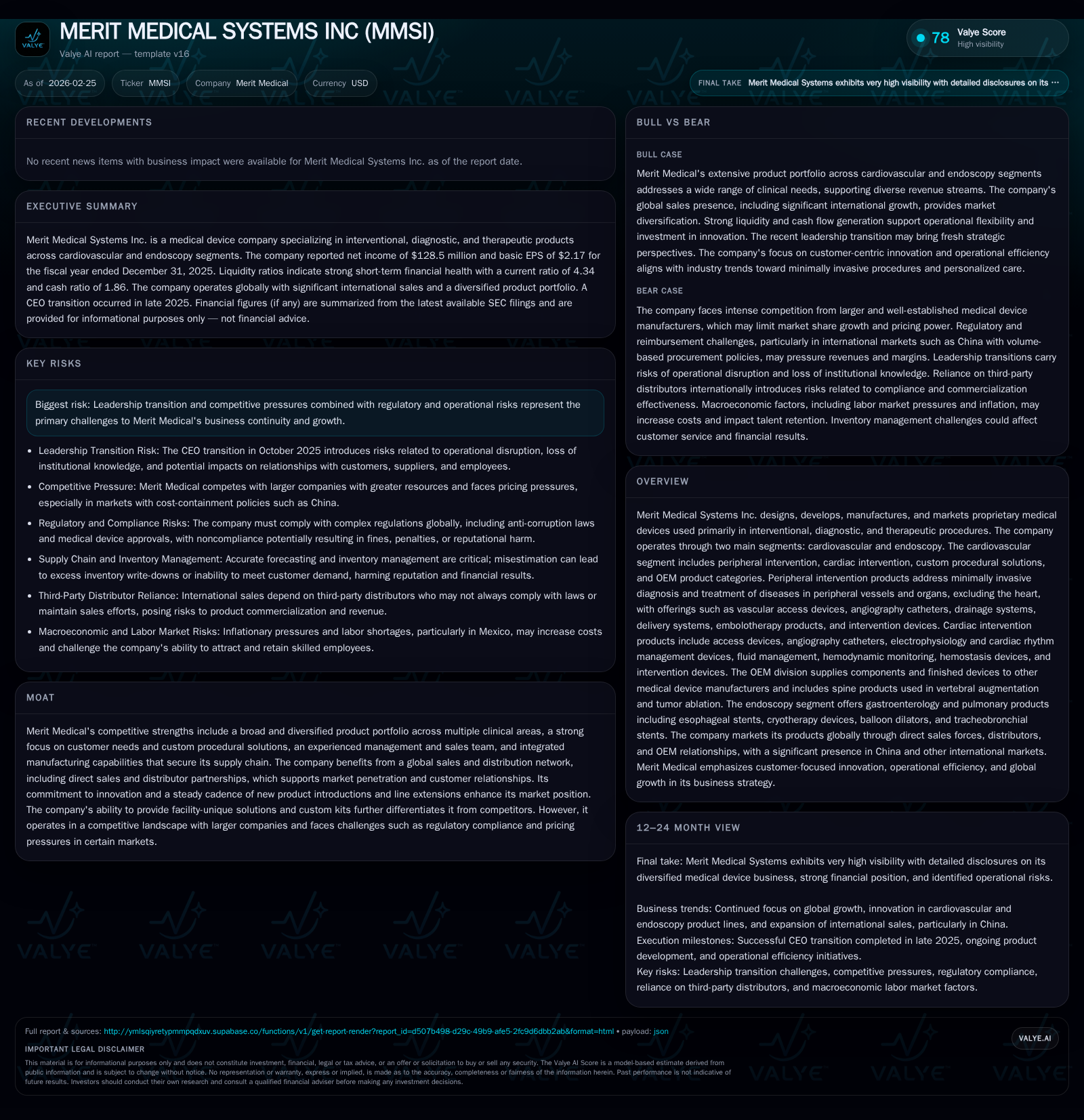
Merit Medical Systems demonstrated solid earnings growth in fiscal 2025, driven by its diversified cardiovascular and endoscopy product segments. The October 2025 CEO transition from founder Fred Lampropoulos to Martha Aronson introduces an important strategic inflection point, with the company emphasizing continuity amid competitive and regulatory pressures. Strong operating cash flow generation enabled increased capital investment, supporting product innovation to maintain market differentiation. Regulatory compliance and evolving reimbursement environments remain the chief external challenges impacting long-term growth prospects.
Revenue and Profit Growth Trends: Performance Insights up to 2025
Merit Medical Systems exhibited substantial financial momentum through the four most recent fiscal years ending December 31, 2025. Operating income notably accelerated by 18.6% from $155.7 million in FY2024 to $184.7 million in FY2025, illustrating robust earnings resilience despite macroeconomic and industry-specific challenges [F1]. Net income increased at a more moderate pace of approximately 6.8%, reaching $128.5 million in FY2025, signaling prudent management of operating expenses amid rising costs related to research & development (R&D) and selling, general & administrative (SG&A) functions [F1]. This divergence indicates an emphasis on strategic reinvestment to sustain innovation while maintaining profitability.
Historical performance (annual)
| FY | Net ($mm) | CFO ($mm) | OpInc ($mm) | Capex ($mm) | Net YoY |
|---|---|---|---|---|---|
| 2025 | 128 | 297 | 185 | 82 | +6.8% |
| 2024 | 120 | 221 | 156 | 35 | +27.5% |
| 2023 | 94 | 145 | 124 | 34 | +26.7% |
| 2022 | 75 | 114 | 88 | 45 |
Note: Omitted columns lack sufficient annual XBRL coverage in the provided tags (need ≥2 annual points): Rev, Div, Buybacks. Source: SEC companyfacts cache [F1].
Capital returns and efficiency (annual)
| FY | FCF ($mm) | ROE% |
|---|---|---|
| 2025 | 216 | 8.1 |
| 2024 | 186 | 8.7 |
| 2023 | 111 | 7.9 |
| 2022 | 69 | 6.5 |
Source: SEC companyfacts cache [F1].
Table: Merit Medical Systems Annual Financial Summary (FY2022–FY2025), sourced from [F1]. Metrics such as dividends and buybacks are omitted due to insufficient disclosed data.
The approximate return on equity rose modestly to about 8.1% in FY2025, indicative of steady shareholder equity utilization enhanced by solid net income growth [F1]. The company's current ratio stood resilient at over 4x at year-end, evidencing strong liquidity [F1]. These financial trends point toward an improving operating environment coupled with effective capital deployment strategies.
Product Segments Driving Merit’s Market Position
Merit Medical’s product portfolio spans two primary segments: cardiovascular and endoscopy, each addressing critical interventional, diagnostic, and therapeutic needs [S1][S29]. The cardiovascular segment encompasses specialized vascular access devices used for minimally invasive procedures targeting peripheral arterial and venous systems outside the heart—such as angiography catheters designed for high precision imaging guidance during interventional radiology procedures.
Within cardiac intervention, Merit’s toolkit includes electrophysiology catheters for arrhythmia ablation alongside hemodynamic monitoring equipment vital for cardiac rhythm management . Their custom procedural solutions model allows assembly of dedicated procedure kits tailored to specific clinical workflows, enhancing convenience and reducing supply chain complexity for healthcare providers.
Endoscopy products complement this offering by providing innovative disposable scopes and accessories for gastrointestinal interventions where sterility is paramount due to infectious risk profiles . This diversification across anatomical sites supports stable demand flows amidst shifting procedural volumes.
Merit’s integrated manufacturing operations reinforce supply chain control—a competitive moat critical given regulatory scrutiny and global logistics disruptions recurring across the medical device sector . Broad clinical use cases combined with frequent line extensions facilitate continuous market presence renewal.
Leadership Transition: Implications and Strategic Continuity
The October 3, 2025 resignation of founder Fred Lampropoulos as CEO marks a pivotal leadership change [S2]. Lampropoulos transitioned into the Executive Chairman role through early January 2026 before continuing as Board Chair, ensuring institutional knowledge remains influential post-transition.
Martha G. Aronson’s simultaneous appointment as CEO inaugurates a new generation of executive leadership tasked with preserving Merit Medical's customer-focused culture while executing on lean processes, product innovation cadence, and international expansion ambitions [S2]. Although succession planning appears deliberate and carefully managed, inherent risks arise including potential disruption to key stakeholder relationships or talent retention challenges during this handover period.
The company explicitly recognizes management continuity's importance in mitigating operational inefficiencies or strategy dilution risks that could otherwise impair competitive execution [S2]. Aronson's initial performance metrics under scrutiny will hinge on maintaining sales momentum within complex multi-product lines amid intensifying pricing pressures globally.
Capital Structure and Liquidity: Managing Debt and Funding Innovation
Merit Medical maintains a conservative liquidity position anchored by its Amended Fourth A&R Credit Agreement securing up to $850 million in credit facilities comprising revolving commitments alongside a $150 million term loan component [S4][S5][S6][F1]. As of December 31, 2025, no borrowings were outstanding under this credit line except for nominal letters of credit totaling approximately $2.8 million; availability remained around $697 million subject to leverage covenants compliance [S6].
A significant portion of leverage arises from the December 2023 issuance of $747.5 million convertible senior notes bearing a fixed coupon of 3%, maturing in early February 2029 [S5][S13]. This unsecured instrument provides funding flexibility with conversion options beginning October 2028 tied to share price triggers enabling potential dilution mitigation if conversion occurs.
The credit agreement imposes customary restrictive covenants limiting additional indebtedness levels (total net leverage ratio capped at five times EBITDA), liens creation, asset dispositions, dividend payments, or debt/equity transactions above approved thresholds [S10]. Merit was compliant with all covenants as of FY-end [S6][S10], signaling effective capital discipline.
Interest expense running at below $21 million annually coupled with ample liquidity buffers underpin manageable debt servicing obligations even amid incremental investment programs [S21][F1]. This balanced capital structure supports sustained R&D funding while preserving optionality against unforeseen macro-financial shocks.
Operational Cash Flow Strength and Investment Activity
Operating cash flow generation displayed consistent strength culminating in a sharp rise of approximately +34.7% during FY2025 to reach nearly $297 million [F1][S21]. This uptick reflects higher net income complemented by non-cash expenses including elevated stock-based compensation linked to equity grants responding positively to share price appreciation.
Capital expenditures more than doubled year-over-year from $35 million (FY2024) to $82 million (FY2025), primarily targeting property and equipment for manufacturing capacity expansion alongside incremental tooling investments linked to new product introductions [F1][S21].
Subtracting capex from CFO yields an estimated free cash flow figure near $215 million—a robust surplus enabling potential funding for internal growth projects without leaning heavily on external financing sources or divestitures.
This capital deployment pattern signals Merit entering an expansion phase focused on sustaining innovation pipeline vitality critical within highly regulated interventional device categories requiring frequent technological refreshes for clinical efficacy.
Market Challenges: Regulatory Risks and Competitive Dynamics
Merit faces entrenched operational risks embedded within FDA oversight frameworks governing design controls, post-market surveillance, labeling accuracy, adverse event reporting requirements as well as foreign jurisdictions adopting evolving medical device regulation such as Europe’s MDR regime enacted fully by May 2021 [S7][S8]. Compliance mandates escalate administrative burdens that may elevate product development cycle times or increase inspection-triggered corrective actions impacting time-to-market metrics.
The company also contends with potential exposure under the U.S. False Claims Acts arising from healthcare fraud allegations tied indirectly via reimbursement claims submitted by user hospitals [S7][S9][S16]. Although Merit’s five-year Corporate Integrity Agreement concluded formally in late October 2025 without ongoing restrictions after formal closure notices received January 23, 2026, historical compliance monitoring costs likely remain embedded internally [S8].
Price concession pressures persist intensely across regions such as China where volume-based procurement policies have reduced pricing since their introduction circa 2019–2020; these measures continue impacting revenue mix negatively despite expanding distributor networks serving more than five hundred hospital accounts nationally [S18]. Globally competitive dynamics include several larger multi-national medtech firms competing aggressively on pricing while pushing procedural adoption curves higher through bundled offerings fused with advanced digital solutions.
Ongoing litigation risks including intellectual property claims or product liability lawsuits further emphasize the prudence required in quality assurance regimes given invasive procedure applications characteristic of Merit’s devices [S9][S11]. Insufficient warranty reserves or recall contingencies could rapidly erode earnings if adverse events materialize unexpectedly.
Future Growth Outlook: Focus Areas and Potential Constraints
While explicit forward-looking guidance remains unpublished as per most recent filings up to early calendar year 2026, Merit’s strategic commentary underscores several foundational pillars expected to drive medium-term growth trajectories including:
- Continued development pace of proprietary medical devices augmented by targeted acquisitions,
- Expansion into emerging international markets balanced against local pricing regulation impacts,
- Deployment of custom kit assembly services enhancing customer retention via tailored procedural workflows,
- Strengthening direct sales force productivity domestically while leveraging distributor synergies abroad,
- Enhancing operational efficiency leveraging lean manufacturing principles lowering production unit costs whilst increasing asset utilization rates [S2].
Risks include talent acquisition cycles compounded by inflationary labor market conditions potentially constraining R&D throughput or sales team scaling under new executive leadership transitions. Maintaining cohesive corporate culture during CEO handover entails focused internal communications aimed at mitigating disruption effects noted previously.
Milestones to Monitor Through 2026–2027
Investors should watch quarterly earnings releases closely for signs of stabilizing or improved revenue trends under CEO Aronson’s stewardship beginning Q4 2025 onward as she gains full operational control beyond transitional period scheduled January 3, 2026. Additionally noteworthy will be tracking interest coverage ratios correlated with covenant thresholds given sizable convertible debt maturing early calendar year 2029 offers potential refinancing windows modified by prevailing capital market conditions.
Incremental product launches within core cardiovascular portfolios—particularly electrophysiology catheter enhancements—and commercial traction in Asia-Pacific markets will serve as tangible barometers for sustained innovative momentum. Monitoring inventory build levels relative to demand forecasts will indicate supply chain agility adapting responsively amidst logistic volatility.
From a governance perspective, follow-through regarding CSR initiatives embracing sustainability goals embedded within manufacturing footprint evolution attest increasingly important reputational assets influencing procurement decisions among institutional customers globally.[S14]
This analysis is based solely on publicly available information including SEC filings and company-provided disclosures as of February 25, 2026; it does not constitute investment advice or recommendations regarding the company’s securities or business outlook.
Disclaimer: This is research-only, informational analysis and not investment advice. It may include AI-generated interpretation and general industry context. Always verify important details using primary sources.

Comments