
Mills Music Trust: Royalty Streams, Copyright Expiry, and the Economics of a Passive Music Rights Conduit
Mills Music Trust stands as a pure-play royalty conduit, distributing payments from a historic catalogue of over 12,000 songs. With no direct control over the assets or collection process, the Trust’s future hinges on the longevity of copyright protections, the continued relevance of its top-earning titles, and the operational reliability of its counterparties.
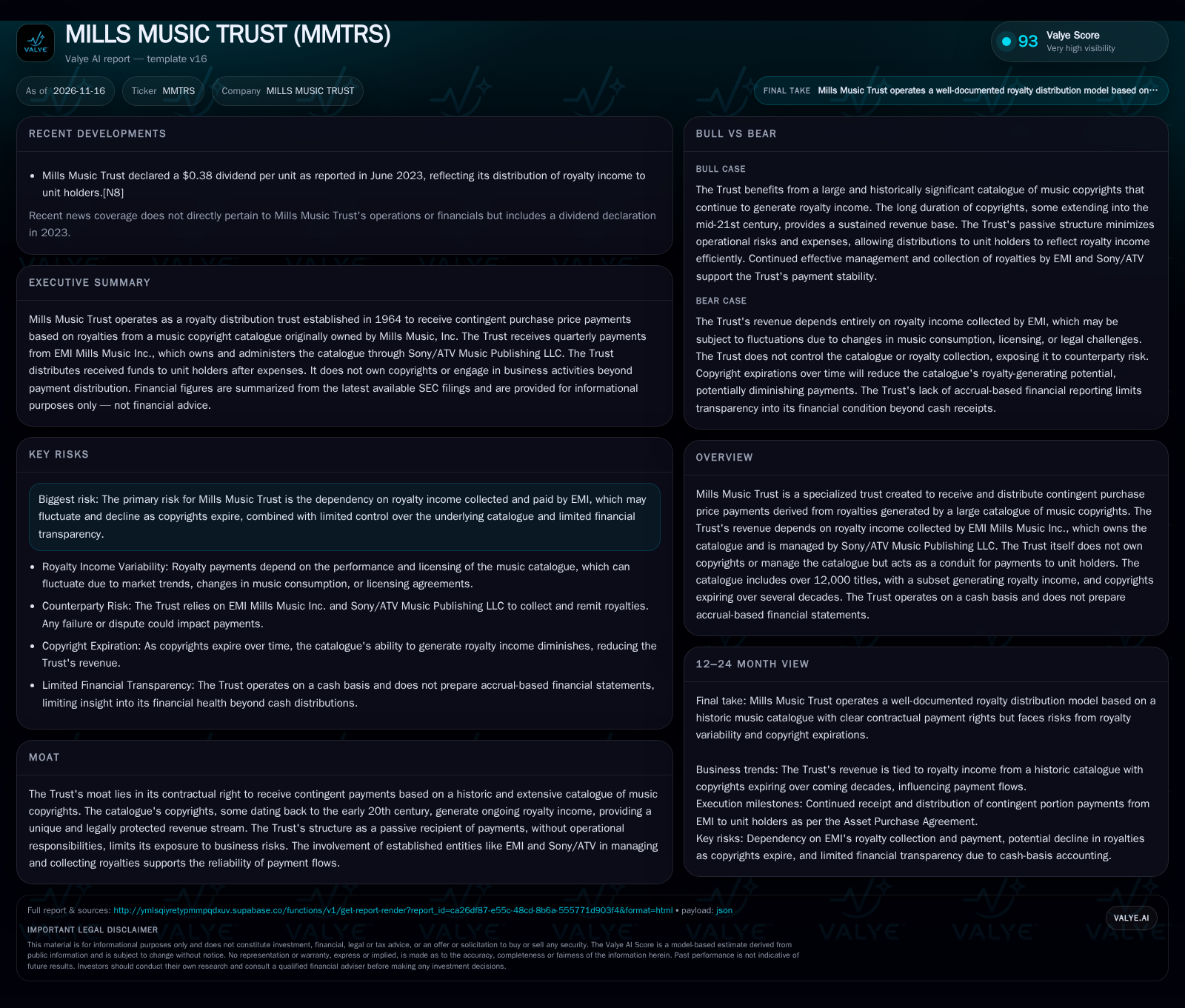
Mills Music Trust receives and distributes contingent royalty payments derived from a catalogue of more than 12,000 music copyrights, with only about 1,430 currently producing income. Its fate is tethered to the royalty collection and payment performance of EMI Mills Music Inc. and Sony/ATV, as well as the gradual expiration of key copyrights over the coming decades. The Trust’s passive structure minimizes operating risk but exposes unit holders to declining income as copyrights lapse and to limited transparency due to cash-basis reporting. [S1] [S2]
Mills Music Trust exemplifies the purest form of a pass-through royalty vehicle: it neither owns nor manages its underlying music catalogue, but is contractually entitled to a share of royalties collected by EMI Mills Music Inc., now administered by Sony/ATV. With over 12,000 historic titles but only a fraction generating meaningful income, the Trust’s distributions are dictated by the evolving performance of legacy copyrights, the reliability of external counterparties, and the inexorable march of copyright expiration. As a result, investors face a unique blend of vintage asset exposure, minimal operating risk, and a slow but inevitable income decline absent new value creation.
A Royalty Trust Defined by Legacy Assets and Limited Transparency
Mills Music Trust’s business is fundamentally passive: its sole function is to receive quarterly contingent payments from EMI Mills Music Inc., reflecting royalties collected from a catalogue of over 12,000 historic music copyrights. Of those, only about 1,430 titles have produced royalty income in recent years, highlighting a concentrated revenue base. The Trust does not own or manage the catalogue, which is currently administered by Sony/ATV, and operates entirely on a cash basis—issuing distributions to certificate holders after deducting minimal expenses. Copyrights in the catalogue expire between the 2020s and 2050s, setting a finite horizon for royalty streams. Notably, the Trust does not prepare a balance sheet or accrual-based financial statements, providing only cash receipts and distributions as financial disclosure. [S1] [S2]
How the Trust’s Cash Flows Are Engineered—and Can Erode
Mills Music Trust’s economics are uniquely simple but inherently limited. The Trust receives contingent payments, calculated from royalties collected by EMI Mills Music Inc. according to a pre-set formula in the original Asset Purchase Agreement. The Trust’s revenue is essentially a function of (a) how much royalty income the catalogue generates, (b) the contractual split, and (c) EMI/Sony/ATV’s collection effectiveness. No leverage, reinvestment, or operational scaling is possible: all net receipts, after modest expenses, are distributed to certificate holders.
The fixed nature of the Trust’s rights means it cannot influence royalty rates, renegotiate contracts, or pursue new licensing opportunities. Its cost base is minimal—primarily trustee and administrative fees—so nearly all incoming cash is passed through. However, this also means the Trust is exposed to pure volume risk: as copyrights expire or as music consumption patterns shift away from its catalogue, distributions will inevitably decline. There is no offsetting mechanism, margin expansion lever, or capital allocation optionality. The finite nature of copyright terms (with staggered expirations) introduces a slow, predictable decay to the Trust’s income profile, while the lack of accrual accounting prevents early warning of adverse trends.
Contractual Rights Trump Market Competition—But Not Structural Decay
Unlike a typical operating company, Mills Music Trust does not compete for customers, market share, or licensing deals. Its moat is purely contractual: the right to receive a portion of royalties from a specified catalogue, as long as the underlying copyrights persist and generate income. This right is legally protected and insulated from direct competition, but it is also static—there are no levers for growth or strategic repositioning.
The Trust’s only true competitive exposure is to substitutes for its royalty income, which are determined by end-market trends in music consumption, licensing, and copyright law. The rise of streaming, shifts in music tastes, or changes in copyright enforcement could all impact the royalty pool. However, the Trust cannot respond to these trends; it is reliant on the ongoing relevance of its catalogue and the diligence of EMI/Sony/ATV as administrator and collector. In this sense, the Trust’s ‘competitive position’ is more akin to a wasting asset than a traditional business with defendable market share.
Catalogue Resurgence or Licensing Upside Could Prolong Royalty Streams
The most favorable scenario for Mills Music Trust involves a resurgence in demand for its top-earning songs—through film, television, advertising, or viral digital use—leading to a temporary or sustained increase in royalty income. If Sony/ATV, as administrator, successfully places these works in high-profile projects or negotiates favorable licensing deals, the Trust’s quarterly contingent payments could rise or remain resilient even as some copyrights expire.
Evidence confirming this scenario would include: (a) an observable uptick in cash distributions to unit holders, (b) publicized placements of catalogue songs in high-value media properties, and (c) a slower-than-expected decline in the number of royalty-generating titles. Conversely, if distributions remain flat or decline in line with copyright expirations, or if there is no evidence of increased licensing activity, the upside scenario would be falsified.
Gradual Decline in Distributions as Copyrights Expire and Catalogue Ages
The most plausible trajectory for Mills Music Trust is a gradual, stepwise decline in distributions as key copyrights expire and the catalogue’s commercial relevance wanes. With only about 1,430 titles actively generating royalties and copyright terms expiring through the 2050s, the income stream is likely to become increasingly concentrated in a shrinking set of enduring hits.
Confirmation of this scenario would come from sequential decreases in quarterly distributions, a narrowing list of top-earning titles, and no evidence of new licensing initiatives or catalogue revitalization. Falsification would require either a material, sustained increase in royalty receipts or a structural change—such as an extension of copyright terms or a novel licensing breakthrough—neither of which is currently indicated.
Counterparty Disruption or Accelerated Catalogue Obsolescence
The primary adverse scenario for Mills Music Trust is a disruption in royalty collection or remittance by EMI Mills Music Inc. or Sony/ATV, whether due to operational failures, legal disputes, or counterparty distress. Any such event could delay or permanently impair the Trust’s sole revenue stream. Alternatively, an acceleration in copyright expirations, legal challenges to ownership, or a rapid shift in music consumption away from the Trust’s catalogue could cause distributions to contract faster than expected.
Evidence for this scenario includes missed or delayed quarterly payments, publicized disputes between EMI/Sony/ATV and the Trust, or a sudden, material drop in distributions not explained by regular copyright expirations. If payments remain steady and catalogue relevance persists, the downside scenario would be mitigated.
Tracking Royalty Sustainability, Counterparty Performance, and Copyright Attrition
Quarterly cash distributions to certificate holders—absolute amounts and year-over-year trends.
Number and identity of catalogue titles actively generating royalty income, if disclosed.
Expiration schedule of top-earning copyrights and projected impact on royalty streams.
Any public disclosure of new, high-profile licensing deals or media placements involving catalogue songs.
Operational or legal developments at EMI Mills Music Inc. or Sony/ATV that could impact royalty collection or remittance.
Changes in the administrative or contractual structure between the Trust, EMI, and Sony/ATV.
Disclosure of any disputes, delays, or modifications to the Asset Purchase Agreement or contingent payment formula.
Any regulatory or legislative changes affecting U.S. or international copyright duration and enforcement relevant to the catalogue.
Disclaimer: This is research-only, informational analysis and not investment advice. It may include AI-generated interpretation and general industry context. Always verify important details using primary sources.

Comments