
Monro, Inc. Refines Store Network and Executes Strategic Review to Unlock Shareholder Value
Monro's latest quarterly results reveal operational streamlining through targeted store closures and strategic initiatives aimed at enhancing profitability in a competitive retail auto service market.
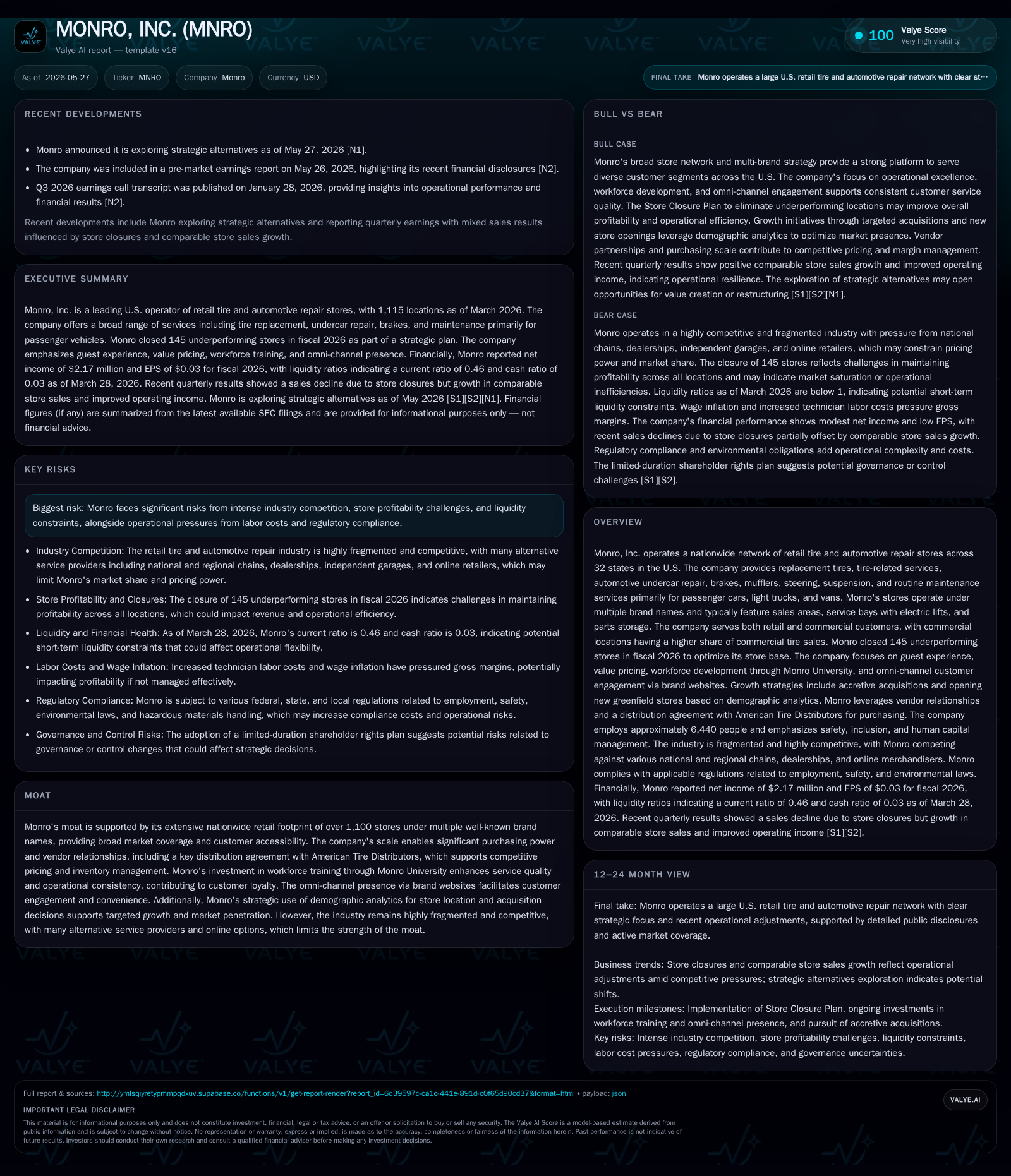
In Q3 fiscal 2026, Monro reported net income of $11.1 million but adjusted net income declined primarily due to rising material costs. The company adopted a limited-duration shareholder rights plan to safeguard shareholder value amid market pressures. Building on closing 145 underperforming stores, Monro focuses on optimizing its multi-brand retail footprint, leveraging workforce development, and expanding omni-channel customer engagement. Industry competition remains intense, while balance sheet liquidity measures and debt management provide cautious support for growth initiatives. A strategic alternatives review underway signals potential structural moves to enhance long-term shareholder returns.
Recent Quarterly Operating Update: Earnings Trends and Strategic Posture
In the three months ended December 27, 2025 (Q3 fiscal 2026), Monro posted net income of $11.1 million [S2]. However, adjusted net income—a non-GAAP measure excluding one-time costs such as store closure expenses and consulting fees—declined to $5.0 million from the prior-year comparable period. This disparity primarily stemmed from escalation in material costs by approximately 80 basis points impacting gross profit margins despite beneficial occupancy cost trends [S2]. Diluted earnings per share rose sharply by 133% year-over-year to $0.35, though adjusted diluted EPS dipped about 16% to $0.16 as cost pressures unfolded [S2].
A notable governance action was the adoption of a limited-duration shareholder rights plan in November 2025 designed to protect shareholder interests against opportunistic control attempts without equitable compensation [S2][S1]. This defensive mechanism issues one right per outstanding common share that becomes exercisable if an entity acquires over 17.5% ownership without direct board negotiation. The Rights Plan reflects management’s vigilance amidst valuation or takeover risks given the company’s ongoing strategic repositioning.
Business Model Nuances: Multi-Brand Retail Footprint and Service Offering
Monro operates over 1,100 company-operated stores across 32 states under eight primary brand names including Tire Choice Auto Service Centers, Mr. Tire Auto Service Centers, Monro Auto Service and Tire Centers, Car-X Tire & Auto, among others [S1]. These stores serve roughly 3.8 million vehicles annually providing replacement tires predominantly for passenger cars, light trucks, and vans alongside comprehensive automotive repair services including brakes, mufflers/exhaust systems, steering/suspension components, wheel alignment, and routine maintenance.
Retail locations are generally freestanding buildings with sales areas supported by electric vehicle lifts in service bays enabling efficient mechanical repairs [S1]. Commercial customers are served at select sites with higher commercial tire sales concentration. Inventory replenishment is managed through centralized purchasing leveraging American Tire Distributors under a distribution agreement enabling optimized stock control and competitive pricing [S1]. Vendor relationships benefit from Monro’s scale purchasing power which enhances margin resilience against inflationary pressures.
Monro invests heavily in workforce development via its proprietary Monro University program focusing on consistent service quality training and operational excellence [S1]. Complementing physical presence is an omni-channel customer engagement approach through branded websites facilitating appointment booking and improved guest experience. The diversified brand portfolio enables regional targeting aligned with demographic analytics supporting acquisition decisions and new store openings.
Industry Dynamics: Competitive Pressures and Supply Chain Strategies
The automotive repair sector remains highly fragmented with local independent garages competing alongside national/regional chains operating varying business models [S19]. Competitors range from franchised operators specializing in undercar repair or tires to dealership service departments and mass merchandisers offering installation services partnered with online parts retailers.
This diversity breeds intense competition primarily on price points while reputation, convenience of location, service quality, and brand recognition serve as key differentiators [S19]. Inflationary headwinds affecting material input costs—such as raw rubber for tires—and labor wages influence pricing strategies. Consequently, Monro’s supply agreements with ATD facilitate inventory just-in-time replenishment minimizing working capital drag yet require delicate volume/mix balancing to sustain margins against discounting pressures.
Demand exhibits sensitivity to macroeconomic cycles affecting vehicle usage patterns (mileage driven) as well as consumer willingness to spend on vehicle maintenance versus trading down or leasing new vehicles [S19]. Regulatory standards for consumer protection add complexity on compliance front across Monro’s multi-state operations.
Growth Drivers: Targeted Store Optimization, Workforce Training, and Omnichannel Engagement
A cornerstone growth lever has been the disciplined Store Closure Plan announced mid-2025 which shuttered or divested 145 underperforming locations principally identified through demographic segmentation analysis focused on unprofitable geographies or subscale units [S1][S2]. This pruning activity aims at improving portfolio profitability by reallocating resources toward higher-return sites while reducing ongoing real estate/operating expenses related to vacant stores where leases were reassigned or terminated early yielding net gains totaling over $21 million in recent quarters [S2].
Complementing this is sustained investment in employee training through Monro University enhancing consistency in guest experience—a critical retention vector given limited switching costs but significant competition based on trust and expertise [S1]. Enhanced team engagement correlates directly with higher throughput conversion once customers enter outlets.
Digital enablement expands omnichannel capabilities delivering ease of booking services online driving improved customer convenience that can increase repeat visits and cross-sell of adjacent maintenance services [S1]. Moreover, acquisition growth is guided by focused analysis of population density shifts and market penetration gaps allowing accretive expansion rather than indiscriminate scaling.
Risks and Challenges: Competition, Store Profitability, and Balance Sheet Considerations
Competitive risks include pricing pressure from larger or more regionally entrenched rivals who may leverage distribution advantages or greater brand awareness resulting in shrinking margins for Monro especially if consumer spending weakens leading to reduced discretionary maintenance budgets or deferred repairs [S19]. Inflationary labor cost increases also challenge profit recovery given wage hikes mandated federally/statewide that elevate fixed operating expenses potentially outpacing price increases.
Balance sheet scrutiny reveals a working capital deficit that widened to approximately $274.5 million anchored by extended negotiated payables terms with suppliers reflecting leveraging of payment cycles as part of cash flow management [S2][F1]. Current ratio stands low at roughly 0.46 indicating current liabilities substantially exceed current assets [F1]. Liquidity includes cash & equivalents around $14.6 million at quarter end versus total debt approximated at $45 million stemming largely from credit facility utilization leaving a net debt position near $30 million after cash offsets [F1][S2][S3].
Regulatory environment entails adherence to evolving labor laws, safety regulations across many states plus consumer protection statutes—compliance failures would risk fines or litigation adversely impacting financials [S19][S22].
Upcoming Catalysts: Strategic Alternatives Review and Dividend Policy Update
On May 27, 2026 Monro announced initiation of a strategic alternatives review which could encompass evaluating potential joint ventures, partnerships or structural capital changes aimed at maximizing shareholder value amidst challenging margin trajectories [S3][N7]. While no specific outcomes were disclosed this signals active board engagement seeking transformative pathways beyond incremental operational improvements.
Also noteworthy was declaration of a quarterly cash dividend of $0.28 per share payable June 16, 2026 reflecting confidence in sustainable cash generation despite near-term earnings pressures [S3]. Dividend continuity often signals management optimism regarding liquidity outlook balanced against need for reinvestment into store optimization or bolt-on acquisitions.
Financial Highlights: Working Capital Management and Leverage Overview
Gross profit margin deterioration was impacted notably by an approximate +80 basis point rise in material costs offset partially by occupancy cost improvements totaling about +30 basis points contributing modestly from real estate expense reductions related to store closures [S2]. Net income for the trailing twelve months ended March 28, 2026 totaled approximately $2.17 million while operating income stood near $20 million marking tightening profitability amidst transition expenses [F1].
Working capital deficit expanded slightly indicating strategic supplier payment terms extending payables cycle utilized as part of supply chain finance program mitigating short-term cash drains although underpinning below par current ratio of ~0.46 [F1][S2]
In summary, recent financial management shows prudent balance sheet oversight supportive of ongoing restructuring efforts while preserving capacity for targeted investments aligned with Monro's strategic priorities.
Disclaimer: This analysis is intended solely for informational purposes based on publicly filed SEC documents as of early calendar year 2026. It does not constitute investment advice nor an offer or solicitation for purchase or sale of securities related to Monro Inc. Readers should consult their own advisors before making any financial decisions.
Disclaimer: This is research-only, informational analysis and not investment advice. It may include AI-generated interpretation and general industry context. Always verify important details using primary sources.

Comments