
Montauk Renewables: Concentrated RNG Bets, Liquidity Strains, and the Stakes of Operational Execution
Montauk Renewables’ business—turning landfill gas into renewable natural gas and electricity—relies on a handful of large projects and customers, making operational reliability and liquidity management crucial to survival. With covenant risks, customer concentration, and a delayed facility weighing on near-term prospects, the company’s ability to stabilize cash flows and unlock new credit is central to any rebound.
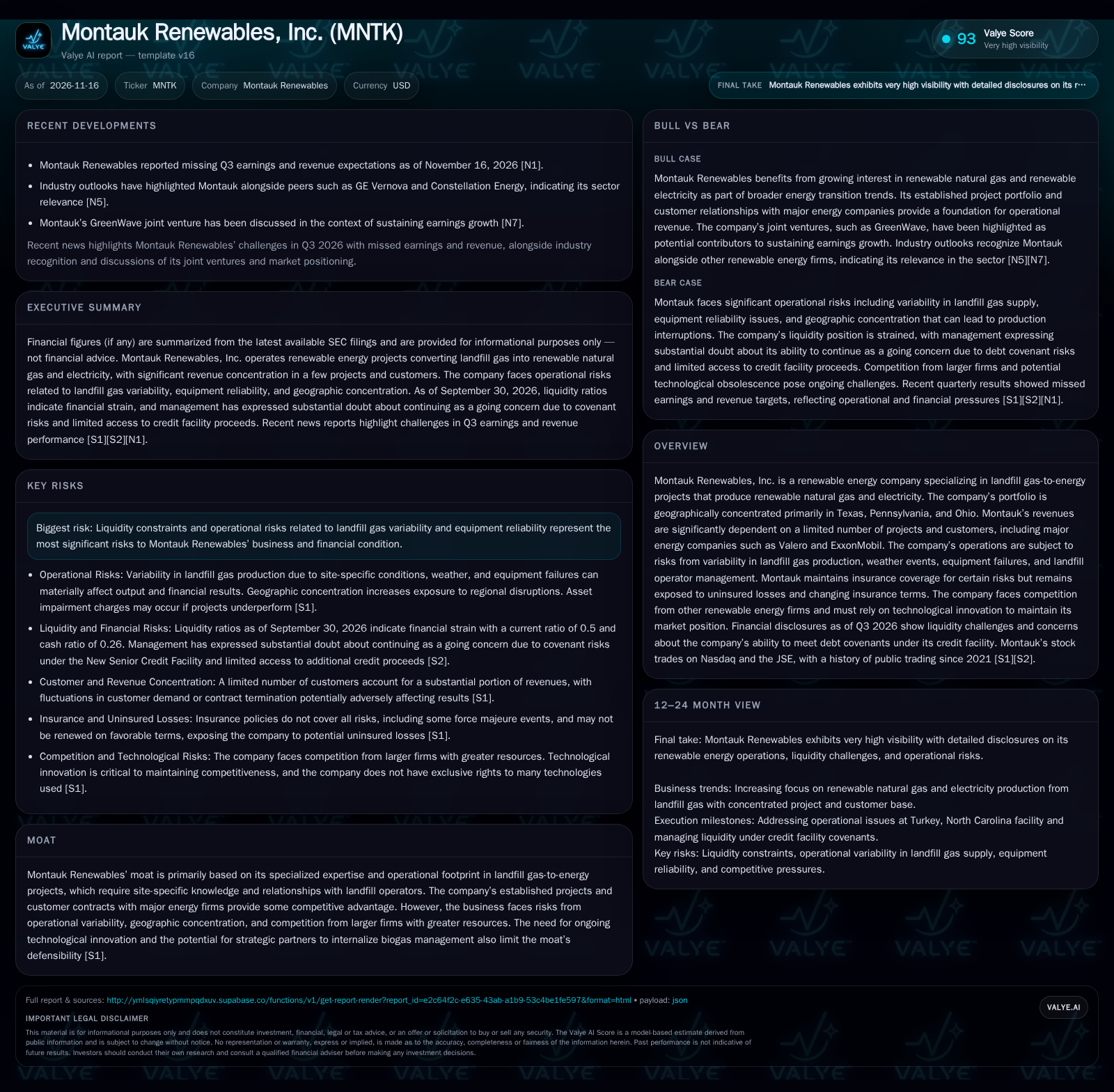
Montauk Renewables faces acute financial strain, with most revenue coming from a handful of projects and major customers like Valero and ExxonMobil. Operational reliability, especially at key facilities, and the ability to access additional capital will likely determine whether Montauk can sustain its RNG-focused business model or face deeper distress. [S1] [S2]
With nearly 68% of revenue tied to just five projects and substantial exposure to a few major customers, any operational hiccup or contract loss could have outsized effects. Management’s warning about going concern status, compounded by delayed facility launches and limited access to credit, puts the company’s future in the hands of operational turnaround and external financing. The next chapters for Montauk will hinge on its ability to stabilize production, diversify its revenue base, and address covenant risks before cash runs dry. [S1] [S2]
Material Facts: Concentrated Revenue, Liquidity Alarm, and Operational Setbacks
Montauk Renewables’ operating profile is defined by significant revenue concentration: five projects contributed roughly 67.7% of operating revenue in 2025, and major customers such as Valero and ExxonMobil represent large portions of its sales base. This concentration magnifies the impact of site-specific disruptions or customer churn. [S1]
As of September 30, 2026, Montauk reported cash and equivalents of $12.4 million against current liabilities of $47.5 million, yielding a current ratio of 0.5 and a cash ratio of 0.26. Management has publicly expressed substantial doubt about the company’s ability to continue as a going concern over the next year, citing liquidity constraints and covenant risks under its New Senior Credit Facility. [S2]
Operationally, the Turkey, North Carolina facility—expected to be a contributor to growth—remained offline in Q3 2026 due to unresolved issues. This has prevented Montauk from accessing additional credit facility proceeds, further tightening its financial position. [S2]
These factors combine to create a situation where even routine operational setbacks can quickly escalate into existential threats, as underscored by Montauk’s recent Q3 earnings and revenue miss. [N1]
How Montauk’s RNG Model Translates Landfill Gas into Cash—And Where the Fault Lines Lie
Montauk’s core business model is converting landfill gas (LFG) from owned or contracted sites into renewable natural gas (RNG) or electricity. Revenue is generated primarily through commodity sales—often under offtake agreements—to large energy companies or utilities. Pricing is influenced by both the underlying natural gas market and the premiums available for renewable attributes (e.g., RINs under the Renewable Fuel Standard).
The economics are volume-driven, with project output dependent on landfill gas flows, which are inherently variable and subject to decline over time and to disruption from weather or landfill management practices. Fixed costs are substantial, including site development, equipment, and ongoing maintenance. Once operational, projects can yield operating leverage if output is stable, but the downside risk is high if gas supply drops or equipment fails.
Customer and project concentration means that Montauk’s cash flows are vulnerable to outages or contract changes at just a few sites. Capital needs are ongoing, both for maintaining aging infrastructure and for bringing new projects like Turkey, North Carolina online. With reported liquidity position and tight covenants, any significant capex or unexpected repair could force difficult trade-offs or trigger covenant breaches.
Operating leverage is a double-edged sword: high utilization boosts margins, but any disruption can quickly flip earnings negative given the company’s reported cash balance. The inability to access new credit until the Turkey facility is operational further restricts potential financial flexibility.
Competitive Dynamics: Scale, Innovation, and the Risks of Customer and Project Concentration
Montauk operates in a competitive segment of the renewable energy market, with peers ranging from specialized RNG developers to large diversified energy companies. Competitors with greater capital, geographic reach, and technical resources may have advantages in winning new projects, weathering operational setbacks, and negotiating offtake agreements.
Montauk’s moat rests on site-specific expertise, relationships with landfill operators, and a portfolio of established projects. However, this moat is narrow: landfill gas projects are not exclusive, and landfill owners may choose to internalize gas conversion or contract with other service providers. Technological innovation—improving gas capture, upgrading, and reliability—is essential to staying ahead, but Montauk does not appear to have proprietary technology or exclusive rights to major innovations. [S1]
Customer concentration is also a vulnerability. If major buyers like Valero or ExxonMobil shift procurement to competitors or renegotiate terms, Montauk could face abrupt revenue losses. This risk is amplified by the company’s inability to quickly diversify or scale up new projects, given its current financial constraints.
In summary, while Montauk is recognized alongside sector peers such as GE Vernova and Constellation Energy, it lacks the scale and resource depth of these larger players, making resilience to shocks and access to growth capital more challenging. [N5]
Rebound Potential: Operational Stabilization and Strategic Leverage from Joint Ventures
A favorable scenario for Montauk would require simultaneous operational and financial improvements. Bringing the Turkey, North Carolina facility online could unlock additional credit facility proceeds, providing much-needed liquidity and the ability to fund maintenance or incremental growth. If operational reliability is restored across the core project portfolio, revenue and cash flow visibility would improve, reducing the risk of covenant breaches.
The GreenWave joint venture could become a meaningful growth engine if it delivers incremental earnings or diversifies Montauk’s revenue base. Success here would be evidenced by new project wins, expanded offtake agreements, or higher utilization at existing sites. [N7]
Confirmation of this scenario would come from sequential improvements in operating cash flow, project uptime, and public disclosures of new customer contracts or successful project launches. Falsification would be signaled by continued outages, inability to bring Turkey online, or further warnings about liquidity and covenant breaches.
Most Probable Trajectory: Managing Through Tight Liquidity and Incremental Project Delivery
The most plausible near-term outlook is one of constrained survival: Montauk manages to keep existing projects running, but incremental growth is slow due to reported liquidity position and project delays. The Turkey facility may eventually come online, but not quickly enough to transform the balance sheet or fully resolve credit constraints within the next year.
Revenue remains highly concentrated, and cash flow is just sufficient to service debt and maintain core operations. Customer relationships hold, but the company is unable to significantly diversify its customer or project base until potential financial flexibility is restored.
Evidence supporting this scenario would include ongoing disclosures of 'substantial doubt' regarding going concern status, flat or modestly improving revenue, and continued project concentration. Falsification would occur if Montauk either rapidly turns around operations and accesses new capital, or conversely, if a major operational or customer setback pushes the company into restructuring or distressed asset sales.
Distress Cascade: Facility Delays, Customer Loss, and the Risk of Forced Restructuring
A negative scenario unfolds if Montauk is unable to resolve operational issues at key facilities—especially Turkey, North Carolina—leading to continued denial of new credit and mounting liquidity pressure. Any significant outage or contract loss at one of the major revenue-generating projects could rapidly erode cash flow, potentially triggering debt covenant breaches and forcing the company into distressed financing, asset sales, or even bankruptcy.
Customer concentration amplifies this risk: a loss or renegotiation of a major contract would have an outsized impact, with limited ability to offset from other projects or customers in the short term. Insurance limitations mean that an uninsured event (e.g., a major equipment failure or weather-related disruption) could inflict unrecoverable losses.
Downside confirmation would come from disclosures of covenant violations, new asset impairment charges, layoffs, or formal restructuring actions. Falsification would require clear evidence of operational turnaround and renewed access to credit.
Benchmarks for Montauk’s Survival and Recovery Prospects
Progress on resolving operational issues and achieving commercial operation at the Turkey, North Carolina facility; this would unlock additional credit and signal improved execution.
Sequential changes in the current ratio and cash ratio; while not sufficient on their own, improvements would support the case for stabilizing liquidity if accompanied by positive cash flow trends.
Disclosure of new or renewed offtake agreements with major customers, or evidence of revenue diversification beyond the current concentration.
Utilization and uptime metrics for Montauk’s five largest projects, if disclosed, as a proxy for operational reliability and earnings visibility.
Updates on the GreenWave joint venture’s financial contribution or new project launches, which could indicate incremental growth momentum.
Any public disclosure of covenant breaches, waivers, or amendments under the New Senior Credit Facility.
Asset impairment charges or announcements of asset sales, which could signal distress or a strategic pivot.
Material changes in insurance terms or disclosures of uninsured losses, highlighting risk exposure to catastrophic events.
Disclaimer: This is research-only, informational analysis and not investment advice. It may include AI-generated interpretation and general industry context. Always verify important details using primary sources.

Comments