Modine Manufacturing Navigates Strategic Shift Amid Fiscal Challenges and Transaction Risks
Modine faces a pivotal transformation with its Reverse Morris Trust deal alongside Gentherm amidst a backdrop of fiscal losses and operational uncertainties.
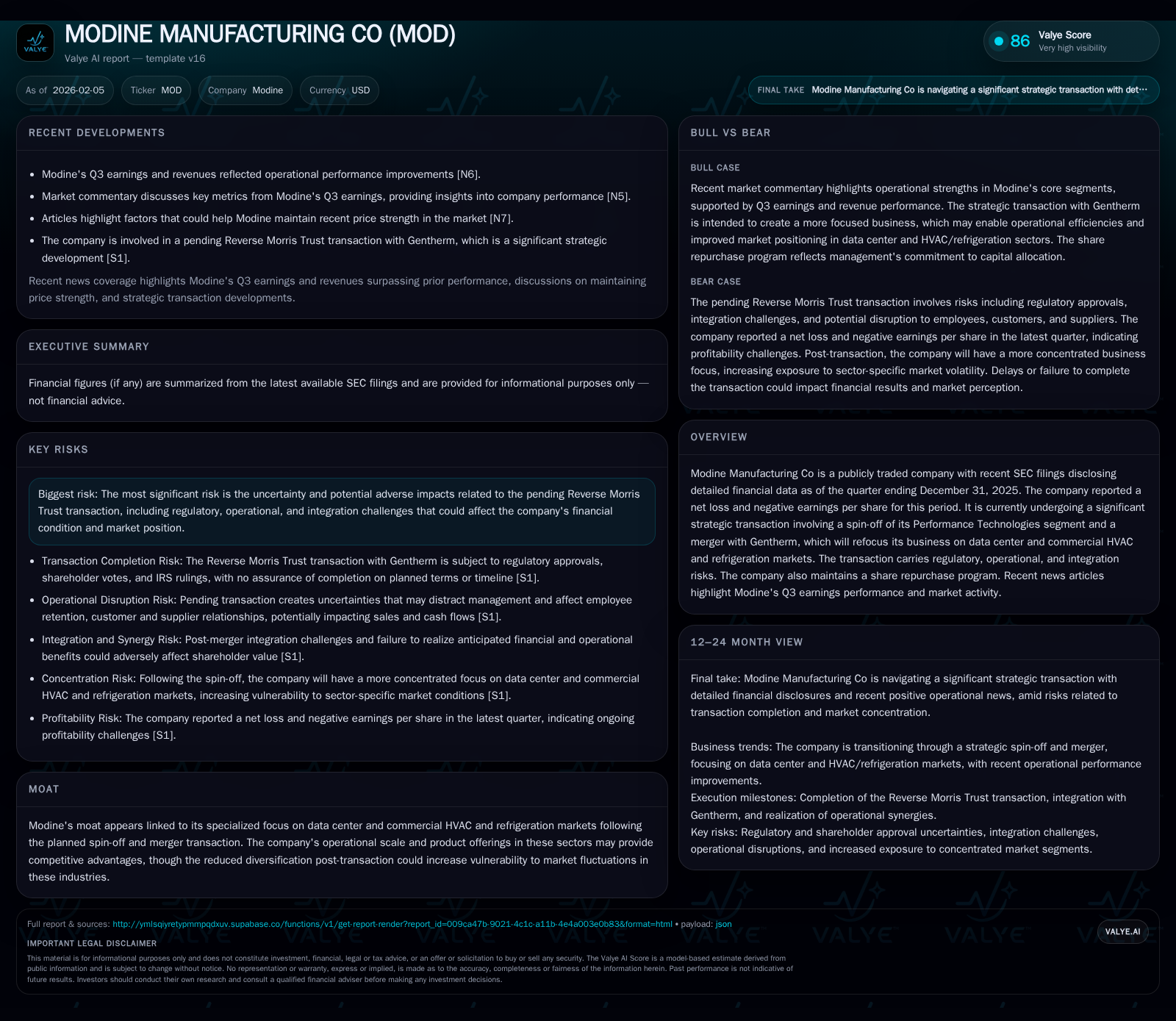
Modine Manufacturing Co reported a full-year net loss ending December 2025 despite a recent quarter where revenues and earnings outperformed expectations. The company is pursuing a complex strategic pivot by spinning off its Performance Technologies segment and merging it with Gentherm through a Reverse Morris Trust transaction, refocusing Modine on data center and commercial HVAC and refrigeration markets. This transaction carries significant regulatory, integration, and execution risks that could materially impact Modine’s future operational profile and financial health. The concentrated market focus post-transaction may strengthen Modine’s competitive moat but also increases vulnerability to sector-specific volatility.
Momentum and Metrics: Unpacking Modine’s Latest Earnings
In late 2025, Modine posted mixed financial signals that encapsulate the company’s transitional state. While the third quarter delivered top-line revenue and earnings above consensus expectations—signaling pockets of strength—the full fiscal year closed with a net loss of $47.4 million [F1][N5][N6]. This dichotomy highlights persistent operational costs and restructuring expenses weighing on profitability despite accelerating sales momentum in core segments. The revenue trajectory suggests successful demand capture in targeted markets; however, such gains remain insufficient to offset legacy burdens across the broader enterprise pre-spin-off.
Maintaining near $1.3 billion in current assets against approximately $596 million in current liabilities yields a robust current ratio of 2.19 [F1], underscoring disciplined working capital management amid uncertainty. Cash balances stood at $98.7 million at year-end, providing breathing room for near-term obligations or strategic investments.
Whether this liquidity suffices through transformative upheaval remains contingent on transaction timing and integration success.
Strategic Crossroads: Anatomy of the Reverse Morris Trust Deal with Gentherm
Central to Modine’s evolution is an intricate Reverse Morris Trust (RMT) transaction with Gentherm [S2][valye_report_excerpt]. The RMT maneuver entails spinning off Modine’s Performance Technologies segment to shareholders while immediately merging this carved-out entity with Gentherm. Structurally designed as a tax-efficient mechanism under U.S. federal guidance—pending IRS private letter ruling approval—the deal aims to create focused entities better aligned with distinct market demands.
Post-transaction, Modine reorients exclusively toward thermal management solutions servicing data centers and commercial HVAC/refrigeration sectors, shedding its more diversified legacy portfolio encapsulated in Performance Technologies.
This separation redefines Modine's operational DNA from a multifaceted manufacturer into a more specialized player emphasizing innovation and scale in rapidly evolving infrastructure markets critical to global digital expansion.
Risks in Focus: Regulatory, Operational, and Integration Challenges Ahead
While strategically coherent, the RMT deal embodies formidable hurdles [S2]. Completion predicates upon securing not only customary shareholder consents from Gentherm’s investor base but also navigating regulatory reviews that could scrutinize competition implications or tax compliance rigor. Delays or outright denial of these approvals threaten heightened transaction costs that can erode anticipated synergy capture.
Operationally, disentangling intertwined Performance Technologies activities introduces complexity beyond straightforward accounting splits. Management admits potential disruptions stemming from employee uncertainty—risking talent attrition—and deferment or cancellation of orders by cautious suppliers or clients amidst transactional ambiguity.
Additionally, executive focus diverted by demanding negotiation milestones may detract from day-to-day operations quality.
Any litigation—either from shareholders challenging process fairness or third-party claims linked to the structural separation—could impose costly legal defenses or restrain deal closure timelines.
Spotlight on the Future Moat: Data Center and HVAC Market Positioning
The post-spin structure concentrates Modine in two demanding sectors: data center thermal management—which benefits from secular tailwinds driven by growing cloud infrastructure needs—and commercial HVAC/refrigeration markets characterized by seasonality but stable demand [valye_report_excerpt]. Such focused specialization potentially fortifies competitive positioning via dedicated product development investments and deeper customer relationships.
However, this narrower scope entails heightened exposure to sector-specific downturns, technological shifts, or regulatory changes (such as environmental standards influencing refrigeration technologies). The prior diversification across unrelated business units offered some risk mitigation that now diminishes.
Whether scale efficiencies materialize fast enough to counterbalance concentration risk will shape long-term moat durability.
Financial Flexibility: Cash, Liquidity, and Capital Allocation Priorities
Despite recording net losses through year-end, Modine preserves solid liquidity buffers including roughly $99 million cash on hand coupled with a strong current ratio exceeding two-to-one [F1][valye_report_excerpt]. These metrics provide foundational stability during transactional execution phases often marked by unpredictable outlays—legal fees, advisory costs, operational realignments.
Notably, management sustains an active share repurchase program amidst these headwinds [valye_report_excerpt], signaling confidence in intrinsic valuation levels or desired capital structure targets. Such buybacks serve dual purposes: supporting share price mechanically and expressing belief in intrinsic business viability beyond headline loss figures.
Balancing ongoing equity return policies while preserving cash flow flexibility for integration-related contingencies remains a delicate calibration challenge for leadership.
Market Reactions and Analyst Perspectives: Decoding Investor Sentiment
Recent commentary reflects measured optimism intertwined with healthy skepticism. Some analysts highlight the strategic clarity gained via spinning off less synergistic segments; others caution over inherent execution complexities amid uncertain macroeconomic dynamics [N10][N12][N13][N5][N6].
Options strategies surfaced advocating tactical positions around expected stock volatility driven by pending events [N10]. Meanwhile, inventories of price targets vary widely underscoring diverse scenarios baked into professional forecasts.
Investor attention focuses equally on quarterly performance beats substantiating operational progress versus looming transitional risks diminishing near-term visibility.
What Could Go Wrong? Litigation and Execution Risks Explored
Legal encumbrances represent an underappreciated threat vector [S2]. Beyond regulatory probes lie potential shareholder lawsuits contending procedural fairness or valuation adequacy related to the spin-off or merger specifics. Historical precedents illustrate how protracted legal battles can drain resources exponentially while eroding confidence among customers and workforce alike.
Execution pitfalls extend into integration friction within newly configured entities hampering synergy realization timelines or inflating restructuring charges beyond initial forecasts.
Any material delay risks exacerbating capital market skepticism prompting share price volatility potentially outside fundamentals.
Conclusion: Will Strategic Focus Translate Into Sustainable Value?
Modine Manufacturing Company situates itself at an inflection point balancing bold strategic refocusing against tangible fiscal adversity compounded by complex transaction mechanics. The Reverse Morris Trust spin-off plus Gentherm merger reflects an intent to streamline operations around high-potential growth markets anchored by data center infrastructure needs and traditional HVAC systems calibrated for efficiency gains.
Yet substantial risk vectors—regulatory scrutiny, operational disentanglement challenges, market concentration vulnerabilities, along with legal uncertainties—temper unreserved enthusiasm. Strong liquidity preserves maneuvering room; earnings beats inject optimism; however consistent execution remains critical.
Ultimately, whether Modine emerges as a leaner specialized competitor able to harness innovative capabilities closer to end-market demands will dictate if this transformation engenders lasting value creation or merely shifts risk profiles without resolving structural profitability challenges.
This report is prepared solely for informational purposes based on publicly available information as of early February 2026. It does not constitute investment advice nor an endorsement of any securities discussed herein.
Disclaimer: This is research-only, informational analysis and not investment advice. It may include AI-generated interpretation and general industry context. Always verify important details using primary sources.

Comments