
How 2026 Market Realities Reshape Molina Healthcare’s Medicaid and Medicare Growth
Molina Healthcare faces membership contraction, rising medical cost ratios, and a strategic MAPD exit, refocusing its growth within government-sponsored health plans.
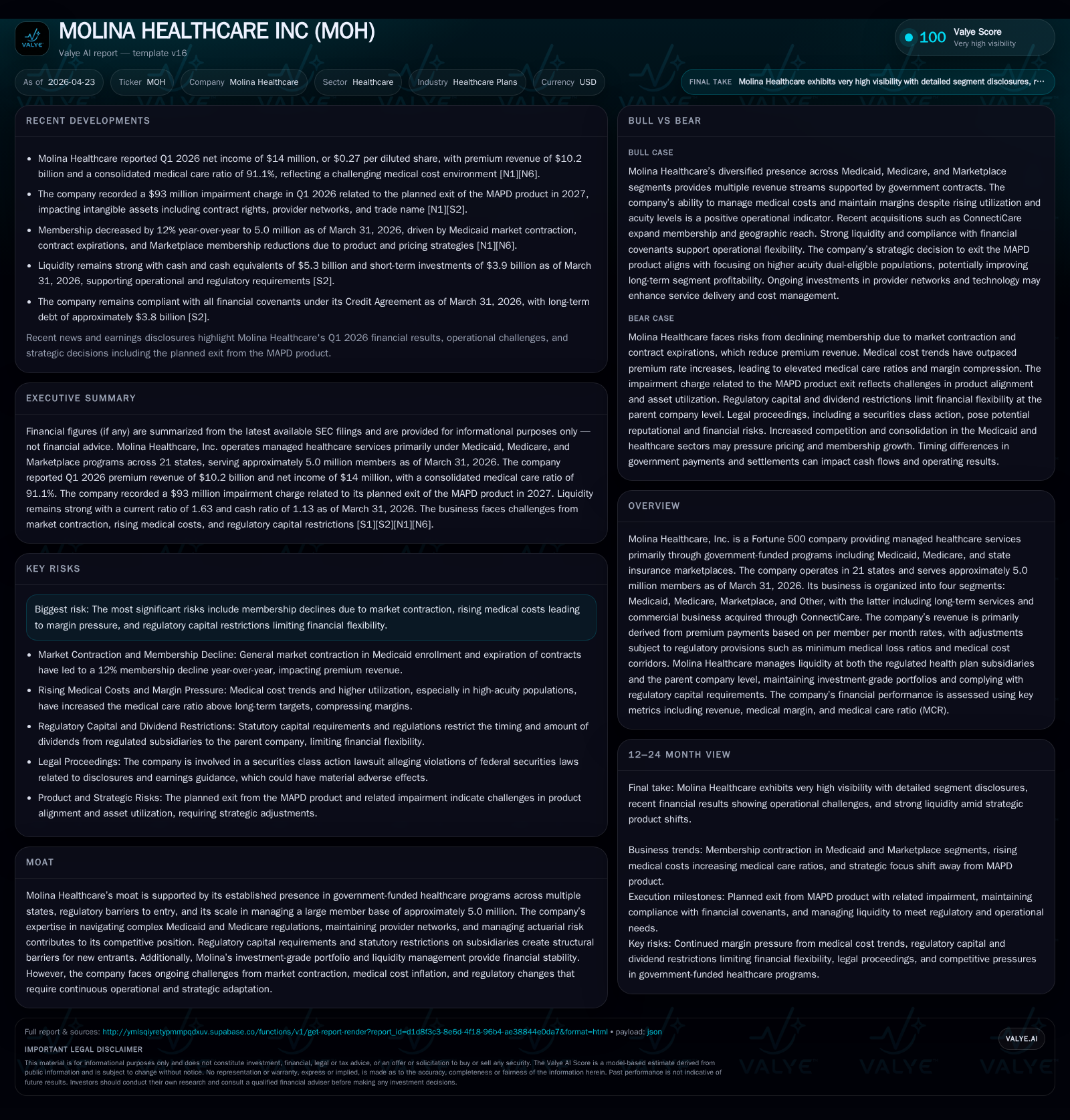
In Q1 2026, Molina Healthcare experienced a 4% decline in premium revenue driven by Medicaid membership decreases resulting from market contraction and contract expirations. The company recorded a $93 million impairment related to its planned exit from the Medicare Advantage Prescription Drug (MAPD) product line in 2027, signaling a strategic refocus on dual-eligible members. Rising medical care ratios across Medicaid and Medicare segments pressure margins amid utilization cost growth. Molina's competitive moat rests on regulatory barriers and scale across 21 states serving around 5 million members, but evolving enrollment dynamics and regulatory capital limits constrain near-term expansion. Key milestones include monitoring membership trends, medical loss ratio trajectories, and execution of pricing and market exits.
Q1 2026 Operating Shift: Premium Pressures and MAPD Impairment
Molina Healthcare’s first quarter of 2026 marks a significant inflection point as premium revenue fell by $456 million or roughly 4% year-over-year. This decline stems largely from shrinking Medicaid membership driven by ongoing market contraction nationwide coupled with the expiration of the company’s Virginia Medicaid contract. Additionally, marketplace membership declined due to deliberate product and pricing adjustments undertaken by management. Although incremental rate updates during Q1 provided some offset, the net effect was a meaningful top-line pressure on Molina’s government-sponsored plan revenues [S2][N1][N12].
Compounding these pressures, Molina took a $93 million impairment charge against intangible assets associated with its Medicare Advantage Prescription Drug (MAPD) business segment following its strategic decision to exit this product offering in 2027 [S2][S3][S25]. This impairment primarily affected contract rights ($62 million), provider networks ($4 million), and trade names ($27 million). The move reflects an operational sharpening towards the dual-eligible Medicare population while abandoning lower-margin MAPD segments that have faced structural challenges such as margin compression from elevated medical utilization.
Moreover, rising Medical Care Ratios (MCRs) impacted profitability. Increases were observed prominently within Medicaid (due to utilization spikes in behavioral health services, long-term services & supports (LTSS), specialty pharmacy drugs) as well as Medicare segments that cater to high-acuity dual populations [S1][S2]. Taken together, these dynamics highlight how shifts in membership composition—fewer volume but higher acuity—and regulatory constraints on rate-setting engender direct revenue and margin consequences.
Mapping Molina’s Core Business Model and Revenue Dynamics
Molina Healthcare’s primary business model revolves around managing government-sponsored health plans—Medicaid, Medicare (primarily dual-eligible beneficiaries), Marketplace insurance plans—and a smaller Other segment including long-term services in Wisconsin plus commercial members gained through ConnectiCare acquisition [S1][S5][S22].
Revenue principally flows from premiums calculated on a per member per month (PMPM) basis governed by contracts with state Medicaid agencies or federal Medicare authorities. These premiums are largely fixed for contract periods but may be adjusted annually based on actuarial risk assumptions tied to member health status and utilization patterns [S24]. Periodic reconciliation mechanisms exist such as minimum Medical Loss Ratio (MLR) thresholds requiring rebates if medical expenses fall below certain floors or corridors shifting compensation relative to actual incurred costs.
The complexity of Molina’s contracts demands rigorous actuarial risk management. Risk adjustment programs compel payments either into or out of risk pools depending on relative risk scores compared to state averages. Additionally, retroactive settlements with CMS for Part D prescriptions further introduce variability [S24][S16].
Margins depend heavily on successful navigation of these contractual nuances plus tight control of provider networks ensuring access at economically viable reimbursement rates. Capital adequacy laws mandate that subsidiaries maintain investment-grade portfolios and regulatory capital buffers which influence operational flexibility [S1][S7].
Competitive Moat: Navigating Government Programs and Regulatory Barriers
Molina's competitive positioning is fortified by entrenched regulatory barriers that limit new entrants in the administered Medicaid/Medicare insurance space across its footprint of 21 states serving approximately five million members [S1]. State governments’ control over plan contracting creates hurdles including licensing processes, capital standards for health plan subsidiaries, mandatory network adequacy criteria, and compliance with intricate medical loss ratio rules.
The sheer scale of Molina gives it enhanced bargaining power over providers ensuring more favorable terms compared to smaller players. Experience managing diverse state Medicaid waiver programs also allows Molina smoother operational execution versus new competitors lacking established systems or relationships [S1][S4][F1].
However, risks persist from policy shifts such as modifications to federal matching formulas or increased scrutiny through audits impacting eligibility determinations or premium rates. The expiration of contracts like Virginia's Medicaid highlights how volatility also stems from competitive rebids or program redesigns that can erode membership bases [S20].
Industry Dynamics: Enrollment Volatility, Pricing, and Cost Trends
Across the managed healthcare sector specializing in public programs like Medicaid and Medicare Advantage, enrollment fluctuations strongly reflect changing state-level eligibility reviews known as redeterminations. Post-pandemic normalization led to sustained declines after temporary enrollment surges [S1][N9].
Rising healthcare utilization—especially among high-acuity populations relying on LTSS services or costly specialty drugs—has caused medical care ratios to exceed historical targets steadily [S1][N11]. Rate increases granted annually often lag behind accelerated cost trends resulting in margin squeeze.
Marketplace plans add further unpredictability given their sensitivity to price changes and fluctuating subsidy structures which directly drive consumer enrollment behaviors [S1]. Constraints posed by risk corridor limitations reduce protections against unexpectedly adverse claims.
These industry-wide factors underscore why Molina faces constant pressure balancing competitive premiums with escalating service costs while adapting to volatile patient mixes.
Pathways for Growth Amid Membership Declines and Margin Compression
Despite membership headwinds in Medicaid stemming largely from macro eligibility trends rather than company-specific failings, Molina has several identified growth vectors:
- Expanding Medicare Advantage coverage focusing on dual-eligible individuals separate from MAPD products set for phase-out.
- Leveraging advanced analytics and digital tools for better care coordination aiming at reducing avoidable costs.
- Pursuing geographic expansion through contract wins where state partnerships open opportunities.
- Employing calibrated premium rate adjustments within regulatory approval frameworks aligned better with cost inflation.
- Utilizing acquisitions such as ConnectiCare integration into an “Other” segment offering potential diversification benefits [S1][S3].
Nonetheless growth will remain constrained by ongoing stringent regulatory capital rules affecting dividend capacity and reinvestment flexibility alongside inherent uncertainties related to continuously evolving government policies impacting coverage mandates or reimbursement formulas.
Key Milestones to Monitor: Membership, Medical Loss Ratios, Strategic Moves
Operational watchers should closely track quarterly membership roll-forwards especially noting trends post-enrollment redetermination cycles for Medicaid renewal success rate. Similarly, medical cost ratio movement—particularly within Medicare post-MAPD exit—will illuminate progress on margin stabilization initiatives.
The company's execution on exiting MAPD effectively while mitigating operational disruptions constitutes another critical milestone. Additionally monitoring CMS settlement liability evolutions linked to Part D reconciliation remains essential given its impact on short-term earnings clarity [S2][S3] . Rate-setting outcomes expected during spring rate filings for subsequent periods will reveal whether pricing adjustments catch up sufficiently with increasing utilization costs. Incremental success integrating ConnectiCare-derived commercial operations into broader financial results offers insight into diversification strategy effectiveness.
Financial Snapshot: Revenue Trends, Margins, Cash Flow, and Capital Management
Molina Healthcare reported full-year revenue reaching approximately $45.4 billion in FY2025 representing an 11.7% increase vs. FY2024 [F1], driven mainly by mix changes within government plans despite recent Q1 2026 headwinds. Operating income demonstrated marked compression falling nearly 54%, reflecting higher medical care costs pushing MCRs beyond target levels alongside the $93 million MAPD impairment charge recorded early Q1 results [F1][S2]. Net income similarly contracted sharply (-60%), underscoring margin pressures exacerbated by rising pharmacy costs and utilization among high-acuity members. Operating cash flow turned negative for FY2025 (-$535 million), contrasting previous years of positive cash generation indicative of investments in infrastructure or working capital increases during strategic shifts.[F1] Capital expenditure remained relatively stable around $101 million illustrating consistent reinvestment levels supporting network management capabilities.[F1] Liquidity remains robust with cash & equivalents totaling roughly $5.3 billion at March-end 2026 providing buffers against reimbursement payment timing uncertainties.[F1][S7] Additionally,$1 billion share repurchase authorization active since April 2025 signals board confidence despite near-term earnings pressures.[F1][S17]
Historical performance (annual)
| FY | Rev ($bn) | Net ($mm) | CFO ($mm) | OpInc ($mm) | Rev YoY | Net YoY |
|---|---|---|---|---|---|---|
| 2025 | 45.4 | 472 | -535 | 781 | +11.7% | -60.0% |
| 2024 | 40.6 | 1179 | 644 | 1707 | +19.3% | +8.1% |
| 2023 | 34.1 | 1091 | 1662 | 1573 | +6.6% | +37.8% |
| 2022 | 32.0 | 792 | 773 | 1173 |
Source: SEC companyfacts cache [F1].
Capital returns and efficiency (annual)
| FY | Buybacks ($mm) | FCF ($mm) | ROE% |
|---|---|---|---|
| 2025 | 1000 | -636 | 11.6 |
| 2024 | 1000 | 544 | 26.2 |
| 2023 | 0 | 1578 | 25.9 |
| 2022 | 400 | 682 | 26.7 |
Source: SEC companyfacts cache [F1].
In sum, Molina Healthcare confronts material near-term challenges reshaping its core segments due to enrollment contraction pressures layered against rising healthcare cost complexity amid a strategic retreat from certain Medicare products. Its business model remains anchored heavily within governmental managed care programs that provide structural moats stemming from regulatory frameworks yet impose constraints on pricing agility and capital deployability while demanding continuous operational adaptation.
This analysis incorporates SEC filings through April 23, 2026 ([S1]-[S29]) complemented by Nasdaq news transcripts ([N1]-[N14]) plus consolidated historical financial data ([F1]). It does not offer investment advice but aims to present a grounded evaluation of recent operational developments affecting Molina Healthcare's business trajectory amid evolving industry conditions.
Disclaimer: This is research-only, informational analysis and not investment advice. It may include AI-generated interpretation and general industry context. Always verify important details using primary sources.

Comments