
MapLight Therapeutics: Clinical and Capital Crossroads for Circuit-Targeted CNS Drug Platform
MapLight Therapeutics is advancing a proprietary muscarinic agonist approach for schizophrenia and Alzheimer's disease psychosis, with substantial liquidity and multiple Phase 2 readouts pending. The company's next chapters hinge on translating circuit-specific neuroscience into regulatory success, all while navigating the capital, competition, and risk realities of clinical-stage CNS drug development.
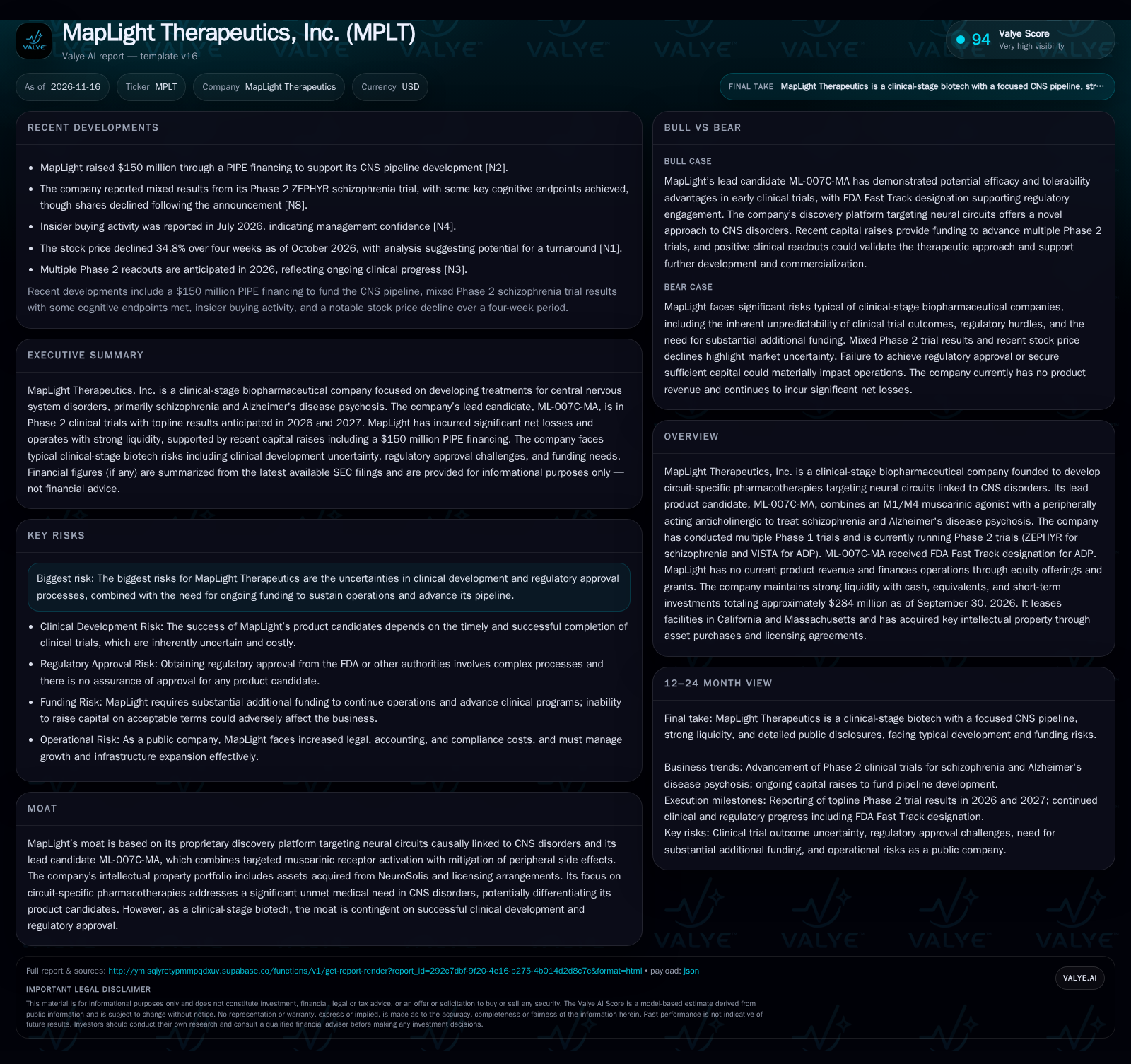
MapLight Therapeutics is a clinical-stage biotech focused on circuit-specific CNS drugs, notably ML-007C-MA for schizophrenia and Alzheimer's psychosis. Recent Phase 2 trial results were mixed, but the company retains reported liquidity position and FDA Fast Track status for its Alzheimer's program. Upcoming trial readouts and capital deployment decisions will be pivotal for validating the platform and determining MapLight’s ability to carve out a differentiated position in a high-risk, high-need therapeutic space. [S2] [N8]
MapLight Therapeutics represents a distinct bet in CNS drug development: the company is advancing a novel circuit-targeted muscarinic agonist platform for schizophrenia and Alzheimer’s disease psychosis, aiming for improved efficacy and tolerability over legacy antipsychotics. While ML-007C-MA has advanced through early and mid-stage clinical trials—with some cognitive endpoints reached in schizophrenia and regulatory momentum in Alzheimer’s—the commercial and clinical path remains fraught with risk. The company’s substantial liquidity and proprietary IP offer time and optionality, but the near-term thesis is dominated by upcoming Phase 2/3 data, regulatory interactions, and the ability to convert scientific promise into pipeline and platform value.
Phase 2 Outcomes, Liquidity Status, and Regulatory Developments Shape Current Outlook
MapLight Therapeutics’ lead asset ML-007C-MA achieved a primary endpoint in its Phase 2 ZEPHYR trial for schizophrenia, though the results were characterized as mixed and the company’s shares declined following the announcement. This trial, with a target enrollment of 300 participants, is expected to yield additional topline data in Q3 2026. Meanwhile, the VISTA Phase 2 trial for Alzheimer’s disease psychosis (ADP) is ongoing, with results anticipated in the second half of 2027. Notably, ML-007C-MA received FDA Fast Track designation for the ADP indication in December 2025, a development that could accelerate regulatory review and potential market entry if supported by robust data. [S2] [N8]
From a financial perspective, MapLight reported $55.6 million in cash and equivalents and $228.5 million in short-term investments as of September 30, 2026, with a current ratio of 9.53 and a cash ratio of 9.19. [S2]
Despite these strengths, MapLight remains pre-revenue and posted substantial net losses—$161.2 million in 2025 and $77.6 million in 2024—highlighting the capital intensity and binary risk profile typical of CNS drug development. [S2]
Pipeline Depth, Fixed Costs, and Funding Dynamics in CNS Drug Innovation
MapLight’s economics are defined by the high fixed costs and binary outcomes of clinical-stage biopharma. The company’s primary expenses are R&D—driven by personnel, CRO contracts, and clinical trial execution—and G&A associated with operating as a public company. With no product revenue expected in the near term, value creation is tied to successful advancement of ML-007C-MA and, longer-term, the potential for out-licensing, partnering, or commercialization.
The combination of a muscarinic agonist with a peripherally acting anticholinergic is designed to maximize central efficacy while mitigating peripheral side effects, potentially enabling a differentiated pricing and reimbursement profile if clinical benefit and safety are demonstrated. CNS drugs that address schizophrenia or ADP typically command premium pricing due to high unmet need and the chronic nature of these conditions, but market access is fiercely competitive and payer scrutiny is intense.
However, the absence of revenue and persistent net losses mean that future funding rounds are likely unless a major value-creation event (e.g., successful pivotal trial or partnership) intervenes. [S2] [N2]
Standing Out Through Circuit-Specific Efficacy in a Competitive CNS Landscape
MapLight’s competitive position is built on its proprietary circuit-targeted pharmacotherapy platform, with ML-007C-MA as the flagship asset. The core hypothesis is that selectively activating M1 and M4 muscarinic receptors in the brain can address cognitive and psychotic symptoms with fewer side effects than dopamine antagonists or non-specific anticholinergics. The IP portfolio, including molecules acquired from NeuroSolis and licensing arrangements, provides some insulation, but ultimate defensibility rests on clinical validation and the ability to secure regulatory and payer acceptance.
The CNS drug landscape for schizophrenia and ADP is highly competitive, with entrenched antipsychotics, emerging small-molecule and biologic approaches, and a history of high clinical attrition. Leading competitors include large pharma with established sales channels, as well as other biotech firms pursuing novel mechanisms (e.g., TAAR1 agonists, NMDA modulators). MapLight’s approach may offer a differentiated clinical profile, but the bar for adoption is high—requiring not just statistical significance, but also clinically meaningful improvement and tolerability.
Switching frictions in CNS are significant: prescribers are cautious, payers are cost-sensitive, and patients are vulnerable to side effects. A successful entrant must demonstrate not only efficacy, but also safety, convenience, and cost-effectiveness to displace standard of care.
Unlocking Value Through Successful Circuit-Targeted Therapeutics
The bullish scenario for MapLight is driven by successful Phase 2 and 3 readouts for ML-007C-MA in both schizophrenia and Alzheimer’s disease psychosis. If the drug demonstrates robust efficacy on both cognitive and psychotic endpoints, with a tolerability profile superior to existing antipsychotics, MapLight could secure regulatory approvals, attract lucrative partnerships, or become an acquisition target.
FDA Fast Track status for the ADP indication could accelerate the path to market, and positive data would validate the broader circuit-targeted platform, opening the door for pipeline expansion into other CNS disorders. The company’s reported liquidity position allows it to advance multiple programs in parallel, and a breakthrough could trigger substantial value re-rating.
Confirmation of this scenario would require: (a) clear, statistically and clinically meaningful efficacy and safety data in upcoming topline trial results; (b) positive regulatory interactions, such as agreement on pivotal trial design or priority review; and (c) evidence of commercial or partnering interest (e.g., upfront payments, co-development deals, or M&A interest). Falsification would come from failure to achieve primary endpoints, safety signals that cannot be managed, or regulatory pushback on trial design or data sufficiency.
Data Progression Enhances Options While Commercialization Remains a Future Goal
The most plausible path for MapLight is one of incremental clinical progress: further Phase 2 readouts provide additional evidence of efficacy and safety, but the results remain mixed or only partially supportive of best-in-class claims.
In this base scenario, MapLight may pursue partnership discussions or additional capital raises to share risk and access commercialization infrastructure, particularly if data are positive but not clearly transformative. The market remains cautious, assigning limited value until late-stage validation is achieved, and the company’s cash burn continues at a measured but material pace.
This scenario would be confirmed by steady trial execution, ongoing R&D spend, and measured capital deployment, with further news of regulatory engagement and possible early-stage partnerships. Falsification would come from major clinical setbacks, inability to enroll or execute trials, or failure to secure additional funding when needed.
Setbacks in Trials or Regulation Could Prompt Strategic Shifts
The primary risk to the MapLight thesis is clinical failure—either inability to replicate efficacy/significance in larger trials, or the emergence of safety/tolerability issues that preclude approval or market uptake. Regulatory rejection, either due to insufficient data or trial design flaws, would similarly undermine the company’s value proposition.
Given the absence of product revenue and ongoing net losses, a major clinical or regulatory setback would likely force MapLight to conserve cash, restructure operations, and seek strategic alternatives such as asset sales, out-licensing, or a distressed merger. Investor confidence would erode, capital access would tighten, and the company could face delisting or bankruptcy if unable to pivot successfully.
Confirmation of this scenario would be negative trial readouts, regulatory refusals (e.g., clinical holds, CRLs), or announcements of drastic cost-cutting and strategic reviews. Falsification would occur if the company continues to report progress, secures new funding, or demonstrates clear regulatory momentum.
Upcoming Milestones That Will Influence MapLight’s Validation and Value Trajectory
Topline efficacy and safety data from the ZEPHYR Phase 2 schizophrenia trial—does ML-007C-MA deliver clinically meaningful improvements over standard of care? [N8]
Interim and final results from the VISTA Phase 2 ADP trial—does the drug demonstrate benefit in hallucinations/delusions with acceptable tolerability? [S2]
Updates on FDA regulatory interactions, including any feedback on pivotal trial design, Fast Track status implications, or requests for additional data. [S2]
Potential partnership or licensing announcements—are there signs of external validation or commercial interest from larger pharma? (if disclosed)
Pipeline expansion or new indications leveraging the circuit-targeted platform—does MapLight initiate new programs or asset acquisitions? (if disclosed)
Insider transaction activity was reported in the cited source; this activity does not by itself establish insider confidence. [N4]
Disclaimer: This is research-only, informational analysis and not investment advice. It may include AI-generated interpretation and general industry context. Always verify important details using primary sources.

Comments