
Matinas BioPharma: Clinical Pause, Asset Monetization, and the Uncertain Road from Platform Promise to Transaction-Driven Value
Matinas BioPharma’s clinical-stage ambitions have been overtaken by financial constraints and operational retrenchment. With MAT2203’s development on hold and the company pivoting toward asset sale and potential merger outcomes, the remaining value proposition now hinges on execution of strategic transactions and the fate of its NYSE American listing.
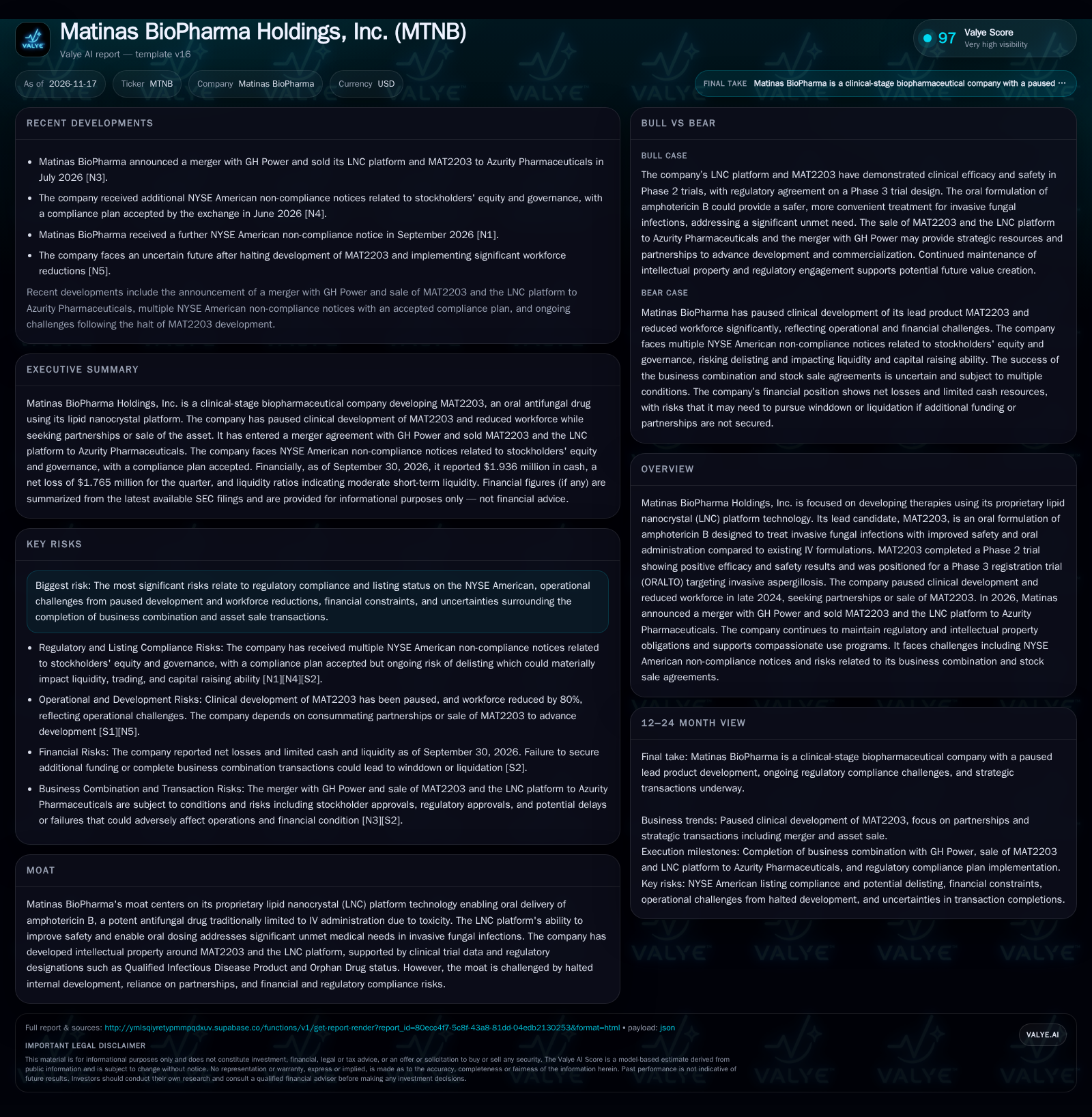
Matinas BioPharma, once advancing an innovative oral antifungal therapy, has shifted focus to asset monetization after pausing internal development and reducing its workforce. The company’s future now depends on the successful sale of MAT2203 and the LNC platform, completion of a business combination with GH Power, and maintaining NYSE American listing compliance in the face of ongoing financial and operational headwinds. [S1] [S2] [N1] [N3] [N4] [N5]
Matinas BioPharma Holdings, Inc., once advancing a differentiated oral antifungal therapy through its lipid nanocrystal (LNC) platform, now finds its future dictated by the outcome of strategic transactions and its ability to preserve listing status. After pausing clinical development of its lead candidate MAT2203 and reducing its workforce by 80% in late 2024, the company has shifted to a transactional strategy, seeking to monetize its intellectual property and platform through asset sales and a business combination with GH Power. Against a backdrop of financial losses, cash constraints, and repeated NYSE American non-compliance notices, Matinas’s ability to deliver value now hinges not on clinical or commercial execution, but on the outcome of asset negotiations and regulatory compliance. [S1] [S2] [N1] [N3] [N4] [N5]
Strategic Shift: From Clinical Development to Asset Monetization and Transactional Uncertainty
Matinas BioPharma’s most material developments are defined by a dramatic pivot away from internal R&D toward asset monetization and transactional outcomes. The company paused further clinical development of its lead product, MAT2203—an oral amphotericin B formulation—following positive Phase 2 data but amid financial and operational constraints. This move was accompanied by an 80% reduction in workforce in late 2024. [S1] [N5]
The company remains listed on the NYSE American but has received multiple non-compliance notices related to stockholders’ equity and governance, with a compliance plan accepted by the exchange. However, the specter of delisting remains. [N1] [N4] [S2]
Financially, Matinas reported cash and equivalents of $1.936 million as of September 30, 2026, with a net loss of $1.765 million for the quarter. The company reported cash and liquidity metrics for the period; these figures do not by themselves establish operating runway, investment capacity, financial flexibility, or financing capacity. [S2]
The company’s current strategy is centered on the sale of MAT2203 and the LNC platform to Azurity Pharmaceuticals and a potential business combination with GH Power, both of which are subject to numerous conditions and uncertainties. [N3] [S2]
How Value Could Be Captured: Platform Monetization and the Economics of Transactional Outcomes
Matinas’s original business model was predicated on successful clinical development, regulatory approval, and commercialization of MAT2203 and other LNC-based therapies. The LNC platform’s enabling of oral amphotericin B, if successfully commercialized, could have addressed a major unmet need in invasive fungal infections, with pricing potential reflecting improved safety and convenience relative to IV formulations. In such a scenario, value would have accrued from premium pricing, potential orphan drug exclusivity, and the ability to expand into additional indications—a classic high-margin, low-volume rare disease revenue model.
However, with development paused and internal capabilities reduced, Matinas’s economics now hinge on extracting value from its intellectual property through asset sales, out-licensing, or business combinations. The principal economic levers have shifted from future product revenue to near-term transaction proceeds, milestone payments, or royalties if included in any asset sale agreement. The company’s cost structure is now lean, but also lacks the infrastructure to restart independent development without substantial new capital or partnership.
The company’s ability to capture meaningful value will depend on negotiating favorable terms with Azurity Pharmaceuticals and successfully closing the GH Power transaction. The timing and certainty of any proceeds are unpredictable, and the company’s reported cash balance constrains its negotiating leverage. If transaction proceeds are sufficient, they could provide a bridge to future opportunities or enable an orderly wind-down. If not, the risk of insolvency or forced liquidation increases.
Competitive Moat and Its Erosion: LNC Platform Potential Versus Execution and Funding Gaps
Matinas’s competitive advantage historically stemmed from its proprietary lipid nanocrystal (LNC) platform, which enables oral delivery of amphotericin B—a molecule with established efficacy but notorious for IV-related toxicity. The platform’s technical differentiation was supported by positive Phase 2 efficacy and safety signals in cryptococcal meningitis and regulatory alignment on Phase 3 trial design. [S1]
In principle, this could have established a defensible moat through intellectual property, regulatory exclusivity (Orphan Drug, Qualified Infectious Disease Product designations), and a head start in oral amphotericin B development. However, the halt to internal development and workforce reductions have substantially weakened execution capacity, making Matinas dependent on external parties for value realization.
Competitors in the antifungal space include both large pharmaceutical companies with established IV and oral antifungal agents and smaller biotechs pursuing novel formulations or mechanisms. The risk for Matinas is that, without internal momentum or a strong partner, its platform becomes stranded IP—potentially leapfrogged by competitors with greater resources or alternative oral delivery technologies. The moat remains theoretical unless a partner or acquirer commits to advancing and commercializing MAT2203 or the LNC platform.
Transaction Success: Asset Sale and Merger Unlock Residual Value
In the favorable scenario, Matinas successfully closes the sale of MAT2203 and the LNC platform to Azurity Pharmaceuticals on terms that include upfront cash and/or meaningful downstream milestones or royalties. Simultaneously, the business combination with GH Power is completed, providing either liquidity for shareholders or a continuing equity interest in the combined entity. [N3] [S2]
This outcome could be catalyzed by Azurity or another acquirer recognizing the strategic value of oral amphotericin B, especially with positive Phase 2 data and a ready Phase 3 protocol. If the company maintains NYSE American listing through transaction completion, it may preserve access to public markets for future capital raises or strategic flexibility.
Evidence confirming this scenario would include: (1) definitive agreement execution and subsequent closing of the asset sale and business combination; (2) disclosure of material cash proceeds or milestone payments; (3) regulatory filings or press releases affirming transaction completion and continued listing status.
Prolonged Transactional Limbo: Operational Pause and Listing Risk Define the Middle Path
The most plausible near-term trajectory is a period of prolonged uncertainty, with Matinas maintaining its regulatory and IP obligations, supporting compassionate use, and seeking to close asset sale and combination transactions. Cash burn is minimized but net losses persist, and the company’s limited resources constrain its ability to withstand delays or renegotiations.
Ongoing NYSE American non-compliance notices and reliance on a compliance plan keep listing risk front and center. If transactions are delayed, renegotiated, or fail to close, Matinas may exhaust its cash position before value can be realized, forcing difficult decisions around wind-down or liquidation.
Confirmation of this scenario would be: (1) continued disclosure of regulatory and listing compliance activities; (2) lack of material transaction closings or cash inflows; (3) maintenance of a skeletal corporate structure with minimal new development activity. Falsification would come from either successful transaction closings or a forced delisting/wind-down announcement.
Transaction Failure and Delisting: The Path to Forced Liquidation
If the asset sale to Azurity and/or the GH Power business combination fail to close—due to regulatory, shareholder, or counterparty issues—Matinas would be left with limited cash, no ongoing product development, and no clear path to value creation. Ongoing net losses would rapidly erode remaining liquidity. [S2]
A delisting from NYSE American would further restrict access to capital and reduce visibility, potentially triggering investor redemptions, covenant breaches, or other adverse outcomes. In this scenario, Matinas could be forced into an orderly wind-down or liquidation, with residual value for shareholders highly uncertain and possibly negligible.
Evidence confirming the downside scenario would include: (1) public disclosure of failed or terminated transaction negotiations; (2) NYSE American delisting; (3) announcements of wind-down or liquidation proceedings; and (4) further workforce reductions or cessation of all clinical and regulatory activities.
Testing the Matinas Thesis: Transaction Outcomes, Listing Status, and Asset Value Realization
Progress and closing of the MAT2203 and LNC platform sale to Azurity Pharmaceuticals, including disclosure of agreed terms and upfront or milestone payments, would directly impact value realization.
Definitive progress or closing of the business combination with GH Power, including shareholder and regulatory approvals, would determine the company’s ongoing structure and liquidity.
Any additional NYSE American non-compliance notices, compliance plan updates, or actual delisting events would materially affect the company’s ability to raise capital and retain shareholder value.
Disclosure of ongoing cash burn, cash balance, and updated run-rate estimates (if provided) would help assess the timeline before a forced transaction or wind-down becomes necessary.
Updates on the maintenance or extension of MAT2203’s regulatory designations (Orphan Drug, Qualified Infectious Disease Product) and IND status, which could influence asset attractiveness to acquirers.
Any indication of revived clinical development, new partnerships, or out-licensing of the LNC platform beyond the Azurity transaction would signal alternative value creation paths.
Board and management changes, particularly those with transactional or restructuring experience, may foreshadow the direction and likelihood of strategic outcomes.
A useful metric would be disclosure of any ongoing compassionate use requests or expanded access programs for MAT2203, which may reflect continuing clinical need and strategic relevance.
Disclaimer: This is research-only, informational analysis and not investment advice. It may include AI-generated interpretation and general industry context. Always verify important details using primary sources.

Comments