
NextEra Energy’s Dual Engine: Regulated Utility Stability Meets Renewable Growth Ambitions
NextEra Energy leverages its Florida Power & Light regulated utility and renewables platform to navigate evolving energy markets and capital demands.
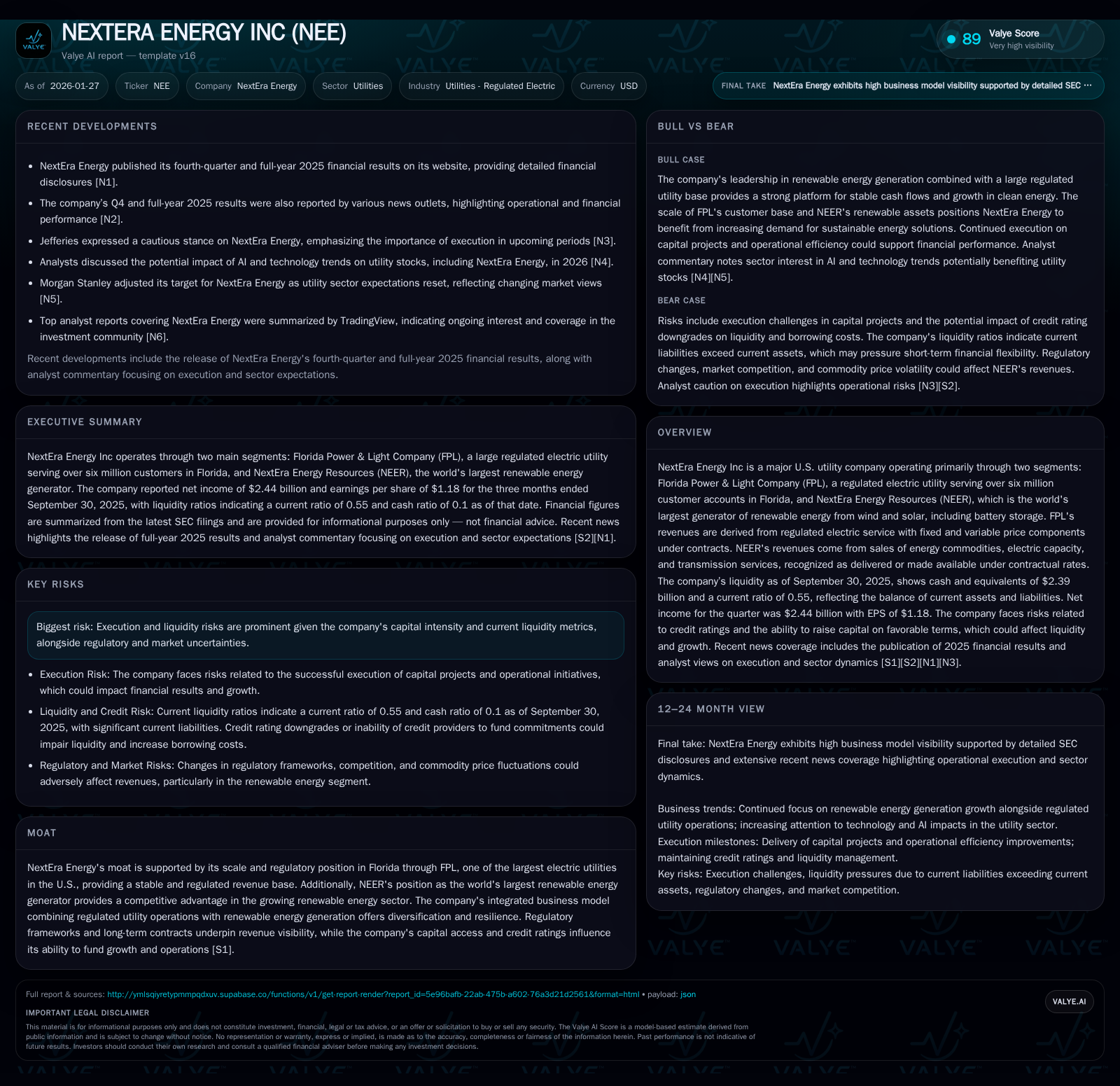
NextEra Energy Inc operates two core segments: Florida Power & Light (FPL), a large regulated utility serving over six million customers in Florida, and NextEra Energy Resources (NEER), the world’s largest renewable energy generator. Recent quarterly results underscore solid earnings supported by regulatory frameworks and long-term contracts, yet capital intensity and liquidity constraints pose execution challenges. The company’s integrated model provides revenue diversification, but competitive pressures in renewables and regulatory uncertainties require close monitoring.
What Changed Recently
NextEra Energy released its fourth-quarter and full-year 2025 financial results, showing net income of $2.44 billion and earnings per share of $1.18 for the latest quarter [N1][N2]. These results reaffirm the company’s earnings stability derived from its regulated utility segment (FPL) and growth from its renewable energy platform (NEER). Morgan Stanley recently upgraded its outlook on NextEra, citing a reset of utility expectations in 2026, yet Jefferies maintains a cautious stance emphasizing execution risks [N4][N6]. Additionally, discussion around AI's role in energy markets has begun to surface, speculating on how utilities like NextEra could benefit from technology-driven efficiencies [N3].
Despite positive headline earnings, liquidity metrics remain a focal point. NextEra reported cash and equivalents of $2.39 billion as of September 30, 2025, but with current liabilities exceeding current assets, the current ratio stands at a conservative 0.55, reflecting tight short-term liquidity conditions [S1]. Capital intensity remains a defining operational feature as the company continues to invest heavily in generation assets and grid modernization.
Business Model as a System
NextEra operates principally through two segments: Florida Power & Light (FPL) and NextEra Energy Resources (NEER) [S1].
Florida Power & Light (FPL): This is a vertically integrated, regulated electric utility serving over six million customer accounts in Florida. Revenues stem from contracts containing both fixed and variable price components tied to energy usage. Regulatory commissions set allowed rates, providing revenue visibility but also limiting upside. Approximately $590 million in fixed-price contract revenues remain over contract terms, ensuring predictable cash flows [S2]. FPL’s role encompasses generation, transmission, and distribution within its service territory.
NextEra Energy Resources (NEER): NEER is the world’s largest generator of renewable energy from wind, solar, and battery storage. It operates primarily in wholesale markets, selling energy commodities, electric capacity, and transmission services. Revenue recognition aligns with delivery and availability of energy or capacity per contract terms. NEER’s contracts often span multiple years, with maturities extending well beyond the near term, allowing for forward revenue visibility [S2]. The segment focuses on development, construction, and operation of renewable and clean energy assets.
These segments function as complementary pillars: FPL provides regulated revenue stability, while NEER drives growth through renewable project development and merchant sales. The company integrates these to diversify risk and capitalize on energy transition opportunities.
The business model requires ongoing capital deployment for asset construction and maintenance, with sustained investments planned over several years [S14]. Funding sources include operating cash flow, debt issuance, and equity capital, balancing liquidity needs amidst a capital-intensive footprint.
Industry Map & Competitive Battlefield
The U.S. utilities sector is bifurcated between regulated utilities with stable, rate-regulated revenues and competitive merchant generators selling in wholesale markets. NextEra straddles both domains, offering a hybrid model:
Regulated Utilities: In Florida, FPL operates under state regulatory frameworks that permit cost recovery and a regulated return on invested capital. This environment provides stable earnings but constrains upside and imposes regulatory compliance costs.
Renewable Energy Generation: NEER competes in a global and U.S.-dominated renewable energy market alongside traditional utilities expanding renewables, independent power producers, and emerging technology firms. Auction-based project awards, tax incentives, and power purchase agreements (PPAs) shape competitive dynamics. Price competition and supply chain constraints for components like solar panels and batteries pressure margins.
Transmission: NextEra Energy Transmission, a subsidiary, plays a role in regional grid interconnections, which are increasingly critical for integrating renewables. Transmission projects face regulatory approvals and require coordination among multiple stakeholders.
Competitors include Southern Company, Duke Energy, and Dominion Energy in regulated markets, and renewable-focused independent power producers such as Invenergy and Pattern Energy. Competitive advantages derive from scale, regulatory relationships, capital access, and technology deployment.
Where the Economics Become Real
NextEra’s unit economics differ markedly between FPL and NEER:
FPL Economics: The regulated nature caps margins but ensures predictable cash flows. Revenue is driven by rate base growth and allowed returns, moderated by regulatory reviews. Operating expenses, including fuel costs and maintenance, are largely recoverable. Capital expenditures (~$800 million to $900 million annually projected) focus on grid maintenance, storm hardening, and incremental capacity [S14]. Depreciation and amortization run over $1 billion annually, reflecting significant asset bases [S16].
NEER Economics: Margins depend on contract pricing for energy and capacity, project development costs, and operational efficiencies. NEER benefits from tax credits and renewable incentives, which materially affect after-tax project returns [S6]. Commodity price exposure exists but is partly mitigated via hedging and long-term contracts. The variable nature of renewables introduces intermittency risk, managed through storage and diversified asset portfolios. Project commissioning timing and capital deployment pace are critical for realized returns.
Liquidity constraints are evident with a current ratio of 0.55, signaling more current liabilities than current assets, necessitating efficient working capital management and capital markets access [S1][S13]. Long-term debt issuance and refinancing strategies will be vital to fund ongoing capex and acquisitions.
Diligence Questions / Disconfirming Signals
Execution Risks: How effectively can NextEra manage project construction timelines and cost overruns, particularly in NEER’s capital-intensive renewables and storage projects? Past delays or cost escalations would challenge earnings growth.
Liquidity Adequacy: Given the current ratio below 1, is the company’s liquidity cushion sufficient to cover near-term obligations? What is the maturity schedule and cost of outstanding debt, and how reliant is the company on capital markets access?
Regulatory Environment: How might changes in Florida’s regulatory policies impact FPL’s allowed returns and investment approvals? Could policy shifts at federal or state levels affect renewable incentives critical to NEER?
Market Competition: Is NEER’s scale advantage sustainable against new entrants leveraging innovative technologies or lower costs? How are supply chain constraints for critical components affecting project pipelines?
Commodity Price Exposure: To what extent does NEER’s revenue remain exposed to commodity price volatility despite hedging? Could rising interest rates or inflation pressure project economics?
Technology Adoption: How is NextEra incorporating emerging technologies like AI or grid modernization to improve operational efficiency and customer engagement?
Capital Allocation: Are investment priorities balanced between sustaining FPL’s grid reliability and scaling NEER’s growth, considering capital constraints?
Environmental & Social Governance: How does NextEra manage environmental liabilities, community relations, and workforce challenges amid rapid renewable deployment?
Conclusion
NextEra Energy presents a distinctive model combining regulated utility stability with aggressive renewable growth, positioning itself at the nexus of energy transition. Its financial disclosures reveal a company balancing the demands of capital-intensive growth against liquidity management and regulatory compliance. While its scale and integrated segments form a moat, execution and funding risks remain salient. The evolving competitive landscape and policy environment will test NextEra’s ability to sustain its leadership in both regulated and unregulated energy markets.
This analysis is based solely on publicly available information and does not constitute investment advice or a recommendation to buy or sell securities.
Disclaimer: This is research-only, informational analysis and not investment advice. It may include AI-generated interpretation and general industry context. Always verify important details using primary sources.

Comments