
NeoVolta Accelerates Utility-Scale Battery Production with Strategic Joint Venture
NeoVolta's recent capital commitments and joint venture formation mark a strategic escalation in manufacturing capacity to capture growth in energy storage.
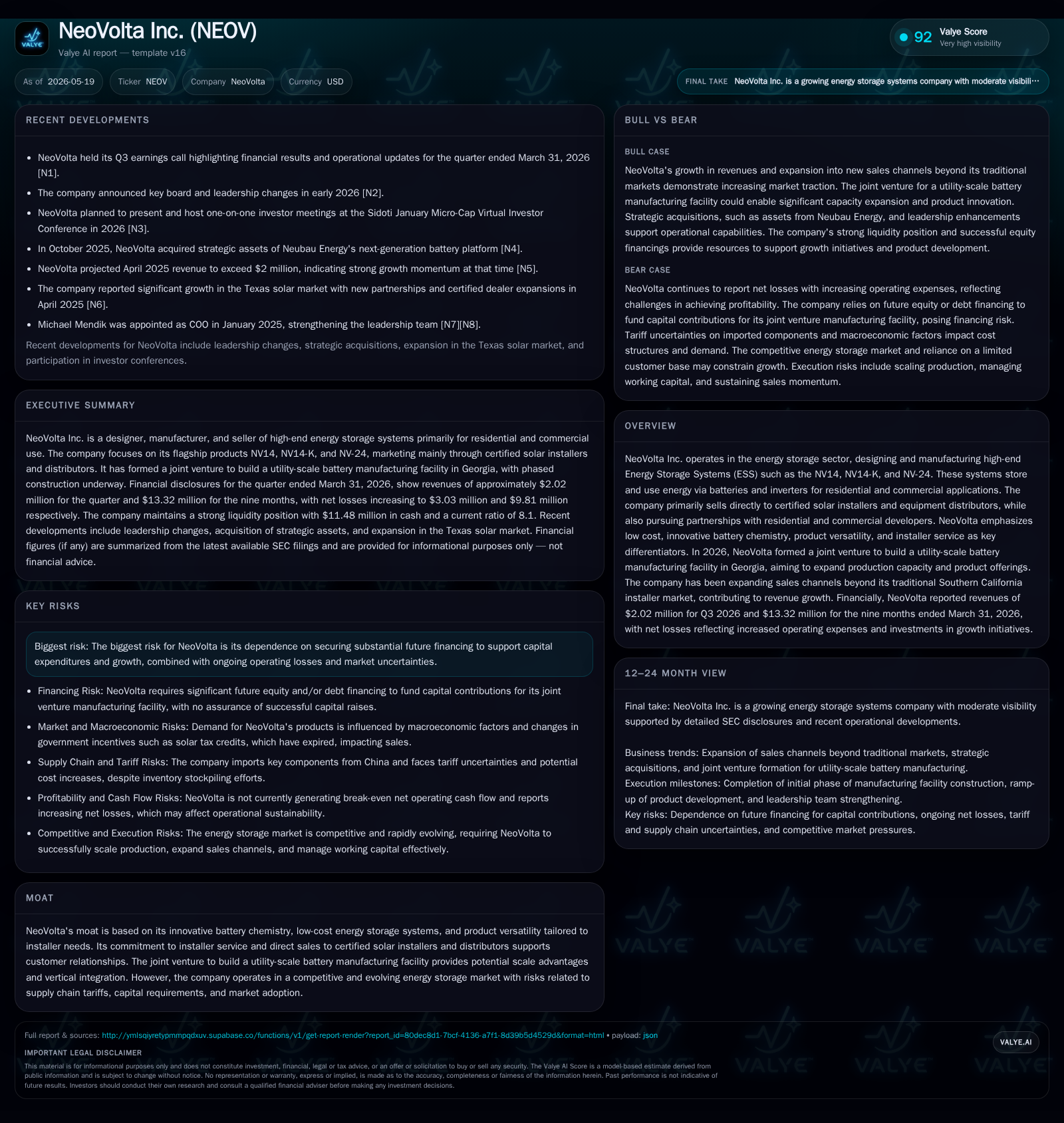
NeoVolta Inc. has taken decisive steps in early 2026 to expand its production footprint through an 80%-owned joint venture focused on utility-scale battery manufacturing in Georgia, backed by phased capital contributions totaling up to $40 million by mid-2027. This move complements its existing product portfolio—high-end energy storage systems tailored for certified solar installers—and supports geographic expansion beyond its traditional Southern California base. While revenues have grown with expanding sales channels, ongoing net losses and elevated operating expenses reflect the costs of scaling and new product development. The company's ability to secure additional financing for future JV capital calls remains a critical watchpoint amid competitive industry pressures and tariffs on component imports.
Latest Quarterly Operating Update: Capital Infusions Power Capacity Build-Out
NeoVolta's May 15, 2026 Form 10-Q unveils the material progress on a newly formed joint venture (JV) that marks a significant inflection point for the company's manufacturing strategy. Established in January 2026 with the U.S. affiliate of a foreign entity, NeoVolta holds an 80% stake in this domestic JV tasked with developing a utility-scale battery manufacturing facility in Georgia. The company authorized an initial capital contribution of $7 million at formation followed by an anticipated second payment of $8 million due in June 2026 primarily funding equipment procurement.
The plant construction is designed as a multi-phase project, with the initial phase slated for completion by summer 2026 enabling limited battery production for customer sales. This marked shift from a primarily small-to-mid scale production model towards substantial utility-scale capacity reflects NeoVolta's ambition to underpin broader product offerings and generate sustainable revenue streams over time. However, executing this vision depends heavily on successful capital raises earmarked for additional contributions up to $25 million through June 30, 2027; failure to fully fund these JVs may trigger dilution through incoming third-party members as per joint venture terms. Thus, this JV represents both a growth catalyst and a financing risk requiring close monitoring from investors.
Core Business Model and Product Differentiation: ESS Innovation for Installer Channels
NeoVolta specializes exclusively in Energy Storage Systems (ESS) focused on residential and commercial use cases. Its flagship products—the NV14 series including NV14-K and NV-24—combine proprietary battery chemistry innovations with integrated inverters targeted at certified solar installers and equipment distributors. This direct-sales model ensures tight alignment with installers who form the primary purchasing channel while facilitating product customization tailored to emerging energy delivery trends.
A key element of NeoVolta's competitive positioning lies in its emphasis on low-cost systems combined with versatile configurations adaptable across various site requirements. Its commitment to dedicated installer service further enhances customer retention by embedding NeoVolta’s solutions within installers’ offerings rather than competing solely on price or feature sets. As new generation products are developed, resources remain fully focused on enhancing technological capabilities that address sector demands such as modular scalability, back-up functionalities, and grid integration compatibility.
Competitive and Industry Context: Fragmented Storage Market Driving Scale Needs
The energy storage sector remains highly competitive with numerous startups jostling alongside incumbents seeking scale economies crucial in reducing EBITDA-margin compressing costs. NeoVolta’s move into utility-scale manufacturing via the JV aligns it more closely with peers capable of producing batteries at scale—an increasingly non-negotiable factor given pricing pressures exacerbated by volatile raw material prices and tariffs.
Currently reliant on Asian suppliers for batteries and inverter components primarily sourced from China, NeoVolta has faced tariff shifts following U.S. trade policy changes commencing April 2025. The Supreme Court’s February 2026 decision invalidating prior tariffs under the International Emergency Economic Powers Act has introduced some regulatory uncertainty but also underscores the challenge of stable supply chain cost management. Stockpiling inventory pre-tariff surges evidenced proactive procurement but was inherently costly.
Amid this backdrop, vertical integration through JV-owned manufacturing capability offers differentiated control over cost structure while fostering faster innovation cycles necessary for competitive viability.
Strategic Growth Drivers: Manufacturing Expansion and Channel Diversification
Key growth drivers now center around scaling production capacity via phased plant commissioning starting summer 2026 which will facilitate both volume expansions in existing product lines and enable introduction of new ESS variants aligned with evolving market demands.
Simultaneously, NeoVolta expands beyond its traditional Southern California footprint into additional regional markets targeting residential developers and commercial clients directly—a transition supported by augmented sales efforts highlighted in its August 2022 equity raise proceeds usage.
This dual-pronged approach—capacity scale coupled with broadened sales channels—aims to convert growing pipeline interest into sustainable order book improvements while enhancing brand presence well beyond local installer markets.
Additionally, management services agreements such as that entered into with Potisedge Technology Singapore suggest tactical partnerships extending marketing coordination expertise specifically tuned toward commercial segment acceleration.
Risks and Constraints: Financing Needs and Market Uncertainties
While strategic initiatives position NeoVolta strongly for growth opportunities within the energy storage industry’s structural expansion phase, they come laden with execution risks centering chiefly on financing adequacy. The company openly discloses expectations of requiring upwards of $25 million more capital contributions for its JV through mid-2027 which hinge upon raising further equity or debt amid prevailing market conditions.
Failure to secure these funds could dilute NeoVolta’s majority JV ownership stake via call rights exercisable by foreign JV partners or external entrants willing to fund deficits.
Compounding funding risks are elevated operating expenses reflecting rapid team expansion under recently engaged CEO (April 2024), intensified R&D efforts focused on next-generation products ($403K vs $28K R&D quarterly spend YoY), marketing ramp-up, travel costs, cash/non-cash compensation inflation—including increased stock-based compensation—all pressuring near-term profitability metrics.
Furthermore, expiration of federal solar tax credits impacting end-consumer demand presents macroeconomic headwinds affecting short-term revenue trajectories despite long-term favorable trends toward electrification/storage adoption.
Forward-Looking Signals: JV Milestones and Sales Expansion Trajectory
Monitoring execution milestones offers tangible markers of progress: the initial plant phase completion expected summer 2026 will be pivotal validating production capability irrespective of scaled volumes initially achievable.
The anticipated second capital contribution installment in June 2026 serves not only as operational fuel but also as a financial litmus test regarding access to incremental funding sources or investor confidence.
Sales channel evolution beyond Southern California markets will be visible through reported backlog growth or incremental order intake announcements typically highlighted during earnings calls or SEC updates [N1]
Management commentary around margin improvements stemming from scalable manufacturing or new product introductions will further clarify path toward operating leverage amidst current net loss profile.
Financial Overview: Liquidity, Cash Burn, and Capital Structure Snapshot
As of March 31, 2026, NeoVolta held approximately $11.5 million cash & equivalents with current assets totaling $22.2 million against current liabilities near $2.7 million yielding a robust current ratio exceeding 8x—a liquidity cushion suitable for short-term obligations.[F1] Operating cash burn remains elevated reflecting nearly $8.2 million used over nine months ended March reflecting increased personnel expenses plus working capital absorption such as accounts receivable buildup.[S2],[S4],[S9]
Net losses widened materially to over $3 million for Q3 alone compared to approximately $1.45 million year-over-year owing largely to heightened G&A spending ($3M vs ~$1.85M) including marketing plus stock compensation expense increases.[S6],[S11] Interest expense rose due to higher borrowings utilized from private lenders since late 2024 even though rates decreased relative to prior year periods.[S6]
Equity financings closing after August 2022 offering cumulatively exceeded $22 million prompting concurrent working capital improvement though future rounds remain vital given JV investment commitments [S9]
Collectively financial data underscores that NeoVolta is investing heavily ahead of anticipated operational ramp yet faces ongoing dependence on external funding—particularly equity—for sustained viability beyond next fiscal year horizon.
Disclaimer: This analysis is based solely on public filings from May 15-19, 2026 interval and related news; it does not constitute investment advice or research views. Readers should consider independent research before forming opinions about NeoVolta Inc.
Disclaimer: This is research-only, informational analysis and not investment advice. It may include AI-generated interpretation and general industry context. Always verify important details using primary sources.

Comments