
Neuphoria Therapeutics Faces Strategic Crossroads Following Negative Phase 3 SAD Trial
Neuphoria's latest quarterly report highlights critical liquidity and clinical development challenges after disappointing Phase 3 results in social anxiety disorder.
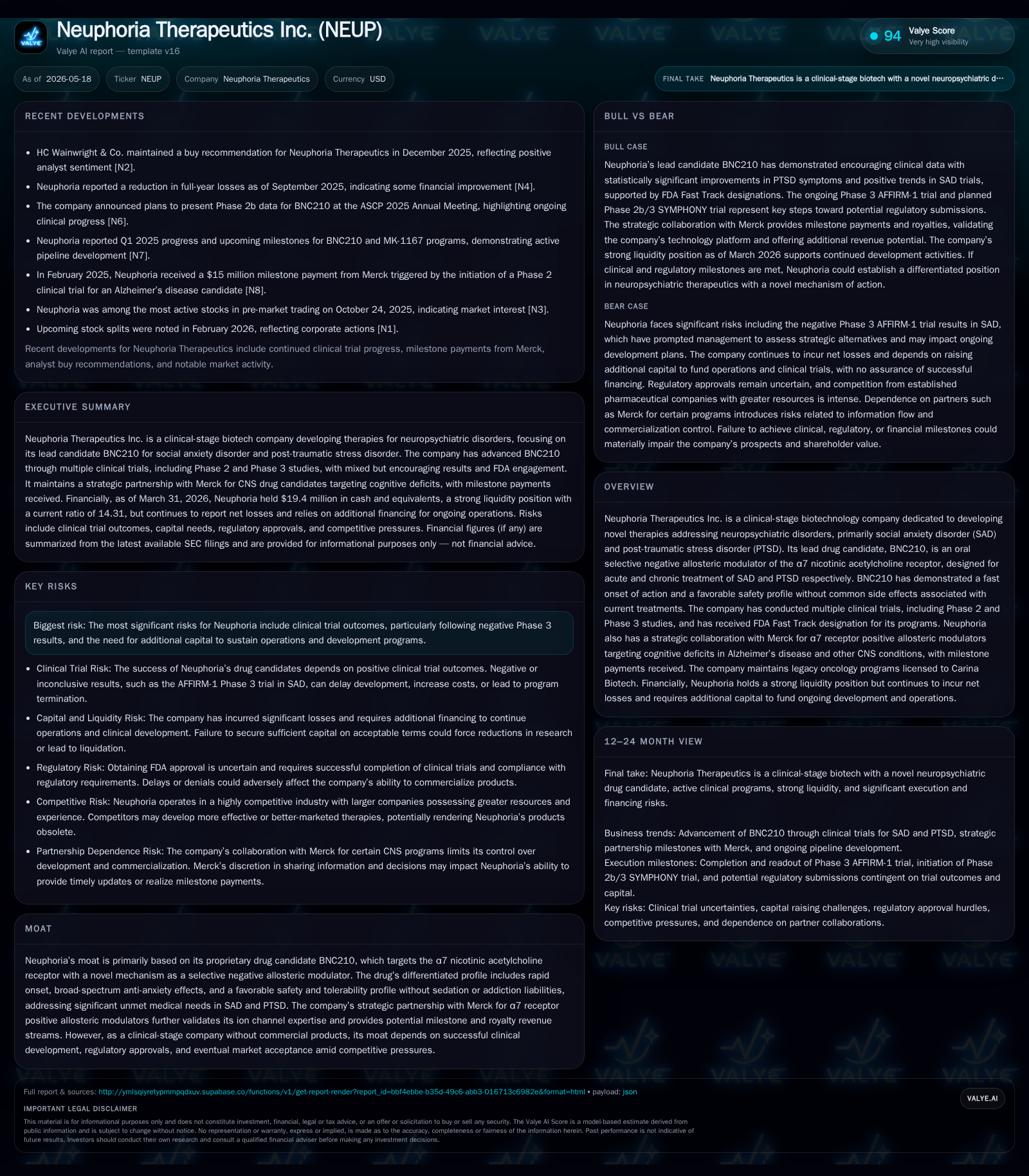
In its most recent SEC filing for the quarter ended March 31, 2026, Neuphoria Therapeutics disclosed ongoing financial strain and strategic evaluation following negative outcomes in its Phase 3 AFFIRM-1 trial for BNC210 in Social Anxiety Disorder (SAD). The company’s lead candidate, BNC210, known for a novel mechanism targeting the α7 nicotinic acetylcholine receptor, demonstrated promising early-stage signals but failed to meet primary efficacy endpoints in late-stage studies. Neuphoria’s business model revolves around advancing this clinical-stage asset alongside collaborative programs with Merck targeting cognitive deficits. With cash reserves sufficient only through mid-2027 and a high cash burn rate, Neuphoria’s near-term viability depends on securing additional capital or pursuing strategic alternatives amid intensified competition and regulatory complexities in neuropsychiatric drug development.
Recent Operating Update: Q1 2026 Filing Highlights Critical Challenges
Neuphoria Therapeutics’ latest quarterly report dated May 15, 2026 [S2] underscores a pivotal moment for the clinical-stage biotechnology company centered on its flagship molecule BNC210. Most notably, the company disclosed that its financial statements were prepared on a going concern basis amid significant uncertainty following negative clinical outcomes from the Phase 3 AFFIRM-1 trial assessing BNC210's efficacy as an acute—"as needed"—treatment for social anxiety disorder (SAD). Management is actively evaluating strategic alternatives to address operational costs and secure additional funding required to sustain ongoing activities.
Despite this adversity, the firm holds approximately $19.4 million in cash and equivalents as of March 31, 2026 [F1]. Current liabilities stand at around $1.5 million, resulting in a very comfortable current ratio exceeding 14 [F1], reflecting a low near-term liquidity strain but highlighting the pressing need for capital beyond mid-2027 to finance further development.
There have been no material changes to other risk factors since the prior annual filing besides those surrounding recent clinical developments [S2]. This quarterly disclosure flags an urgent need for balance-sheet augmentation or strategic transactions to safeguard continuity.
Business Model: Clinical Innovation Focused on Neuropsychiatric Disorders
Neuphoria operates exclusively as a clinical-stage biopharmaceutical company specializing in orally active allosteric modulators targeting ion channels within the central nervous system (CNS) [S1]. Its core asset is BNC210—a proprietary selective negative allosteric modulator (NAM) of the nicotinic acetylcholine receptor. This receptor mediates key neurophysiological functions related to emotional regulation and cognition.
The companys value proposition emphasizes BNC210s unique pharmacology demonstrating rapid onset of anti-anxiety effects without common side effects such as sedation or addiction potential that plague standard therapies like benzodiazepines or antidepressants. This profile aims to address substantial unmet medical needs affecting over 27 million U.S [S1]. SAD patients alone as well as chronic PTSD sufferers
Revenue generation remains contingent on successful progression through regulatory approval phases and eventual product commercialization [S1]. Currently, no product revenues exist; funding largely arises from equity issuances, milestone payments from collaboration agreements most notably with Merck and government incentives
Merck's partnership in developing receptor positive allosteric modulators (PAMs) for cognitive deficits provides milestone payments (the latest being $15 million earned upon initiation of Merck's Phase 2 Alzheimers trial) and future royalties on approved products [S1][S16]. This diversifies income prospects beyond Neuphorias own pipeline but also limits direct control over these assets' commercial execution.
Industry Structure and Competitive Position
Neuropsychiatric therapeutics represent a highly challenging domain marked by long development timelines, complex CNS biology, high attrition rates in late-stage trials, and stringent regulatory scrutiny. The competitive landscape includes established psychiatric medications (SSRIs, benzodiazepines), newer entrants exploring novel mechanisms (e.g., ketamine analogs, psychedelic-derived compounds), and multiple biotech firms advancing CNS-targeted ion channel modulators.
Within this milieu, Neuphoria differentiates through its focus on selective negative allosteric modulation of receptors targeting anxiety and trauma-related stress without sedation or addictive risk an uncommon therapeutic niche where FDA approvals have stagnated for nearly twenty years [S1]. However, failure to meet primary endpoints in Phase 3 SAD trials curtails momentum against competitors potentially gaining regulatory approval from alternative mechanisms or repurposed agents.
Moreover, the company must navigate third-party payor dynamics characterized by fragmented coverage decisions and pricing pressures that increasingly challenge reimbursement viability even post-FDA approval [S3][S22]. Regulatory requirements enforce rigorous safety monitoring post-marketing adding operational complexity to any commercial launch.
Growth Drivers
Clinical Development Advancements
BNC210s early-phase data showed promise with rapid onset anxiolytic effects and strong safety/tolerability profiles relative to standard care agents [S1]. Positive FDA End-of-Phase 2 discussions enabled transition into pivotal SAD trials with the AFFIRM-1 study initiated mid-2024 targeting ~332 patients across U.S. sites.
Although AFFIRM-1 did not meet its primary SUDS endpoint conclusively [S1], encouraging secondary trends suggest potential salvage strategies including refined patient selection or dosing adjustments themes typical of neuropsychiatric drug development where magnitude of effect can be subtle yet clinically meaningful.
Pending regulatory feedback on this trial outcome will critically influence the trajectory toward PTSD indications or alternative CNS conditions addressed by preclinical assets focusing on Kv3.1/3.2 potassium channels [S1]
Partnership Milestones & Royalties
The collaboration with Merck extends growth opportunities via milestone-triggered payments related to Merck's proprietary positive allosteric modulators aimed at cognitive dysfunctions including Alzheimer's disease dementia [S16]. These payments bolster capital resources while validating Neuphorias ion channel platform expertise.
Carina Biotech licensing for CAR-T innovations tied to certain immune-oncology targets similarly generates contingent milestones adding another revenue vector albeit outside Neuphorias core CNS focus [S14]
Addressing Unmet Medical Needs & Market Size
The global neuropsychiatric drug market remains vast but underserved particularly regarding acute social anxiety treatments lacking rapid non-addictive options. The absence of FDA-approved new drugs in these segments since early 2000s underpins structural demand despite periodic headwinds from clinical setbacks.
Risks / Watchpoints / Growth Constraints
Clinical Trial Outcomes & Regulatory Risks
BNC210s failure to achieve meaningful primary outcome improvements in a pivotal Phase 3 setting represents an existential threat given its role as lead candidate underpinning the company's valuation and fundraising ability [S2]. Failure modes common to CNS drug trials including placebo response rates, endpoint sensitivity limitations, and heterogeneous patient populations may complicate trajectory going forward.
Regulatory agencies may also impose additional data requirements such as further trials or delayed approvals impacting time-to-market velocity.
Financing & Liquidity Pressures
Neuphoria maintains about $19.4 million liquidity currently [F1]. Current liabilities of approximately $1.5 million yield a strong current ratio above 14 [F1], indicating solid near-term liquidity. However, given increased expenditures anticipated to complete remaining trials or commercialization preparations plus non-revenue status [S1], the company faces the need to secure additional funding beyond mid-2027 to sustain operations.
Competitive Innovation & Reimbursement Challengers
New modality entrants challenged standard efficacy/safety profiles continuously evolve CNS treatment landscape thereby compressing pricing power margins post-launch.[S3][S22] Payer pushback against high-cost therapies could further limit adoption escalation.
Operational Continuity & Strategic Dependencies
Dependence on external partners like Merck limits visibility into program milestones timing or material information flow which can impair planning.[S16] Furthermore, maintaining specialized talent pipeline amid stretched budgets presents execution risk.
What To Watch Next
- Management announcements regarding strategic alternatives including possible partnerships, asset divestitures or licensing deals aimed at bolstering liquidity.[S2]
- Updates on continuation decisions whether BNC210 development will pursue PTSD programs despite SAD trial setbacks.
- News flow from Merck collaboration regarding upcoming clinical milestones or royalty forecasts impacting revenue outlook.
- Any revised guidance on cash burn rates or capital raising initiatives ahead of second quarter fiscal year 2027 liquidity thresholds.
- Potential regulatory correspondence providing clarity on conditional approval prospects or label claims given mixed clinical signals.
Financial Profile Summary Contextualizing Operating Status
Neuphoria maintains cash & equivalents of approximately $19.4 million as of March quarter end reflecting a lean liability profile with current liabilities near $1.5 million yielding a robust current ratio above 14 indicative of conservative near-term financial cushioning [F1]
Despite modest net losses continuing into recent periods ($0.37 million net loss year ending June '25) [F1], operating outflows remain significant given ongoing R&D investment backing clinical progress. Revenue remains negligible consistent with lack of commercial products though milestone payments from collaborations contribute intermittently.[F1][S14]
Capital deployment will principally focus on sustaining pivotal trials if pursued further plus regulatory submissions alongside platform advancement activities addressing next-generation receptor modulators and potassium channel programs [S1].
This analysis is based solely on public SEC filings dated through May 2026 without extrapolation beyond cited facts. It does not constitute investment advice but aims to provide an industry-aware perspective grounded in Neuphoria Therapeutics disclosed operating realities.
Financial position in context
As of 2026-03-31, companyfacts shows $19mm in cash and equivalents [F1]. Current assets of $22mm and current liabilities of $1,513,309 imply a current ratio near 14.31x for 2026-03-31 [F1].
Disclaimer: This is research-only, informational analysis and not investment advice. It may include AI-generated interpretation and general industry context. Always verify important details using primary sources.

Comments