
NexMetals Mining: Botswana Drilling Results, Metallurgical Progress, and the Stakes of Exploration-Driven Value Creation
NexMetals Mining Corp.’s recent high-grade copper-equivalent drill results, metallurgical validation, and substantial capital raise sharpen the focus on its Botswana assets. But the company’s future pivots on converting technical momentum into resource scale, project economics, and funding continuity amid operational and market risks.
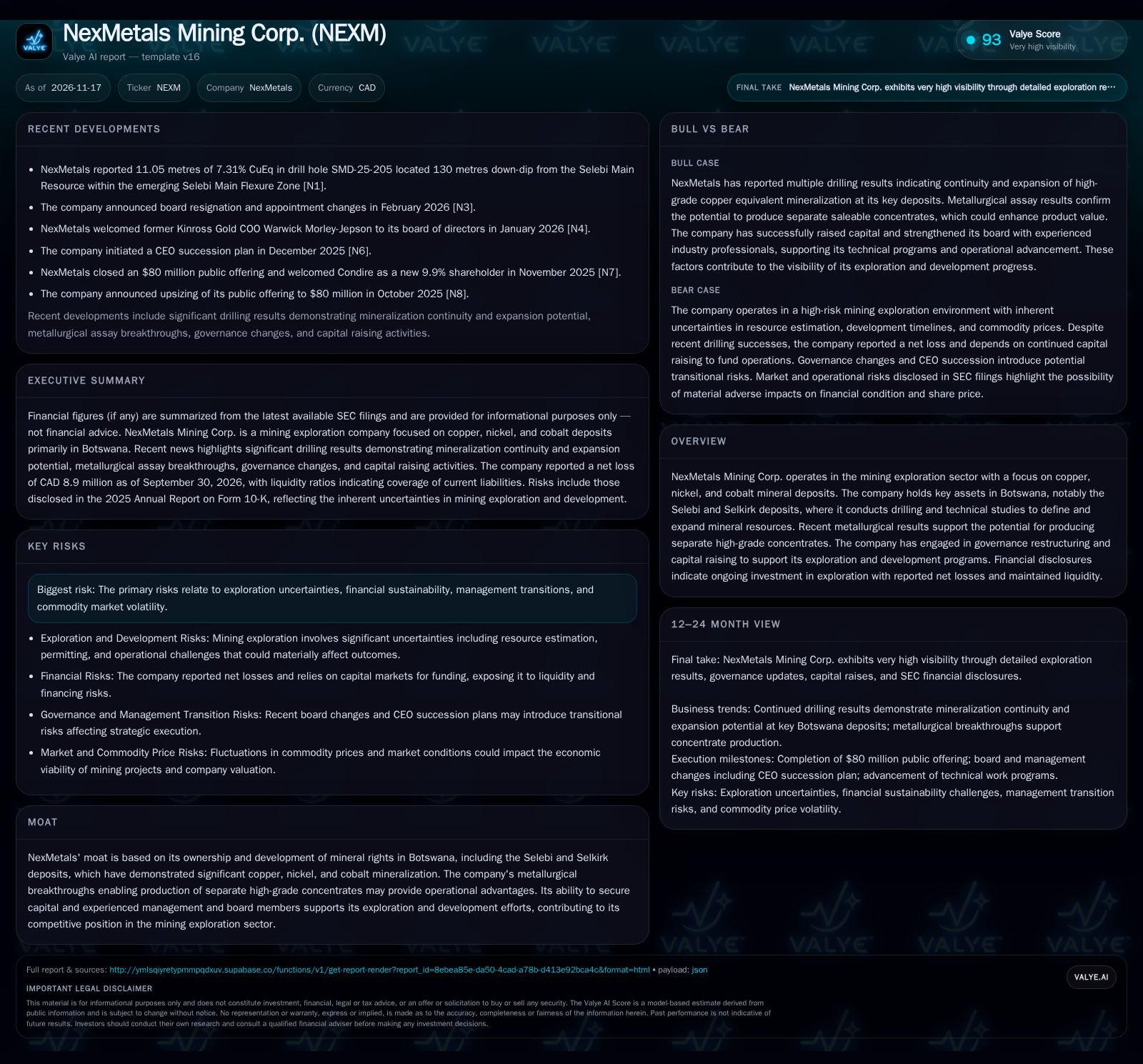
NexMetals Mining’s latest Botswana drilling confirms high-grade copper-nickel-cobalt mineralization and metallurgical viability for separate concentrates, while an $80M capital raise and board upgrades support ongoing exploration. The company’s value now hinges on resource delineation, technical de-risking, and the ability to secure further funding as it advances toward potential development. Key risks include exploration uncertainty, operational execution, and commodity price volatility. [N1] [N8] [S2]
NexMetals Mining Corp. is advancing its copper, nickel, and cobalt exploration agenda in Botswana with a blend of technical progress and fresh capital. Recent high-grade drill results at the Selebi deposits and metallurgical assays supporting the production of separate, high-value concentrates have reinforced the narrative of resource and commercial potential. However, as is typical for exploration-stage miners, NexMetals faces the dual challenge of translating technical milestones into scalable, economically viable resources and maintaining sufficient funding to bridge the long timeline to potential production. Board refreshes and a significant public offering provide near-term resources and credibility, but execution risk and market volatility loom large.
Recent Drilling, Metallurgical Breakthroughs, and Capital Raise Define NexMetals’ Trajectory
NexMetals Mining’s recent technical milestones are centered on its Botswana assets, where new drilling at the Selebi deposits has returned high-grade copper equivalent (CuEq) intersections—such as 11.05 metres at 7.31% CuEq and 32.45 metres at 4.61% CuEq—demonstrating both continuity and expansion potential of mineralization. These results suggest that the resource base could support future growth if further delineation is successful. Metallurgical assays have validated the ability to produce separate, high-grade copper and nickel-cobalt concentrates from the Selebi ore, a critical step for commercial viability in polymetallic deposits. Financially, NexMetals completed a CAD 80 million public offering and added Condire as a 9.9% shareholder, bolstering liquidity for ongoing exploration and technical de-risking. Governance has evolved with the addition of a former Kinross Gold COO to the board and the initiation of a CEO succession plan, signalling a focus on leadership depth and sector expertise. These developments collectively advance the company’s position, but underscore its dependence on continued technical success and capital access to sustain progress. [N1] [N7] [N8] [N3] [N4] [N6] [S2]
Exploration-Driven Value: The Economics of Early-Stage Mining Plays
NexMetals’ business model is inherently speculative and capital-intensive, typical of exploration-stage mining companies. The company’s current economics are defined by ongoing exploration expenditures, technical studies, and minimal or no operating revenue until a resource is delineated and a mine is developed. The company reported cash and liquidity metrics for the period; these figures do not by themselves establish operating runway, investment capacity, financial flexibility, or financing capacity. [S2]
The ability to produce separate high-grade concentrates could eventually could support premium pricing and broaden offtake options, but realization of this potential depends on resource scale, metallurgical recovery rates, and ultimate development costs. Fixed costs remain high during the exploration and feasibility phases, while variable costs will only become relevant upon transition to construction and eventual mining. Operating leverage is latent: if a viable project is proven, margins could expand rapidly on volume, but until then, the company remains exposed to dilution risk and market sentiment swings. Capital requirements will escalate sharply if the company moves from exploration to development, necessitating either substantial new equity, project financing, or joint venture arrangements.
Asset Quality, Technical Differentiation, and the Botswana Context
NexMetals’ competitive standing currently rests on the geological quality of its Selebi and Selkirk deposits and its ability to demonstrate technical progress. High-grade, continuous mineralization and metallurgical proof-of-concept are differentiators in the crowded exploration space, especially for copper, nickel, and cobalt—commodities with strategic significance for energy transition and battery supply chains.
However, the company competes for capital, technical talent, and offtake interest against a global cohort of junior and mid-cap explorers, as well as established producers seeking to replenish reserves. Botswana offers a stable regulatory environment and established mining infrastructure relative to many African peers, but the ultimate competitive advantage will depend on NexMetals’ ability to scale resources, de-risk metallurgy, and advance permitting ahead of potential rivals or acquirers. The recent board enhancements may improve credibility with institutional investors and potential partners, but technical and funding execution remain the primary battlegrounds.
From Drill Results to Resource Scale: What Could Drive a Step-Change in Value?
The most favorable scenario for NexMetals would see continued drilling success confirming large, high-grade, and continuous mineralized zones at Selebi and Selkirk, leading to a substantial upgrade in resource estimates. Further metallurgical work would reinforce the ability to produce high-quality, separate concentrates, attracting interest from strategic partners, major miners, or downstream buyers seeking secure supply of copper, nickel, and cobalt.
Confirmation of robust recoveries, scalable resources, and positive preliminary economics could trigger a re-rating, unlock project financing, or enable value-creative joint ventures. Evidence supporting this scenario would include formal resource upgrades, third-party technical reports validating project economics, expressions of interest from strategic offtakers or partners, and successful completion of further capital raises at favorable terms. Falsification would come from disappointing drill results, metallurgical setbacks, or inability to fund continued exploration.
Technical Progress Balanced by Funding and Execution Constraints
The most plausible trajectory is one where NexMetals continues to report periodic drilling and technical advances, incrementally expanding its resource base and de-risking metallurgy, but faces the persistent need for new capital to finance ongoing work. Exploration success may be mixed, with some zones confirming expectations and others underwhelming, which is typical in early-stage mining projects.
The company may file updated technical reports, pursue additional equity raises, or seek joint venture partners as it moves toward potential feasibility studies. The pace of progress will be governed by exploration outcomes, capital market receptivity, and the ability to manage costs. Confirming this scenario would be a steady cadence of technical disclosures, continued but measured cash burn, and periodic governance or financing events. Falsification would occur if technical results stall, funding dries up, or governance instability derails execution.
Exploration Disappointments and Capital Exhaustion: The Risk of Value Erosion
The principal threat facing NexMetals is that follow-up drilling fails to extend or upgrade the resource, or that metallurgical challenges emerge, casting doubt on the economic viability of the deposits. In this scenario, investor appetite could wane, equity offerings could become dilutive or unavailable, and the company could be forced to scale back or suspend operations.
Additional risks include adverse commodity price moves, cost inflation in Botswana, or permitting hurdles, any of which could erode project economics. Governance disruptions or loss of key personnel—especially during the CEO succession—could further undermine momentum. Evidence confirming this scenario would be disappointing or inconclusive drill results, negative technical reports, missed technical or financial milestones, or abrupt management turnover.
Milestones and Metrics That Will Test NexMetals’ Exploration Thesis
Updates on resource estimates at Selebi and Selkirk, including size, grade, and continuity of mineralization.
Further metallurgical test results confirming recovery rates, concentrate grades, and processing viability.
Cadence and outcome of technical reports (e.g., Preliminary Economic Assessments, updated 43-101s, if disclosed).
Cash burn rate versus disclosed exploration budgets and remaining liquidity.
Ability to raise additional capital at non-dilutive or favorable terms as exploration advances.
Progress on board and management transitions, including the impact of the CEO succession plan.
Permitting progress and engagement with Botswana authorities regarding project advancement.
Any evidence of strategic partnership, offtake agreements, or joint ventures with major mining or battery supply chain players.
Disclaimer: This is research-only, informational analysis and not investment advice. It may include AI-generated interpretation and general industry context. Always verify important details using primary sources.

Comments