
NextDecade’s Rio Grande LNG Expansion Constrained by Heavy Debt and Execution Risks
NextDecade Corp's ambitious LNG export project advances amid significant financial leverage and regulatory uncertainties.
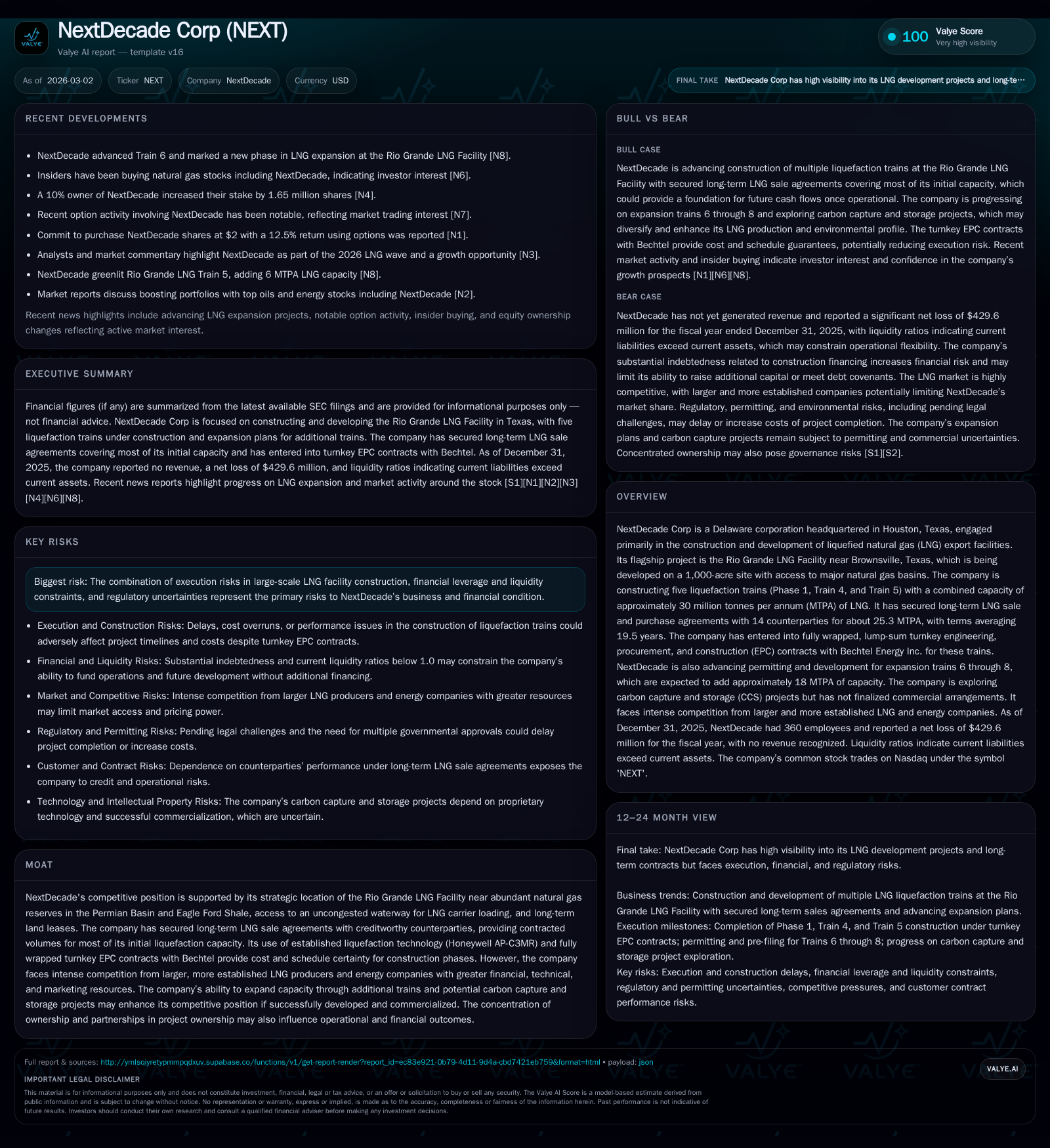
NextDecade Corporation is progressing its Rio Grande LNG Facility, with five liquefaction trains under construction targeting a combined capacity of approximately 30 MTPA. The company’s growth is backed by long-term contracts with creditworthy customers and EPC agreements with Bechtel to control costs and schedules. However, persistent net losses, increasing capital expenditures, and a substantial debt burden highlight ongoing financial pressures. Regulatory challenges and operational execution risks in this capital-intensive stage could further constrain near-term cash flow generation and expansion prospects. Investors should monitor construction milestones, debt refinancing outcomes, and permitting progress for trains 6 through 8 as key indicators of future value realization.
Company Overview
NextDecade Corporation (NASDAQ: NEXT), a Delaware-registered firm headquartered in Houston, Texas, is developing one of the largest LNG export projects in the U.S.: the Rio Grande LNG Facility near Brownsville. The project entails constructing five liquefaction trains (Phase 1 plus Trains 4 and 5) on a 1,000-acre site adjacent to the Brownsville Ship Channel with an expected combined annualized liquefaction capacity around 30 million tonnes per annum (MTPA) [S1].
The company has secured long-term LNG sale agreements aggregating ~25.3 MTPA with fourteen counterparties featuring an average term length nearing two decades—a critical facet for credit underwriting of such capital-intensive energy infrastructure [S1]. These contracts underpin most of its initial liquefaction volume but revenue recognition is contingent on operational commencement.
NextDecade employs Honeywell's proven AP-C3MR technology for liquefaction and has engaged Bechtel Energy Inc. under fully wrapped lump-sum turnkey EPC contracts for the first five trains to mitigate cost overruns and scheduling delays typical in mega LNG projects [S1]. The company intends to develop Trains 6 through 8 subject to securing permits and financing.
Historical Performance & Financials
Fiscal year data illustrate NextDecade's transition from development into full-scale construction with no operational revenues reported through December 31, 2025 [F1]:
Historical performance (annual)
| FY | Rev | Net ($mm) | CFO ($mm) | OpInc ($mm) | Net YoY |
|---|---|---|---|---|---|
| 2025 | 0 | -430 | -169 | -226 | -254.9% |
| 2024 | 0 | 277 | -96 | -171 | |
| 2023 | 0 | -74 | -123 | ||
| 2022 | 0 | -60 | -40 | -54 | -172.6% |
Source: SEC companyfacts cache [F1].
Capital returns and efficiency (annual)
| FY | Buybacks ($mm) | FCF ($bn) | ROE% |
|---|---|---|---|
| 2025 | 17 | -5.0 | -450.6 |
| 2024 | 7 | -2.7 | 73.5 |
| 2023 | 10 | -1.8 | |
| 2022 | 3 | -0.1 | -110.5 |
Source: SEC companyfacts cache [F1].
Note: Operating loss growth reflects intensifying construction activities; negative operating cash flow is expected given capital-heavy phase.
Capital expenditures nearly doubled year-over-year to $4.85 billion in FY2025 as NextDecade aggressively invests in its LNG infrastructure [F1]. Operating losses deepened by over a third compared to the prior year reflecting expanded operational costs before commercial production begins.
Liquidity remains constrained with current liabilities exceeding current assets by a wide margin (current ratio ~0.54), highlighting working capital challenges amid large-scale project spending commitments [F1]. Equity stands at approximately $95 million at year-end against substantial debt balances.
Capital Structure & Leverage Analysis
NextDecade’s subsidiaries have incurred substantial indebtedness primarily to finance construction phases of the Rio Grande LNG Facility [S1,S3,S11]. Key points include:
- Credit facilities totaling several billion dollars bear interest rates ranging from approximately 8% to over 13%, reflecting risk premiums associated with project financing [S12,S13,S15,S16,S17,S19].
- Debt agreements impose restrictive covenants limiting distributions, additional borrowings, asset transfers, and equity repurchases that constrain financial flexibility [S1,S3,S11,S12,S13].
- Failure to comply with these covenants could trigger events of default potentially accelerating repayment obligations and risking foreclosure on key project assets.
- Refinancing risks exist due to market conditions that may lead to higher borrowing costs or more onerous terms upon maturity.
This leverage profile places NextDecade at a competitive disadvantage relative to peers with lighter debt loads or lower-cost capital access [S1]. Mandatory prepayment provisions tied to excess cash flows will pressure free cash flow generation following completion of Train 5 [S21].
Growth Prospects
Near-term growth focuses on advancing Phase I plus Trains 4 and 5 towards completion under EPC contracts managed by Bechtel aimed at minimizing cost overruns and schedule delays [S1]. Long-term expansion depends on successful permitting for Trains 6 through 8 alongside securing necessary financing commitments [S5].
Strategic advantages supporting growth include:
- Proximity to prolific natural gas supplies from Permian Basin and Eagle Ford Shale ensuring feedstock availability via multiple pipeline interconnects at Agua Dulce Hub [S9,S23].
- Uncongested waterway access facilitating vessel logistics compared to other Gulf Coast terminals.
- Long-term leased land supporting up to ten liquefaction trains enabling scalable expansion plans.
- Deployment of Honeywell AP-C3MR liquefaction technology offering operational efficiency benefits.
Additionally, NextDecade is exploring carbon capture and storage (CCS) initiatives that could position the Rio Grande LNG Facility favorably within evolving environmental regulatory frameworks [S14,S18,S24,S26].
Key Risks & Headwinds
Key risks facing NextDecade include:
- Execution Risk: Large EPC projects are vulnerable to supply chain disruptions including volatile commodity prices (nickel, steel), labor shortages, weather events, or contractual disputes that can delay schedules or increase costs [S25,S26,S27].
- Regulatory & Legal Uncertainty: Pending judicial challenges against FERC permits introduce timing risk; evolving environmental regulations impose compliance costs; activist opposition could delay approvals or raise reputational issues .
- Liquidity Constraints: Heavy reliance on external capital markets raises uncertainty over availability or cost of funds required for completing later development phases or CCS projects [S5,N2,S26].
- Customer Concentration: Dependence on a limited number of LNG buyers concentrates cash flow risk; contract modifications or cancellations could materially impact returns given fixed infrastructure costs [S10,S24].
Capital Allocation & Returns
NextDecade remains in a capital-intensive development phase characterized by significant negative operating income (-$225.9 million) and operating cash flow (-$169.4 million) alongside massive capital expenditure outlays ($4.85 billion) as of FY2025 [F1]. This results in deeply negative free cash flow and an approximate return on equity around -451%, reflective of early stage investment rather than mature profitability.
Dividend distributions are currently suspended due to lack of positive earnings and restrictive covenants within financing agreements limiting payouts until stable cash flows are established post-construction completion milestones [S11,S21].
Modest share repurchases occurred totaling $16.9 million in FY2025 but remain small relative to liquidity needs indicating cautious capital deployment priorities during this developmental period [F1].
Outlook & Monitoring Points
Investors should closely monitor:
- Progress against construction schedules for Phase I plus Trains 4/5 including adherence to turnkey EPC contract terms.
- Permitting outcomes for Trains 6 through 8 which are critical for sustaining expansion plans.
- Debt refinancing efforts addressing upcoming maturities while maintaining covenant compliance.
- Natural gas feedstock pricing and availability impacting operating margins once commercial production commences.
- Regulatory developments especially regarding environmental compliance and potential CCS integration.
Revenue recognition will likely follow commissioning milestones making these operational triggers essential liquidity inflection points over the coming years.
Conclusion
NextDecade is advancing a strategically located mega LNG export development leveraging regional hydrocarbon resources alongside logistical advantages supported by long-term customer contracts underpinned by established technology platforms and fixed-price EPC agreements mitigating some execution risk.
However, ongoing negative earnings compounded by heavy capex investment amidst substantial indebtedness pose elevated execution risk compounded by complex regulatory environments marked by active legal challenges surrounding permit validity delaying smooth ramp-up scenarios.
Future value creation hinges on disciplined project execution delivering physical milestones timely complemented by successful capital structure management enabling incremental funding for expansions while monetizing embedded long-duration contracts within this asset base.
Disclaimer: This report provides an analysis based exclusively on publicly available filings and news sources without offering investment advice or price forecasts.
Disclaimer: This is research-only, informational analysis and not investment advice. It may include AI-generated interpretation and general industry context. Always verify important details using primary sources.

Comments