
New Fortress Energy: Liquidity Pressure, Asset Repositioning, and the Stakes of FLNG 1’s Return
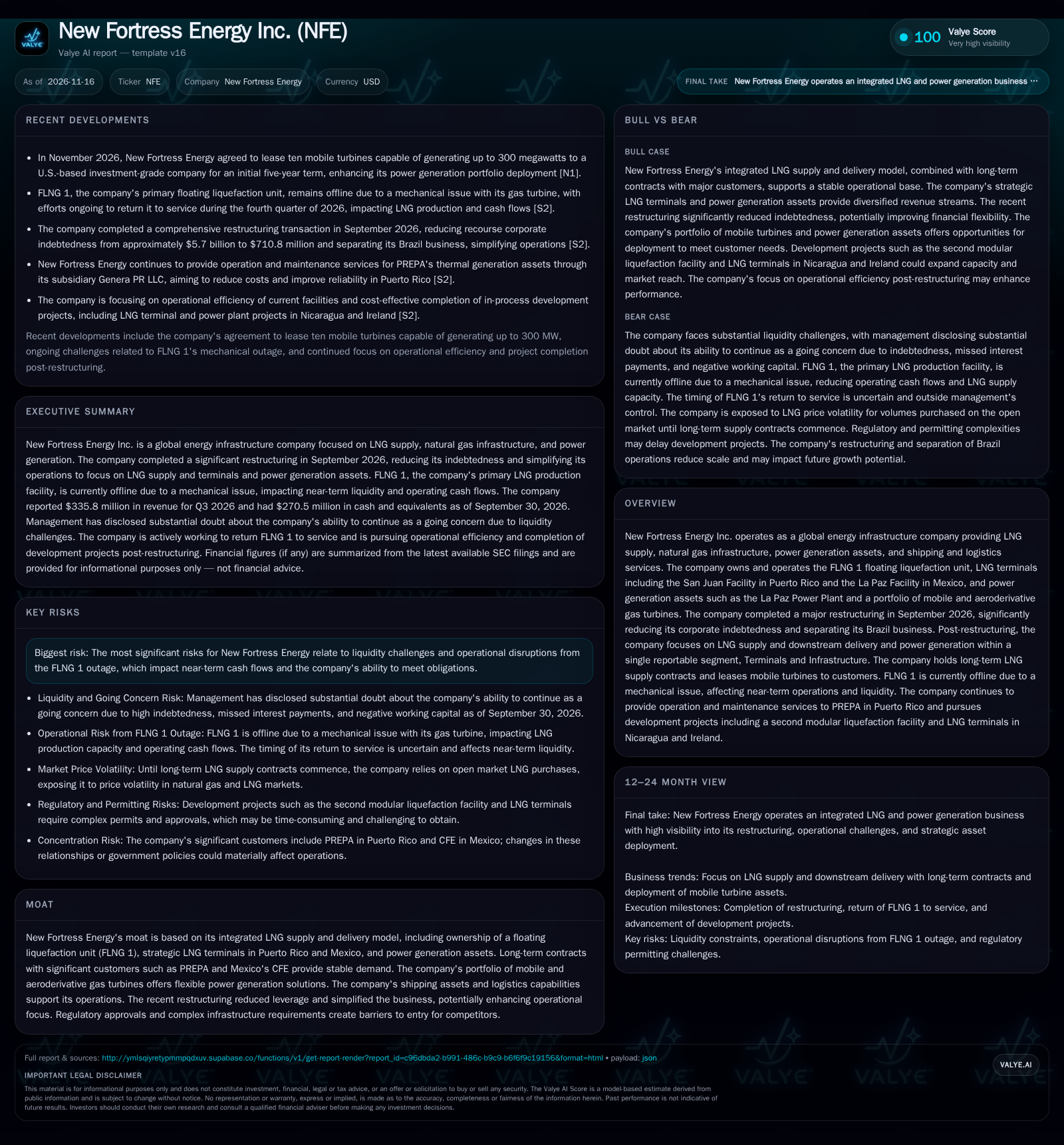
After a dramatic debt reduction and business simplification, New Fortress Energy faces a critical period defined by an unresolved FLNG 1 outage, negative working capital, and the need to extract value from its LNG and power infrastructure portfolio. The outcome of these operational and financial challenges will determine whether the company’s integrated model can translate into long-term resilience—or whether it risks further instability.
The company’s ability to restore FLNG 1, execute on long-term supply contracts, and control costs across its LNG and power infrastructure will be pivotal in determining whether it can overcome current headwinds or faces deeper financial strain. [S2] [N1]
New Fortress Energy stands at a crossroads after a transformative restructuring that sharply reduced its debt load and narrowed its operational scope. With management openly warning of substantial doubt about ongoing viability, and with critical LNG and power infrastructure projects hanging in the balance, the next several quarters will test whether New Fortress’s integrated energy model can deliver on its promise—or whether operational setbacks and capital constraints will undermine the company’s recovery.
Restructuring Aftershocks and the FLNG 1 Bottleneck Define the Near Term
New Fortress Energy’s September 2026 restructuring reduced recourse debt from $5.7 billion to $710.8 million, separated Brazil operations, and streamlined the business to focus on LNG supply, terminals, and power generation. However, this reset is overshadowed by persistent liquidity stress: as of September 30, 2026, the company reported $270.5 million in cash and equivalents, a current ratio of 0.9, and a cash ratio of 0.27. Management has disclosed substantial doubt about the company’s ability to continue as a going concern, citing negative working capital and missed interest payments. [S2]
Compounding the financial strain, FLNG 1—the company’s floating liquefaction unit and primary LNG production engine—remains offline due to a mechanical issue with its gas turbine. Restoration is targeted for Q4 2026 but timing is uncertain, directly impairing LNG output and near-term cash flows. [S2]
In parallel, New Fortress is attempting to extract value from its asset base, exemplified by the recent agreement to lease ten mobile turbines (up to 300 MW) to a U.S. investment-grade customer for five years. This move aims to generate incremental cash flow from underutilized generation assets. [N1]
Integrated LNG-to-Power Model: Margin Leverage and Exposure
New Fortress Energy’s economics hinge on its integrated model: securing and delivering LNG via owned infrastructure, converting it to power through proprietary plants and turbines, and monetizing both commodity and capacity. Long-term contracts (such as the 7-year gas supply agreement in Puerto Rico and 20-year U.S. LNG supply contracts commencing in 2027 and 2030) provide future volume visibility and margin stability, especially as pricing is indexed to Henry Hub plus a fixed fee, partially insulating against market volatility. [S2]
However, with FLNG 1 offline, the company must meet obligations through spot market LNG purchases or draw on storage, exposing it to unfavorable price dynamics and compressing margins. Until long-term supply contracts ramp, operating leverage can turn negative: fixed costs for personnel, maintenance, and debt service persist while production and cash generation lag.
The recent repositioning of mobile turbines via multi-year leases represents a shift toward asset-light, recurring fee income, potentially smoothing cash flow volatility. Yet, capital needs for development projects (such as FLNG 2 and new terminals in Nicaragua and Ireland) remain significant, and negative working capital constrains the company’s ability to self-fund growth without external capital or asset sales.
Barriers, Customer Stickiness, and the Limits of Scale
New Fortress benefits from high barriers to entry in LNG infrastructure and power, including regulatory complexity, capital intensity, and the need for multi-year permitting. Its ownership of integrated terminals in Puerto Rico (San Juan) and Mexico (La Paz), plus proprietary floating liquefaction (FLNG 1), creates switching frictions for utility and industrial customers, particularly those reliant on stable LNG supply.
Long-term relationships—such as with PREPA in Puerto Rico and CFE in Mexico—anchor base demand, while the company’s ability to provide both fuel and power generation services may deepen customer entrenchment. However, the recent separation of the Brazil business has reduced geographic scale and diversification, potentially narrowing the company’s competitive footprint.
Competition from established LNG majors, regional utilities, and emerging modular LNG players remains a structural threat, especially if New Fortress cannot reliably deliver contracted volumes or manage cost overruns in new developments. The company’s moat is most defensible where infrastructure is unique or customer switching costs are prohibitively high; elsewhere, price and reliability could erode its advantage.
If FLNG 1 Returns and Contracted LNG Margins Flow, Cash Flows Could Stabilize Rapidly
In a favorable scenario, FLNG 1 is restored to full service in Q4 2026, restoring the company’s self-supplied LNG flow and reducing reliance on open-market purchases. This would immediately improve gross margins, as the company could deliver LNG to terminals and power plants at more predictable, lower costs. The ramp of long-term supply contracts beginning in 2027 would further solidify revenue and margin visibility, especially with indexed pricing structures insulating against most commodity volatility.
The new turbine lease agreement would contribute steady, recurring revenue, and ongoing operation and maintenance services for PREPA would provide a stable fee base. With development projects (FLNG 2, Nicaragua, Ireland) proceeding on budget and on schedule, New Fortress could gradually rebuild liquidity and regain access to less expensive capital.
Evidence confirming this scenario would include: a public announcement of FLNG 1’s operational restart; sequential improvement in operating cash flow; progress reports on development milestones without major cost overruns; and a reduction in liquidity risk disclosures from management.
Operational Recovery Remains Slow, Funding Options Tighten, and Asset Sales Re-Enter the Conversation
The most plausible trajectory is a mixed operating recovery in which FLNG 1’s restart is delayed or only partially achieved in late 2026 or early 2027, forcing continued dependence on spot LNG purchases. Margin pressure persists as fixed costs remain while cash generation lags, and negative working capital constrains flexibility.
Leasing of mobile turbines and continued O&M contracts provide some offsetting cash flow, but are insufficient to fully bridge the liquidity gap. The company may be compelled to pursue additional asset monetizations, joint ventures, or equity-linked financings to fund both operating needs and the completion of development projects. Progress on FLNG 2 and new terminals is likely to occur, but with delays or scope reductions.
Confirmation would come from continued liquidity risk language in filings, incremental asset sales, or new financing transactions. Falsification would be evident if the company restored FLNG 1 quickly, reduced working capital deficits, and demonstrated stable or improving EBITDA margins.
Prolonged FLNG 1 Outage and Capital Scarcity Force Distressed Actions
In a negative scenario, FLNG 1 remains offline for several more quarters, further eroding operating cash flow and forcing New Fortress to meet contractual obligations with high-cost spot LNG. Liquidity deteriorates rapidly, with working capital deficits deepening and the company unable to access affordable external capital due to ongoing going-concern warnings.
The company may be forced into distressed asset sales at unfavorable valuations, curtail or abandon development projects, or seek restructuring of contractual obligations with customers or lenders. The risk of covenant breaches or insolvency rises, and operational instability undermines customer confidence, potentially triggering contract renegotiations or loss of key business.
Evidence supporting this scenario would include: a public extension of the FLNG 1 outage, further reductions in cash balances, new or escalated going-concern disclosures, and announcements of distressed or fire-sale asset transactions.
Milestones That Will Determine Whether New Fortress Energy’s Reset Succeeds
The timing and outcome of FLNG 1’s mechanical repairs and return to operational service; a public update or restart would be pivotal for cash flow and margin recovery.
Disclosure of additional asset sales, joint ventures, or equity/debt financings; the terms and valuation of such transactions would reveal the company’s bargaining power and market confidence.
Progress reports and budget adherence for FLNG 2 and LNG/power development projects in Nicaragua and Ireland; delays or overruns could signal execution risk.
Changes in management’s going-concern language or risk disclosures in filings; reduced severity or removal would signal improved financial health.
Utilization rates and revenue contribution from the mobile turbine lease portfolio, if disclosed; high utilization would validate the asset monetization strategy.
Updates on customer relationships and contract renewals with PREPA, CFE, and major industrial clients; stability or expansion would reinforce the demand base.
LNG purchase mix—spot versus contract—if disclosed; a shift to higher contract volumes would reduce margin volatility.
Disclaimer: This is research-only, informational analysis and not investment advice. It may include AI-generated interpretation and general industry context. Always verify important details using primary sources.

Comments