
NewHold Investment Corp. III Advances Business Combination Search Amid Trade Policy Uncertainties
Latest quarterly filing highlights ongoing SPAC operations with a focus on industrial technology mergers and evolving trade risks.
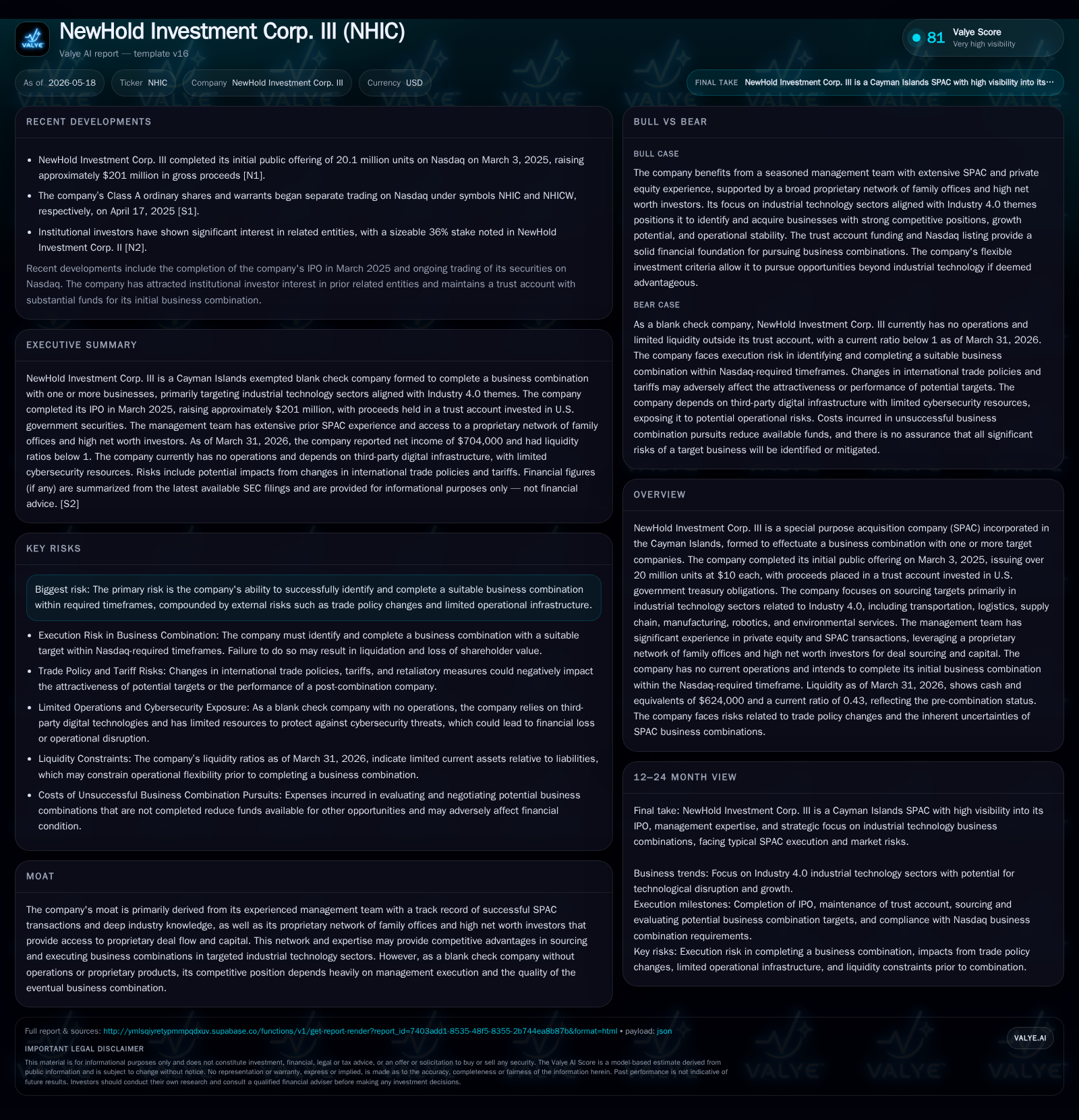
NewHold Investment Corp. III (NHIC) continues its pursuit of a strategic business combination primarily within industrial technology sectors aligned with Industry 4.0 themes. The latest quarterly report confirms stable operational status without current acquisitions but underscores heightened uncertainty from recent changes in international trade policies and tariffs. NHIC’s competitive strength lies in its seasoned management team and extensive proprietary network, while risks center on deal timing and geopolitical-external factors affecting target attractiveness. Financially, NHIC maintains cash reserves from its IPO proceeds held in trust, supporting near-term operation and readiness for acquisition financing.
Recent Operating Update
NewHold Investment Corp. III filed its latest quarterly report on May 18, 2026 [S2], reaffirming its status as a special purpose acquisition company (SPAC) actively seeking an initial business combination. There have been no material changes since the IPO closing in early 2025 [S1]. As of March 31, 2026, the company holds approximately $624,000 in cash equivalents against current liabilities of about $1.86 million, resulting in a current ratio of 0.43 [F1]. This liquidity profile aligns with typical pre-acquisition SPACs that maintain minimal operating costs funded through interest income generated by the trust account holding IPO proceeds.
The recent filing further highlights emerging risks stemming from evolving trade policies and tariffs. The U.S. has introduced new tariffs while other countries have imposed or are considering retaliatory measures, creating uncertainty around global supply chains [S2]. These developments may introduce volatility both in identifying suitable industrial technology targets—due to their exposure to international trade—and in the operational environment post-merger.
Business Model
NHIC is a blank check company incorporated in the Cayman Islands formed to raise capital through its IPO for effecting one or more mergers or acquisitions [S1, S7]. It currently generates no operating revenues or products. The approximately $201 million raised at IPO was placed into a trust account invested primarily in U.S. Treasury obligations until released upon consummation of an acquisition or liquidation [S1]. Post-business combination financing may involve equity issuance or debt alongside these funds [S13].
NHIC offers potential target businesses an expedited route to public markets compared to traditional IPOs, providing advantages such as greater capital access, enhanced public profile, alignment through stock currency use for acquisitions, and scalability support [S12]. Success depends critically on management's ability to identify and secure attractive business combination partners.
Industry Structure and Competitive Position
While NHIC lacks direct operations currently, it targets industrial technology sectors associated with Industry 4.0—encompassing digital transformation themes such as advanced sensor technologies, robotics, manufacturing optimization, logistics solutions, grid resiliency, environmental services, and related applications [S14]. This sectoral focus aligns with broader macro trends favoring automation and data-driven efficiencies across supply chains.
Competitively, NHIC benefits from an experienced management team with over 60 years of combined private equity expertise complemented by four prior successful SPAC transactions under similar mandates [S16]. The firm leverages a proprietary network comprising more than 100 family offices managing multi-billion-dollar assets along with nearly 100 high net worth investors providing access to proprietary deal flow beyond traditional investment banking channels [S15]. This sourcing advantage enhances access to stable businesses with defensible market positions or differentiated technologies capable of delivering operating leverage post-merger.
However, NHIC operates amid intense competition within the SPAC market where investor enthusiasm has moderated following mixed results industry-wide. It also competes against traditional private equity funds targeting middle-market growth companies seeking capital or liquidity alternatives without public listing.
Growth Drivers
Growth fundamentally depends on successfully closing an initial business combination within regulatory timelines (generally two years post-IPO), avoiding liquidation or forced redemptions.
Key growth vectors include:
Risks / Watchpoints / Growth Constraints
Principal risks include:
- Completion Risk: Inability to identify acceptable targets timely or finalize agreements within regulatory deadlines could lead to liquidation or shareholder redemptions [S2].
- Trade Policy Volatility: Recent tariff increases introduce uncertainty impacting valuation assumptions for manufacturing and logistics technology companies targeted by NHIC [S2]. Retaliatory tariffs further elevate risk for companies reliant on cross-border trade.
- Post-Combination Performance: Historical underperformance among some SPAC merger targets signals elevated operational risks during integration or scaling phases [S6].
- Pre-Deal Liquidity Constraints: Limited working capital hampers extended due diligence efforts or pursuit of alternative acquisitions absent external funding which may dilute shareholders [F1][S13].
- Market Perception: As an emerging growth entity with smaller reporting company status limiting disclosure breadth until certain thresholds are met [S22], investor skepticism could affect post-merger stock performance.
- Competitive Deal Pricing: Intense competition for attractive assets may elevate valuations compressing future returns.
- Sponsor Conflicts & Governance: Although safeguards govern insider purchases and redemption rights waivers [S10], alignment between sponsor incentives and minority shareholders remains critical.
What To Watch Next
Key forthcoming developments include:
- Announcements regarding identified initial business combination candidates revealing strategic direction and valuation discipline.
- Proxy filings ahead of shareholder votes detailing transaction terms including any required equity restructuring or supplemental financing beyond trust funds.
- Market activity around warrants exercisable at $11.50 possibly indicating expected capitalization changes post-deal.
- Updates on macro trade policy developments given their impact on sector economics relevant to targeted businesses.
- Progress disclosures concerning due diligence milestones through periodic filings or press releases.
NHIC's ability to convert its capitalization into meaningful portfolio exposure will be pivotal to its long-term trajectory beyond interim financial metrics alone.
Financial Profile Overview
As of March 31, 2026, NewHold Investment Corp. III holds approximately $624,000 in cash equivalents against current liabilities near $1.86 million resulting in a current ratio of 0.43—a profile typical for pre-merger SPACs relying mainly on trust fund interest income pending deal execution [F1]. The operating loss recorded at December 31, 2025 was about $2 million due primarily to administrative expenses partially offset by net income effects linked to warrant accounting totaling roughly $4.9 million net income during that period [F1]. Such financial patterns align with standard pre-combination norms wherein revenue generation awaits consummation of a business combination event.
Liquidity depends principally on the substantial trust account balance exceeding $200 million at IPO closing plus any additional funding arrangements negotiated alongside prospective transactions [S1][S13]
This analysis is grounded exclusively in NewHold Investment Corp. III’s publicly filed regulatory disclosures as of mid-2026 without speculative extrapolation. Given inherent uncertainties linked to blank check entities pursuing future mergers amid evolving geopolitical trade conditions—including tariff escalations—market participants should monitor forthcoming disclosures closely for material operational impacts.
Disclaimer: This is research-only, informational analysis and not investment advice. It may include AI-generated interpretation and general industry context. Always verify important details using primary sources.

Comments