
NewHold Investment Corp IV Commences Public Market Journey Backed by Strong Trust Account Structure
Following its April 2026 IPO, NewHold Investment Corp IV holds $201.25 million in a trust account, setting the stage for its initial business combination.
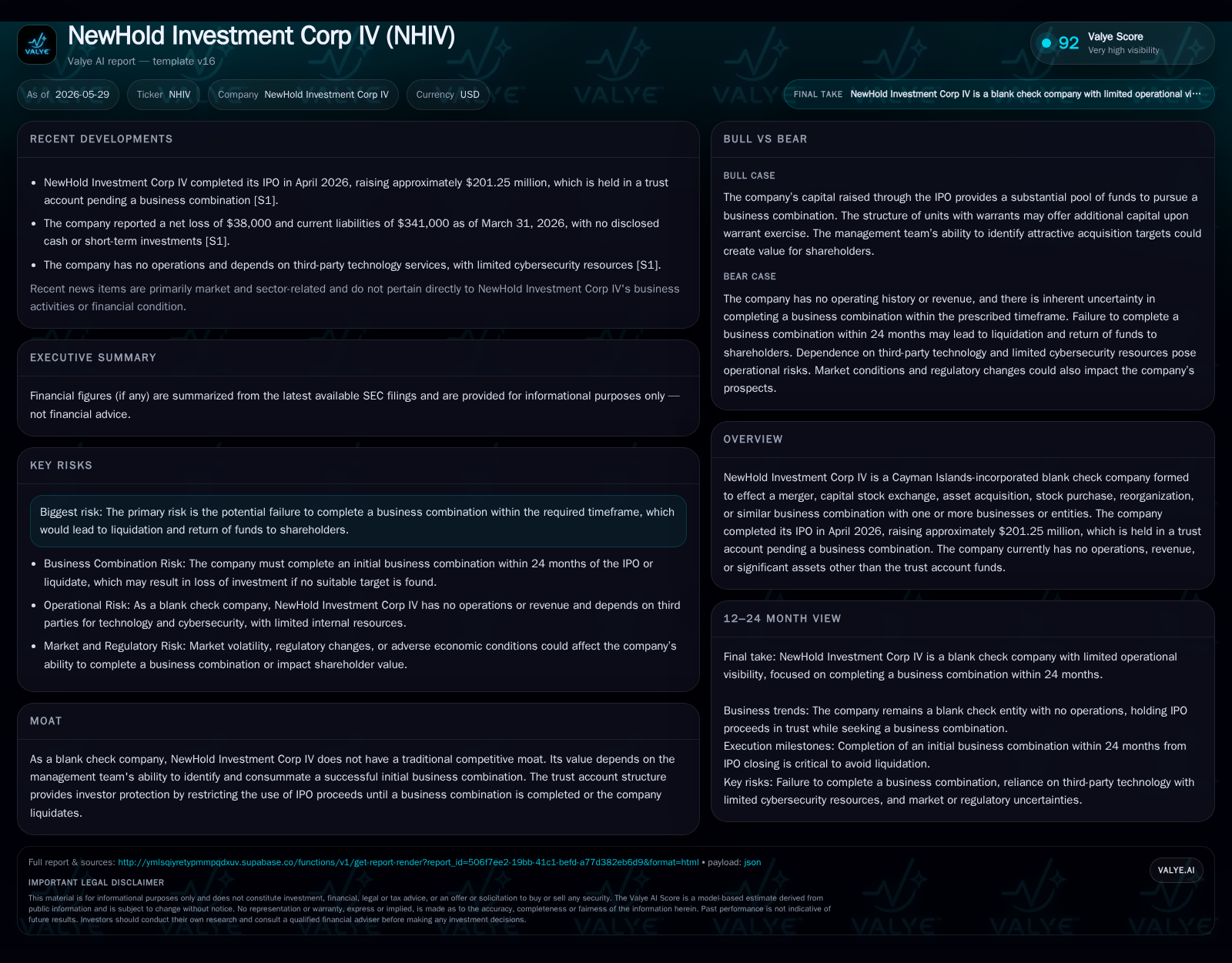
NewHold Investment Corp IV (NHIV) completed its IPO in April 2026, raising approximately $201.25 million, which is securely held in a trust account pending a business combination. As a nascent blank check company with no current operations or revenue, NHIV's primary value driver is the management team's ability to identify and consummate an initial acquisition within a prescribed 24-month timeframe. Structural safeguards, including the trust account and shareholder redemption rights, provide investor protections typical of SPACs but success hinges heavily on execution risk and market receptivity. Key monitoring points include deal announcement timing and shareholder votes related to the business combination process.
Recent IPO Completion and Quarterly Filing Highlights
NewHold Investment Corp IV (NHIV) embarked on its public market journey by successfully completing an initial public offering (IPO) on April 16, 2026. The offering comprised 20,125,000 units priced at $10 each, with an additional fully exercised underwriter overallotment of 2,625,000 units included. This raised gross proceeds of approximately $201.25 million [S3]. Concurrently, private placement agreements facilitated sponsor and underwriter purchases amounting to 641,250 units at the same price point [S12].
These proceeds were immediately placed into a U.S.-based segregated trust account overseen by Continental Stock Transfer & Trust Company as trustee [S4]. Aside from interest earned — which could be used for tax liabilities or dissolution expenses — these funds remain locked until NHIV completes its initial business combination or liquidates after failing to do so within the designated timeframe [S4].
This structural setup aligns with standard SPAC practices preserving investor capital safety by restricting premature or inappropriate fund use. The company's latest quarterly filing reaffirms that it holds no operations or revenue-generating assets beyond these trust funds and reports nominal current liabilities predominantly representing minimal ongoing expenses [F1][S2]. No material unresolved SEC staff comments exist against NHIV at this early stage [S2].
Business Model: Overview of Blank Check Company Operations and Structural Safeguards
NHIV operates purely as a blank check company formed under Cayman Islands jurisdiction specifically for the purpose of effecting a merger, stock exchange, acquisition, or similar business combination transaction [S3][S4]. It does not have commercial operations, products, services, or customers at present; its entire raison d’être rests on identifying a suitable target company for de-SPAC conversion.
A core feature underpinning investor protection is the trust account mechanism holding all IPO proceeds separately — barring only limited interest withdrawals to cover taxes or dissolution costs pending transaction completion [S4]. Shareholders retain redemption rights if they opt out prior to any business combination closing or if no deal transpires within twenty-four months from IPO close [S4]. These provisions are incorporated into an amended and restated memorandum and articles of association established concurrently with IPO closing [S4].
Contracts such as indemnity agreements with officers/directors and administrative service agreements are in place defining governance guardrails around operational stewardship during this interim phase [S5][S11], further emphasizing control structures common among SPACs.
Management’s role centers on deal sourcing expertise — leveraging relationships and sector knowledge to identify accretive targets meeting investment criteria aligned with sponsor objectives. Given NHIV’s lack of operations or physical assets besides cash equivalents in trust, revenue mechanics depend entirely upon successful transaction closure post-IPO with no intermediate revenue [S2][S3]
Competitive Framework: SPAC Industry Positioning and Sponsor Alignment
Within the blank check ecosystem characterized by significant competition among sponsors seeking attractive deals amid shifting market conditions, NHIV positions itself relying on commitments via private placement units that closely align sponsor incentives with transaction success [S12]. Participation by BTIG LLC as underwriter reprised typical underwriting functions while taking part in private placements alongside the sponsor ensures some underwriting-side alignment [S12].
SPACs generally face compressive timing pressures set by regulatory frameworks — here evidenced by the strict twenty-four month deadline [S4] — which elevates execution risk profiles considerably compared to traditional operating companies. Furthermore, NHIV qualifies as an emerging growth company per securities laws reducing ongoing reporting burdens but potentially inviting more scrutiny around deal execution timeliness [S9][S14].
By design, NHIV holds no intrinsic moats related to technology or market share given its shell company status. Thus competitive advantage is sourced through management diligence capabilities and access to capital markets facilitating efficient capital deployment upon suitable target identification.
Key Growth Drivers: Pathways to Value Creation Through Initial Business Combination
Value creation trajectories for NHIV revolve exclusively around consummating a compelling initial business combination that delivers scale and strategic upside exceeding cost of capital represented by IPO unit price plus dilution factors.
Potential growth drivers include:
- Successful targeting of undervalued entities presenting sector-specific growth prospects,
- Efficient structuring enabling shareholder-friendly economics including warrant coverage,
- Timely execution avoiding forced liquidation scenarios,
- Capitalizing on favorable market conditions preserving equity value premiums post-deal announcement.
While NHIV’s filings do not specify targeted sectors or strategic priorities explicitly beyond generic acquisition language typical for SPACs [S3], management will likely pursue sectors where expertise and network advantages reside based on sponsor background — common practice among similar vehicles.
Risks and Constraints: Timeframe Limitations and Market Dynamics Impacting Success
The paramount risk facing NHIV is failure to close an initial business combination within twenty-four months following the IPO closing date. Should this occur without shareholder-approved extension amendments enacted before deadlines expire, trust funds are liquidated pro rata back to shareholders minus expenses incurred [S4]. This binary outcome underscores structural liquidity but caps recourse effectively at original investment levels absent premium returns.
Additional risks arise from cybersecurity exposure since NHIV operates without proprietary systems or personnel dedicated to data security; reliance on third-party infrastructure heightens vulnerability to breaches impacting asset integrity or confidential information [S2][S15]. Limited staffing resources magnify inability to proactively investigate or remediate potential cyber incidents.
Other constraints include minimal operational foothold making it dependent wholly on management’s sourcing acumen amidst competitive SPAC fundraising environment where investor appetite fluctuates broadly influenced by sector rotation trends and macroeconomic variables.
Monitoring Points: Critical Upcoming Events and Company Milestones
Investors seeking transparency into NHIV’s progression should focus on several near-term milestones:
- Announcements regarding prospective targets or letters of intent,
- Shareholder meetings concerning amendment votes especially ones extending initial timelines beyond 24 months,
- Periodic SEC filings updating deal pipeline status or material changes in governance structure,
- Warrants exercise windows potentially unlocking incremental capital inflows contingent on share price performance relative to strike thresholds,
- Audit reports confirming custody status of trust account funds ensuring capital preservation integrity.
Close attention to quarterly filing disclosures will provide incremental insights into management’s cadence towards deal closure efforts and any challenges encountered along the pipeline.
NewHold Investment Corp IV epitomizes a classical newly minted SPAC vehicle commencing its journey equipped with robust structural investor protections primarily through expansive trust account containment of IPO proceeds ready for deployment into a transformative business combination. However, intrinsic operational absence shifts all uncertainty onto managerial execution capability within defined temporal guardrails characteristic of blank check companies. While liquidity appears stable backed by nearly full IPO proceeds maintained apart from nominal liabilities [F1], true value crystallization remains pending successful de-SPAC transaction completion.
This analysis aims to illuminate NHIV's foundational positioning amid the broader SPAC universe rather than apply conventional operating company financial metrics prematurely. The coming months will be pivotal in revealing both targeted sectors for acquisition focus as well as management effectiveness navigating increasingly competitive SPAC landscapes.
Disclaimer: This analysis does not constitute investment advice or research views regarding purchase or sale of securities.
Disclaimer: This is research-only, informational analysis and not investment advice. It may include AI-generated interpretation and general industry context. Always verify important details using primary sources.

Comments