
Non Invasive Monitoring Systems: The Realities of Shell Status, Liquidity Strain, and Strategic Optionality
The current structure offers little visibility or actionable business momentum, leaving any potential future value contingent on either external financing or a fundamental strategic pivot.
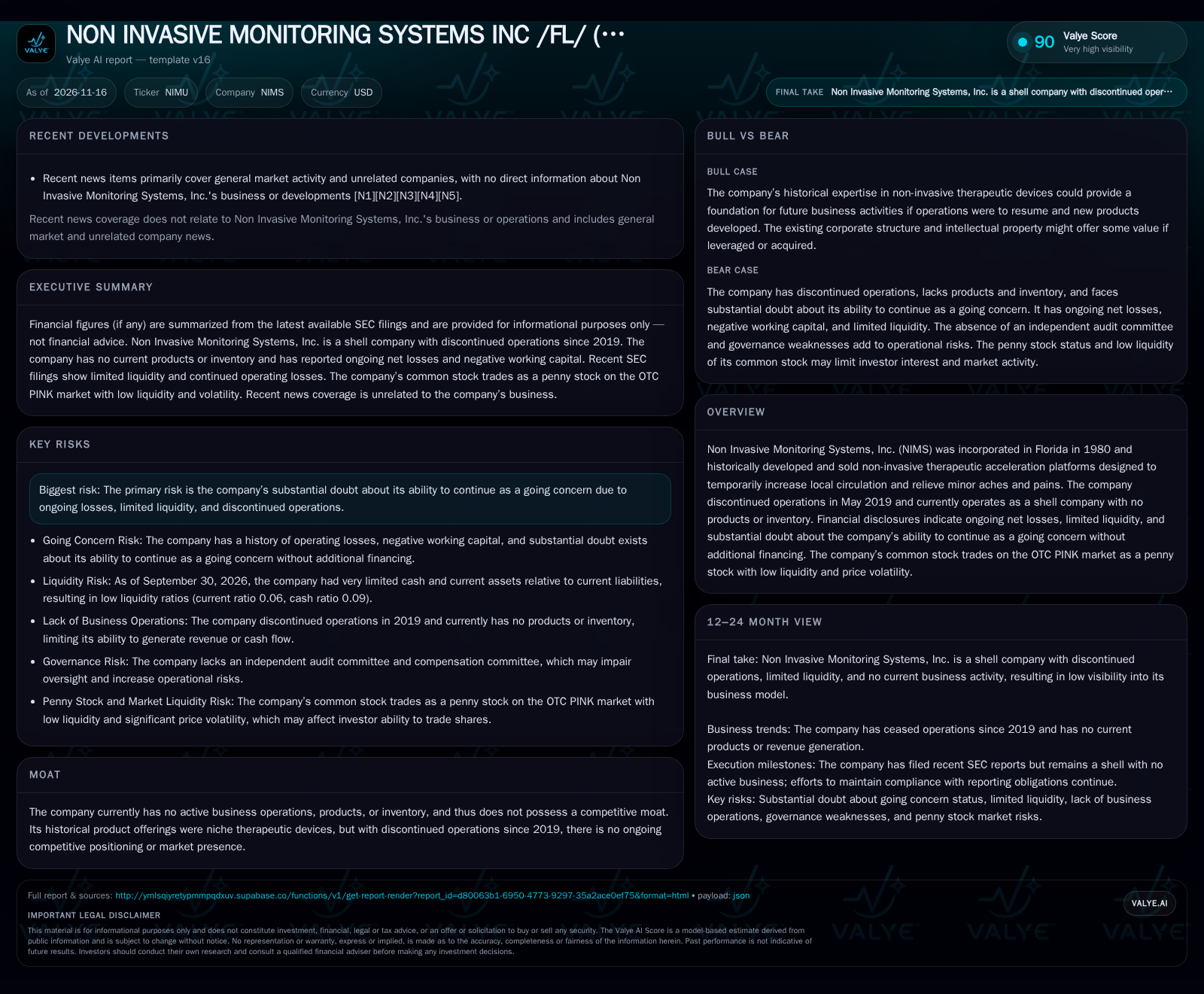
Non Invasive Monitoring Systems, Inc. (NIMS) is a shell company with no active operations, products, or revenue since 2019. Recent filings confirm ongoing net losses, negative working capital, and a severe liquidity shortfall, casting substantial doubt on its ability to continue as a going concern. The company’s stock trades on the OTC PINK market with low liquidity and high volatility. Any future value would depend on external funding or a business restart, neither of which is currently underway or assured. [S2]
Non Invasive Monitoring Systems, Inc. (NIMS) presents a textbook case of the challenges and uncertainties facing shell companies in the public markets. Having discontinued all operational activity in 2019, NIMS now exists without products, inventory, or revenue, and recent financials reveal an acute liquidity crisis amid ongoing losses. With negative working capital, limited cash, and substantial doubt about its ability to continue as a going concern, the company’s future hinges on the unlikely prospect of external funding or a transformative transaction. For investors or potential acquirers, the real question is whether there is any path to value creation, or whether the shell status simply prolongs an inevitable dissolution. [S2]
Discontinued Operations and Acute Liquidity Shortfall Define Current State
As of the latest SEC filing, Non Invasive Monitoring Systems, Inc. is confirmed as a shell company, with no products, inventory, or active business operations since ceasing all commercial activity in May 2019. The company reported a net loss of $282,000 for the quarter ended September 30, 2026, and holds only $160,000 in cash and equivalents against $1.84 million in current liabilities—resulting in a current ratio of just 0.06 and a cash ratio of 0.09. These metrics reflect severe liquidity constraints and underscore the substantial doubt raised about the company’s ability to continue as a going concern in the absence of new financing. The stock remains listed on the OTC PINK market, trading as a penny stock with low liquidity and significant price volatility. [S2]
Shell Company Economics: No Operating Model, Only Residual Optionality
With operations discontinued and no products or inventory, NIMS currently generates no revenue and incurs only residual corporate expenses. The historical business—manufacturing and selling non-invasive therapeutic acceleration platforms—has been fully wound down. As a result, there are no active pricing, volume, or margin dynamics at play. The company’s cost structure now primarily consists of public company compliance, minimal administrative expenses, and the costs associated with maintaining its OTC PINK listing. Capital needs are acute: ongoing net losses and negative working capital mean that even baseline corporate existence depends on immediate external funding. The only plausible economic value lies in the shell’s potential as a vehicle for a reverse merger or acquisition, which could allow a private entity to go public more rapidly or cheaply than through an IPO. However, such transactions often occur at steep discounts and are highly contingent on both regulatory compliance and market appetite.
The economic dynamics of shell companies like NIMS also reflect the broader market conditions influencing the demand and valuation of such entities. In periods of heightened market volatility or regulatory scrutiny, shells tend to trade at deeper discounts due to increased perceived risk and uncertainty. Conversely, when capital markets are more favorable, there may be a modest uptick in speculative interest, although this rarely translates into sustainable value without a credible business plan or operational turnaround. Additionally, the cost of maintaining a public listing, even on OTC markets, can be disproportionately burdensome relative to the minimal corporate activities, further eroding net asset value over time. This structural economic pressure creates a narrow window for shells to attract meaningful transaction opportunities before capital depletion forces liquidation or delisting.
From a capital structure perspective, the absence of operating cash flow places the company in a highly precarious position where any financing must be both timely and strategically aligned. Debt financing is typically infeasible given the lack of collateral and cash flow, leaving equity issuance or convertible instruments as the primary options. However, equity raises often come with significant dilution and may require concessions such as warrants or rights that further complicate future capital structures. The willingness of investors to provide such financing depends heavily on the shell’s perceived cleanliness, regulatory compliance, and potential to serve as a viable acquisition vehicle. Without these attributes, the cost of capital rises sharply, and the risk of value destruction increases.
No Active Market Presence—Shell Status Lacks Moat or Differentiation
NIMS currently possesses no products, no customer relationships, and no ongoing commercial activity, and thus has no competitive position in any operating market. Its historical expertise in non-invasive therapeutic devices is now largely irrelevant absent active development, manufacturing, or sales. In the shell company category, differentiation is minimal; value is typically determined by the cleanliness of the shell (absence of hidden liabilities), compliance with SEC reporting, and availability of a public listing. The lack of an independent audit committee and delayed filings may further erode whatever residual attractiveness NIMS might have as a shell. In practice, there is little to distinguish the company from numerous other defunct or semi-dormant shells trading on the OTC markets.
If Fresh Capital or a Reverse Merger Arrives: Pathways to Revival
The most plausible route to value creation would be a successful capital raise or a reverse merger, where a private operating business uses NIMS’s public listing as a shortcut to market access. In this scenario, new investors or acquirers would inject sufficient capital to settle outstanding liabilities, recapitalize the balance sheet, and repurpose the shell for a new business plan. Evidence supporting this outcome would include the announcement of a binding financing agreement, merger letter of intent, or a regulatory filing detailing acquisition or recapitalization terms. Falsification would be confirmed by continued operating losses, lack of transactional news, or further erosion of the company’s compliance standing. Even in a best-case scenario, existing shareholders might see only limited upside, as most value typically accrues to new capital providers.
Stasis and Erosion: The Most Likely Trajectory Without Intervention
Absent a capital infusion or strategic transaction, NIMS is likely to remain in its current state: a dormant shell incurring ongoing administrative losses while seeking to maintain minimal compliance. The company’s reported liquidity position may force it to seek bridge financing on punitive terms or to allow its public listing to lapse. Confirmation of this scenario would include continued net losses, delayed or qualified SEC filings, and the absence of any new business development or strategic announcements. Falsification would require concrete evidence of a new business initiative or external investment.
Liquidity Exhaustion and Potential Dissolution Loom Without Rescue
If NIMS is unable to secure additional funding or attract a merger partner, the current liquidity trajectory points toward insolvency and eventual dissolution. The company’s negative working capital and inability to generate revenue mean that even basic corporate obligations could soon become unsustainable. Confirming evidence would include further deterioration in cash position, delisting from the OTC PINK market, or an SEC notice regarding failure to comply with reporting or listing standards. In this scenario, any residual value for existing shareholders would likely be negligible or zero.
Signals That Could Alter the Thesis for Non Invasive Monitoring Systems
Announcement of a financing agreement or private placement that meaningfully addresses working capital deficits.
SEC filings disclosing a definitive merger or acquisition agreement, or a letter of intent for a reverse merger.
Evidence of new business development activity—such as hiring, technology licensing, or partnership announcements—if disclosed.
Changes in board composition, management, or governance structure that might indicate preparation for a strategic transaction.
Improved compliance status, including timely and unqualified SEC filings, which could enhance shell attractiveness.
Delisting notices, trading suspension, or formal dissolution filings that would signal further downside risk.
Material changes in outstanding liabilities or settlement of legacy obligations, which would affect shell value.
Any indication of renewed interest from external investors or activist shareholders.
Disclaimer: This is research-only, informational analysis and not investment advice. It may include AI-generated interpretation and general industry context. Always verify important details using primary sources.

Comments