
Nixxy, Inc.: AI-Driven Telco Ambitions Meet Margin Realities and Execution Crossroads
Having exited its legacy recruitment business, Nixxy is betting on AI-powered telecom infrastructure and fintech convergence to carve out a differentiated position in wholesale voice, messaging, and transaction-enabled services.
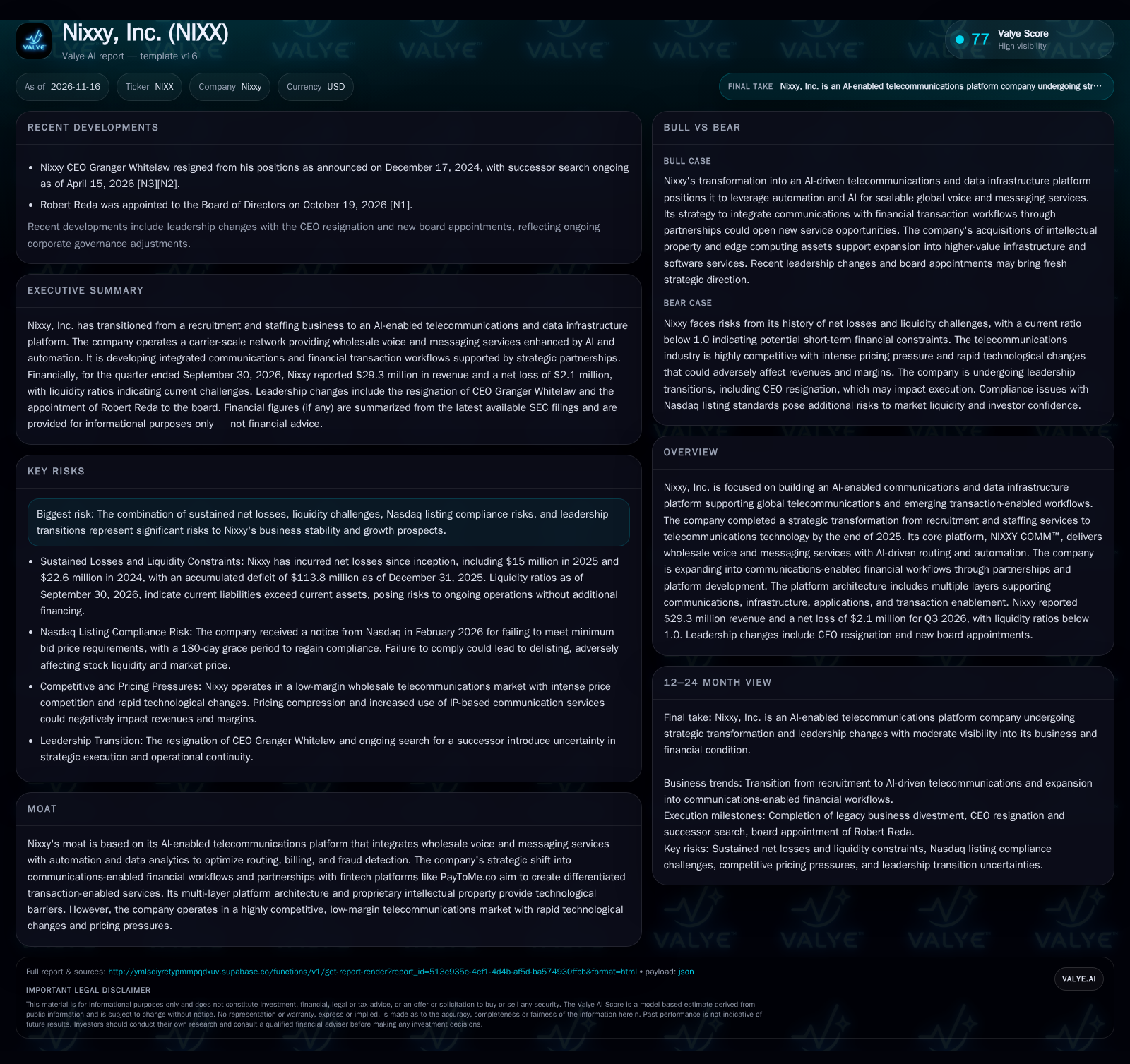
Nixxy, Inc. has completed a high-stakes pivot from recruitment into AI-enhanced carrier-scale telecommunications, aiming to blend communications with fintech workflows. The company reported $29.3M in Q3 2026 revenue and a $2.1M net loss, but faces sub-1.0 liquidity ratios and ongoing CEO succession. Its future hinges on scaling volume, achieving automation-driven margin gains, and successfully integrating transaction-enabled services amid intense industry competition and capital constraints. [S2] [N1] [N2] [N3]
Nixxy, Inc. stands at a pivotal moment in its evolution, having fully transitioned from a staffing business to an AI-centric telecommunications and data infrastructure provider. Now operating a carrier-scale network delivering wholesale voice and messaging services, Nixxy seeks to differentiate itself by integrating intelligent routing, automation, and transaction-enabled workflows—an ambitious play at the intersection of telecom and fintech. Yet, the company’s latest financials reveal persistent net losses and tight liquidity, while leadership turnover and Nasdaq compliance issues cloud operational and strategic visibility. The next chapter for Nixxy will hinge not only on technological execution and commercial uptake, but also on its ability to navigate competitive margin pressures and stabilize its financial footing. [S2] [N1] [N2] [N3]
Recent Transformation and Financial Realities Define Nixxy’s Starting Point
Nixxy, Inc. has completed its strategic transition from a recruitment services provider to an AI-enabled telecommunications platform, fully divesting its legacy operations by December 2025. The company’s core focus is now on carrier-scale wholesale voice and messaging services, with a platform architecture designed to support communications, infrastructure, applications, and transaction enablement. For the third quarter of 2026, Nixxy reported revenue of $29.3 million and a net loss of $2.1 million. Liquidity constraints are evident, with a current ratio of 0.62 and cash and equivalents totaling $0.9 million. Leadership instability compounds these challenges: CEO Granger Whitelaw resigned in December 2024, and as of late 2026, the company is still searching for a permanent successor. Additionally, Nixxy faces Nasdaq listing compliance risks due to failure to maintain minimum bid price requirements. These facts collectively underscore a business at an inflection point—operationally repositioned but financially and organizationally unsettled. [S2] [N1] [N2] [N3]
How Nixxy’s Platform Could Unlock Value—And Where Margin Leaks May Persist
Nixxy’s economic model is built on scaling wholesale telecom traffic while using AI and automation to optimize routing, billing, settlement, and fraud detection. In theory, this enables improved margin capture in an industry notorious for razor-thin spreads. The NIXXY COMM™ platform’s ability to automate traffic flows and settlement could reduce labor costs and manual errors, while AI-driven analytics may allow more dynamic pricing and improved network utilization.
However, the core wholesale telecom business is structurally low-margin, with pricing dictated by volume, carrier interconnect rates, and intense competition. The path to improved economics hinges on three levers: (1) volume growth, which could deliver operating leverage if fixed platform costs are high relative to variable traffic costs; (2) automation-driven cost reductions, which depend on the efficacy and adoption of Nixxy’s AI tools; and (3) expansion into higher-value transaction-enabled services, where integration with fintech partners (e.g., PayToMe) may allow for new fee-based or revenue-sharing models.
Capital intensity remains a concern. Building and operating a carrier-scale platform, especially with edge computing and AI inference layers, requires ongoing investment in infrastructure, software, and connectivity. The company reported cash and liquidity metrics for the period; these figures do not by themselves establish operating runway, investment capacity, financial flexibility, or financing capacity. The company’s future economics will thus be shaped as much by its commercial scaling as by its ability to access capital on favorable terms. [S2]
Positioning Against Wholesale Telco Giants and the Fintech-Telco Convergence Race
Nixxy operates in the highly competitive wholesale telecommunications market, where incumbent global carriers, specialized voice/SMS aggregators, and rising cloud communications platforms vie for traffic and margin. The traditional competitive levers—price, quality of service, global reach, and reliability—are now joined by the ability to deliver automation, analytics, and integration with adjacent workflows.
The company’s AI-driven routing and automation capabilities could, if effective, reduce cost-to-serve and enable more responsive traffic management than legacy systems. Its ambition to converge communications with financial transaction workflows places it at the intersection of telecom and fintech, a space where few established carriers have fully integrated solutions. Strategic partnerships, such as with PayToMe, may enable differentiated offerings (e.g., messaging-enabled payments, cross-border remittance integration) if execution matches vision.
However, barriers to entry remain low in basic wholesale services, and new entrants leveraging cloud-native architectures can scale quickly. Incumbents possess deep carrier relationships, regulatory expertise, and the balance sheets to absorb pricing shocks. Nixxy’s two-employee structure and reliance on contractors may limit its ability to compete on breadth, relationship management, and global regulatory compliance. The real test will be whether its platform delivers enough margin improvement or unique transaction-enabled features to attract and retain high-value traffic in a market where switching costs are typically low.
Automation, Platform Stickiness, and Fintech Integration Drive a Margin Inflection
The most constructive scenario for Nixxy sees its AI-enabled platform successfully scaling wholesale volumes while delivering meaningful cost reduction through automation. If the company’s intelligent routing and billing systems materially lower network operating expenses and reduce fraud, unit economics could improve, especially as volume increases amortize fixed platform costs. Expansion into transaction-enabled workflows—such as messaging-based payments or cross-border financial services—could create higher-margin revenue streams, especially if these capabilities attract large enterprise customers or fintech partners.
Confirmation of this scenario would require evidence of sustained communications traffic growth, rising gross margins, and successful onboarding of fintech-enabled workflows with measurable transaction volume. Additional signs would include new long-term partnership announcements, repeat business from high-value customers, and improved cash conversion cycles. Falsification would occur if revenue growth stalls, margin improvement fails to materialize, or if fintech partnerships do not translate into incremental, recurring revenue.
Incremental Growth Amid Margin Pressure and Ongoing Execution Challenges
A more likely near-term trajectory for Nixxy involves modest growth in wholesale telecom revenues as the company continues to ramp its AI-powered platform and seeks to stabilize operations post-leadership transition. Margins may remain under pressure due to intense pricing competition and the capital intensity of platform enhancements. Transaction-enabled service integration may progress slowly, with limited early-stage contributions to overall revenue.
Under this scenario, Nixxy may need to secure additional financing to support ongoing operations and investment in its platform. Operational risks remain elevated until CEO succession is resolved and the company demonstrates consistent execution. Confirmation would be visible in gradual quarterly revenue growth, stable or slightly improving margins, and timely progress on new service launches. Falsification would be indicated by continued net losses without operating leverage, customer attrition, or further deterioration in liquidity.
Liquidity Squeeze and Leadership Uncertainty Trigger Strategic Setbacks
A negative scenario could unfold if Nixxy’s liquidity constraints intensify before the platform achieves scale or margin improvement. Failure to secure timely external financing could force the company to curtail investment, delay platform enhancements, or even face operational disruptions.
Leadership instability—prolonged absence of a permanent CEO or further board turnover—could undermine partner confidence and slow strategic execution. If the company fails to regain Nasdaq compliance, public market access and investor sentiment could deteriorate further, potentially leading to delisting. Confirmation of this scenario would include missed payroll or vendor payments, emergency financings on unfavorable terms, customer loss, or public disclosure of going-concern risks.
What Will Ultimately Test Nixxy’s Strategic Reset and Market Prospects
Quarterly revenue and gross margin trends—especially any evidence of margin expansion as automation and AI-driven routing are deployed at scale.
Volume metrics for wholesale voice and messaging traffic; if disclosed, these would clarify whether platform adoption is accelerating.
The pace and commercial impact of transaction-enabled workflow launches—such as messaging-based payments or integrated fintech partnerships.
Progress on CEO succession and executive team stability, including new appointments or departures.
Resolution of Nasdaq minimum bid price compliance and any related market access updates.
Updates on external financing—whether new equity, debt, or strategic investment is secured to support operations and platform growth.
Customer concentration and retention rates; a useful metric would be renewal rates or the share of revenue from top customers, if disclosed.
Operational cash flow trends and any disclosure of going-concern risks or adverse auditor commentary.
Disclaimer: This is research-only, informational analysis and not investment advice. It may include AI-generated interpretation and general industry context. Always verify important details using primary sources.

Comments