
Neumora Therapeutics: Pipeline Milestones, Liquidity Window, and the Realities of CNS Drug Development
With encouraging data for its lead CNS candidates and a sizable reported cash balance, Neumora Therapeutics faces a classic biopharma inflection: translating early-stage promise into clinical and regulatory value before capital needs return to the fore. The next 12-18 months will be defined by clinical execution, operational discipline, and strategic leadership under its new CEO.
Neumora Therapeutics is advancing two lead CNS drug candidates—NMRA-215 and NMRA-511—supported by recent positive toxicology and Phase 1b data. The ultimate value hinges on clinical progress, regulatory milestones, and the ability to manage capital until potential inflection points in 2027.
Neumora Therapeutics sits at a pivotal juncture for any clinical-stage biotech: recent early-stage wins have propelled its CNS pipeline forward, but the company is still pre-revenue and burning cash. The recent appointment of CEO Joshua Pinto adds a layer of strategic uncertainty and potential, as Neumora seeks to convert scientific progress into tangible asset value.
Clinical Wins and Financial Position Define the Near-Term Landscape
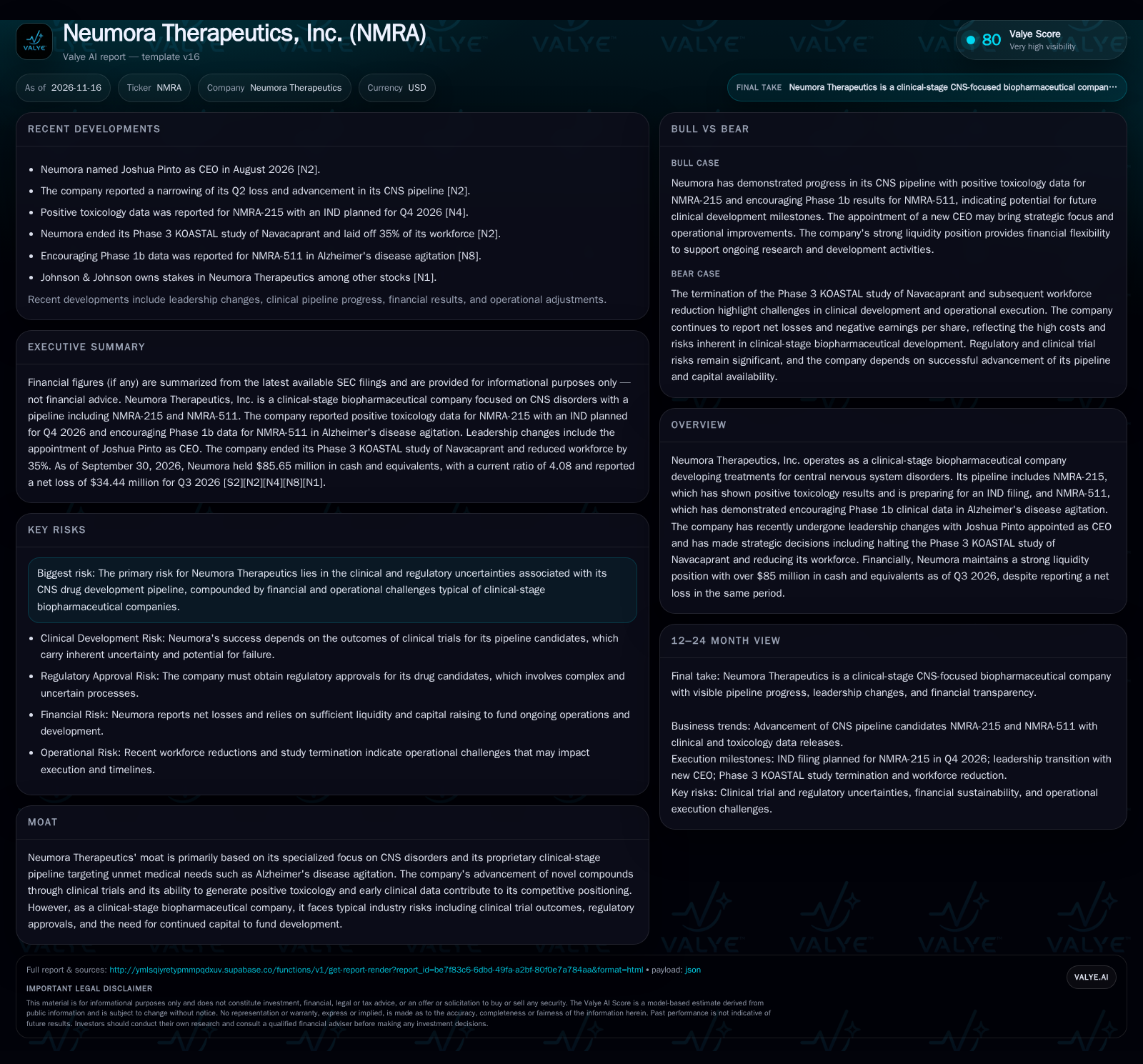
Neumora Therapeutics’ most material recent developments are concentrated in its clinical pipeline and capital base. The company reported positive toxicology data for NMRA-215, targeting CNS disorders, and plans to file an investigational new drug (IND) application in Q4 2026—a critical regulatory step that, if successful, allows progression into human trials [N4]. Meanwhile, NMRA-511 has yielded encouraging Phase 1b data in Alzheimer’s disease agitation, suggesting potential for further clinical advancement [N8]. On the financial side, Neumora ended Q3 2026 with $85.65 million in cash and equivalents, current assets of $94.75 million, and a current ratio of 4.08, reflecting a reported liquidity position for a clinical-stage biotech, though the company remains loss-making with a Q3 net loss of $34.44 million [S2]. The August 2026 appointment of Joshua Pinto as CEO introduces new leadership at a time when operational focus and capital discipline are paramount [N2]. These developments set the stage for a high-stakes 12-18 months as Neumora seeks to convert early clinical promise into pipeline momentum.
Beyond the immediate clinical and financial metrics, the company’s near-term trajectory will be shaped by its ability to integrate clinical data into a coherent development narrative that supports regulatory and investor confidence. This includes not only achieving IND acceptance but also demonstrating a clear understanding of patient selection criteria, biomarker strategies, and trial endpoints that align with regulatory expectations. Operationally, the new leadership must ensure that clinical trial design incorporates adaptive elements to mitigate risk and optimize resource allocation, which is especially critical in CNS indications where heterogeneity and placebo effects complicate efficacy assessments.
The Economics of CNS Drug Development: Cash Burn, Milestone Value, and Capital Cycles
Neumora’s economic engine is classic pre-commercial biopharma: high fixed costs for research and clinical operations, with minimal to no revenue until a drug achieves late-stage approval and commercialization. The company’s quarterly net loss of $34.44 million reflects the resource intensity of advancing multiple CNS programs simultaneously [S2]. The company reported cash and liquidity metrics for the period; these figures do not by themselves establish operating runway, investment capacity, financial flexibility, or financing capacity.
Value creation in this context is milestone-driven. Positive toxicology and early clinical data can unlock new rounds of funding or attract partnership interest, especially in high-need indications like Alzheimer’s disease agitation. However, the variable costs associated with scaling up to Phase 2/3 trials are substantial, and capital needs typically accelerate as programs advance. Fixed costs dominate in the early clinical phases, but variable costs rise sharply with larger, multicenter trials. The ability to maintain operational focus and avoid costly trial setbacks is critical to stretching runway and maximizing the value of each clinical milestone.
Navigating a Crowded and High-Risk CNS Therapeutics Landscape
Neumora operates in one of the most challenging and competitive segments of biotech: central nervous system disorders. The CNS drug development space is characterized by high unmet need, but also by historically high rates of clinical failure and regulatory attrition. Many established pharmaceutical players and emerging biotechs target similar indications, particularly Alzheimer’s-related agitation, making differentiation through mechanism of action, safety profile, or efficacy essential.
Neumora’s proprietary pipeline and early clinical progress provide some insulation, but do not guarantee market access or pricing power. Switching costs for prescribers and patients are typically low unless a therapy delivers a step-change in efficacy or safety. If Neumora’s programs progress, partnerships or licensing deals with larger pharma companies could accelerate commercialization, but such deals depend on demonstrating clear clinical and regulatory advantages. The presence of Johnson & Johnson as a shareholder may indicate some level of industry validation, but is not, by itself, a source of commercial moat.
In a crowded CNS landscape, differentiation is often achieved through a combination of novel mechanisms of action and robust clinical validation. Given the complexity of CNS disorders, a program’s ability to demonstrate meaningful cognitive or behavioral improvements with an acceptable safety profile is paramount. Additionally, payer and health technology assessment perspectives increasingly influence commercial viability; therapies must not only improve clinical outcomes but also demonstrate cost-effectiveness or address significant unmet needs to justify premium pricing. Neumora’s strategic positioning will depend on its ability to anticipate these market access challenges early and incorporate health economics considerations into development planning.
If Clinical and Regulatory Milestones Align, Value Creation Could Accelerate
The most favorable outcome for Neumora would occur if NMRA-215’s IND is accepted and first-in-human studies show safety and early efficacy, while NMRA-511 advances to and through a successful Phase 2 trial in Alzheimer’s agitation. Such progress could attract strategic partners or acquirers, unlock milestone payments, or support premium-priced follow-on equity raises. The CNS field, especially in Alzheimer’s-related indications, has seen outsized valuations for late-stage assets with strong data.
Confirmation of this scenario would come from: (1) timely IND acceptance and trial initiation for NMRA-215; (2) positive interim or top-line results from ongoing NMRA-511 trials; (3) announcements of partnerships, collaborations, or licensing deals with larger pharma entities; and (4) the ability to raise capital on favorable terms, reflecting increased market confidence in pipeline value.
Clinical Progress with Capital Constraints: The Most Likely Trajectory
The most plausible outcome for Neumora is incremental clinical progress—advancing NMRA-215 into early-stage trials and NMRA-511 through further Phase 2 studies—while managing cash burn and preparing for future capital raises.
Evidence supporting this scenario includes steady updates on trial enrollment and data readouts, continued net losses consistent with clinical-stage operations, and eventual announcements of new financings or dilutive capital raises. Falsification would come from unanticipated trial delays, regulatory setbacks, or an inability to raise sufficient capital, which could force program discontinuations or strategic pivots.
Trial Setbacks or Financing Gaps Could Put Pipeline and Value at Risk
The primary risk for Neumora is that one or more clinical programs encounter safety, efficacy, or regulatory setbacks—such as a failed IND submission for NMRA-215 or disappointing NMRA-511 Phase 2 results. In this scenario, the company’s ability to raise new capital could be impaired, leading to program discontinuations, layoffs, or fire-sale licensing of assets at suboptimal valuations.
Downside confirmation would include: public disclosure of clinical trial terminations or hold letters; significant delays in milestone timelines; inability to secure additional capital within 12-18 months; and operational restructuring or cost-cutting measures that signal distress. Market confidence could erode rapidly if clinical or regulatory news flow turns negative, amplifying dilution risk for existing shareholders.
Operational risks compound the clinical and financial uncertainties inherent in CNS drug development. For example, delays in patient recruitment or site activation can cascade into missed regulatory deadlines and increased expenses, eroding investor confidence. Moreover, CNS trials often require specialized expertise and infrastructure, meaning that any gaps in operational execution or vendor management could disproportionately impact timelines and data quality. In the event of setbacks, the company may face difficult decisions about resource reallocation or prioritization of programs, which could lead to strategic shifts that unsettle stakeholders and complicate future fundraising efforts.
Milestones and External Dynamics That Will Define Neumora’s Next Chapter
The outcome and timing of the IND filing and acceptance for NMRA-215 in Q4 2026 [N4].
Interim or top-line data releases for NMRA-511 in ongoing Alzheimer’s agitation trials [N8].
Quarterly cash burn rates and updated liquidity projections as clinical programs advance [S2].
Announcements (if any) of strategic partnerships, licensing, or non-dilutive funding agreements.
Ability to raise additional capital without excessive dilution or punitive terms—a useful metric would be the average cost of new equity or debt financing, if disclosed.
Operational updates, including any changes in workforce, study terminations, or R&D prioritization.
Clarity on the new CEO’s strategy, including pipeline prioritization, cost management, and external engagement.
Disclaimer: This is research-only, informational analysis and not investment advice. It may include AI-generated interpretation and general industry context. Always verify important details using primary sources.

Comments