
Nobility Homes: Navigating Manufactured Housing Volatility with Financial Strength and Channel Flexibility
Despite a 13% sales decline in 2025, Nobility Homes enters late 2026 with reported liquidity position, strong equity, and a dual-channel sales model. The company’s ability to convert assets into earnings amid sector cyclicality will determine whether its financial resilience translates into long-term value.
Nobility Homes faces ongoing sales volatility in the manufactured housing sector, highlighted by a 13% drop in 2025 sales. However, as of Q3 2026, the company maintains reported liquidity position, a solid equity base, and positive net income. The core question is whether its dual-channel model and balance sheet strength can counterbalance market cyclicality and drive sustainable growth [S2].
Nobility Homes Inc, a Florida-based manufacturer and seller of manufactured homes, stands out for its conservative balance sheet and consistent profitability even as it contends with sector headwinds. The company’s prospects hinge on how effectively it leverages its dual sales channels and robust financial footing to weather industry swings and capitalize on housing affordability trends.
Recent Performance and Financial Position Set the Stage
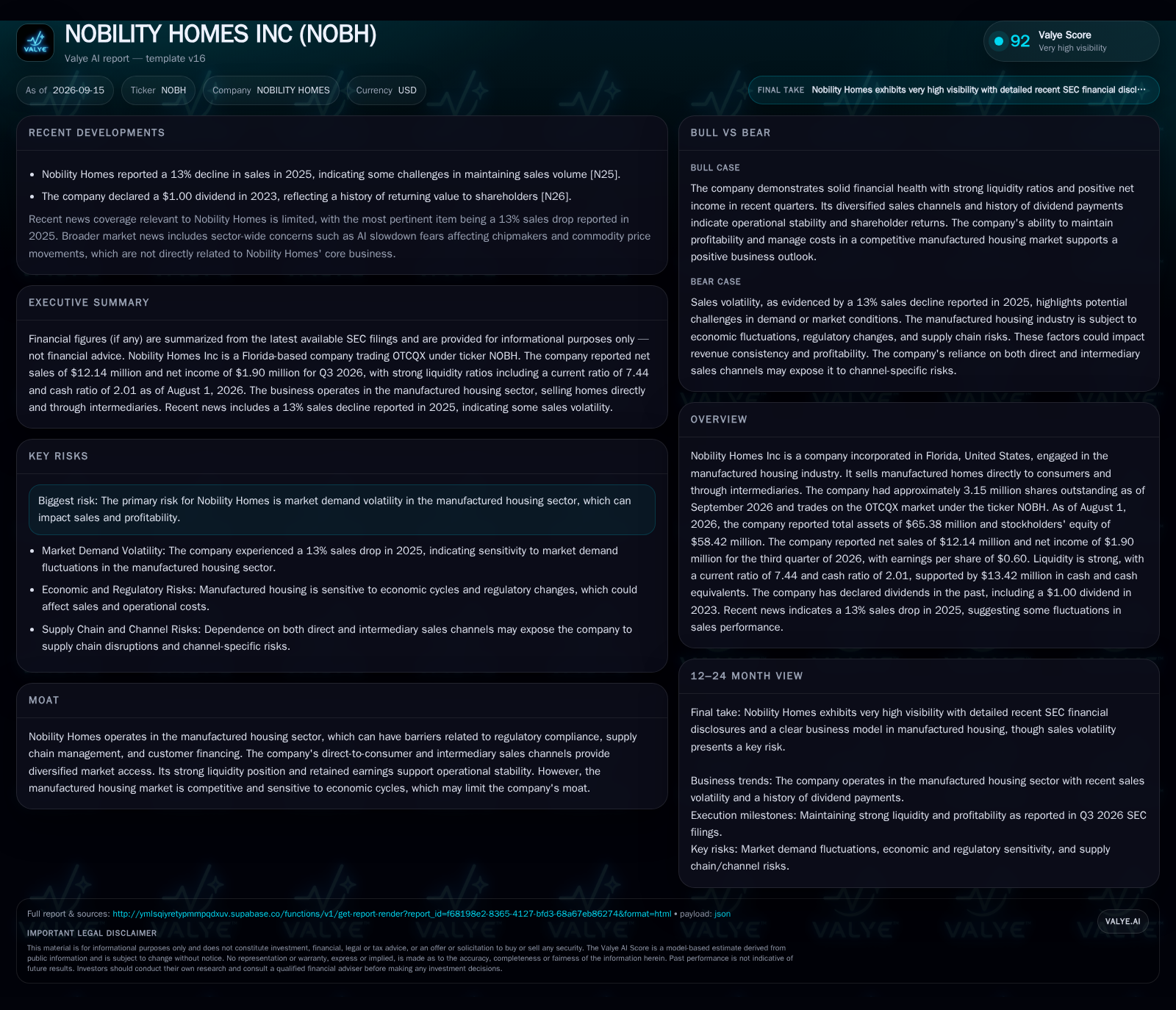
As of August 1, 2026, Nobility Homes reported $12.14 million in net sales and $1.90 million in net income for the third quarter, with 3.15 million shares outstanding and earnings per share of $0.60 [S2]. The company reported a current ratio of 7.44 for the period. [S2] Stockholders’ equity stands at $58.42 million, suggesting a conservative balance sheet. Notably, the company experienced a 13% sales drop in 2025, indicating demand volatility in its core manufactured housing market [S2]. These facts highlight a business with significant liquidity and capital strength, but also one exposed to shifts in housing sector demand.
Beyond headline liquidity and equity metrics, a deeper examination of working capital components would clarify Nobility Homes’ operational efficiency amid demand fluctuations. For instance, if the company manages to keep inventory turnover stable despite sales volatility, it suggests robust supply chain coordination and demand forecasting. Conversely, rising inventories or receivables could indicate channel or market stress, potentially tying up cash and constraining flexibility. Additionally, the timing and composition of current liabilities relative to current assets influence the quality of the current ratio figure; a high ratio driven by slow-paying receivables or non-liquid assets may overstate short-term financial health.
How Nobility Homes Converts Assets into Profits
Nobility Homes generates revenue from selling manufactured homes, both directly to consumers and through intermediaries. This dual-channel model may allow the company to capture a broader customer base, but can also introduce complexity in pricing, margin management, and inventory allocation. Manufactured housing typically features lower gross margins than site-built homes but can benefit from higher asset turnover and reduced capital intensity per unit. The company’s recent net income margins (approximately 15.7% for Q3 2026) suggest disciplined cost controls and an ability to defend profitability even amid revenue declines [S2].
Operating leverage is likely moderate: much of the cost base (materials, labor, distribution) scales with volume, but fixed costs (such as manufacturing facilities and corporate overhead) can pressure margins during downturns. The company reported cash and liquidity metrics for the period; these figures do not by themselves establish operating runway, investment capacity, financial flexibility, or financing capacity. If the company can maintain asset efficiency and avoid overextending on inventory or receivables, its economics should remain resilient, but sustained volume declines would eventually compress margins and returns on equity.
The dual-channel sales approach introduces nuanced margin management challenges. Direct sales may offer higher gross margins due to elimination of intermediary fees but require greater marketing and customer service investment. Intermediary channels, while potentially lower margin, can provide volume stability and geographic reach. Balancing inventory allocation between these channels is critical; overcommitting to one channel can lead to stock imbalances and margin pressure. Moreover, cost structure sensitivity to volume changes means that fixed overhead absorption rates will fluctuate, making the company’s ability to flex operational costs a key determinant of profitability resilience.
Industry Structure and Nobility Homes’ Position within Manufactured Housing
The manufactured housing industry is fragmented, with regional players competing against larger national producers and alternative housing options. Nobility Homes’ presence in Florida positions it in a market with persistent housing affordability challenges and demographic demand tailwinds (retirees, cost-sensitive buyers), but also exposes it to competition from both established manufacturers and local builders. Regulatory compliance, supply chain stability, and customer financing access are persistent hurdles.
Nobility’s dual-channel approach—selling both directly and via intermediaries—provides some insulation against channel-specific risks but does not guarantee recurring revenue or customer lock-in. The company’s reported balance sheet position may offer a buffer against downturns and a potential edge in securing materials or bridging temporary demand gaps, but the manufactured housing market remains highly sensitive to interest rates, consumer sentiment, and local regulation. Substitutes include traditional site-built homes, rental units, and, increasingly, modular or prefab alternatives with different price points and customization options.
Nobility Homes’ regional concentration in Florida presents both strategic advantages and risks. While demographic trends such as retiree influx and affordability constraints support demand, localized regulatory shifts or economic downturns could disproportionately impact the company compared to more geographically diversified peers. Furthermore, the competitive landscape’s fragmentation implies that scale economies are limited, increasing the importance of operational efficiency and customer relationship management. The company’s ability to differentiate through product customization, financing options, or service quality could become decisive factors in maintaining or expanding market share amid competitive pressures.
Affordability Tailwinds and Channel Optimization Drive Recovery
A constructive scenario for Nobility Homes would see sector demand rebound as affordability concerns push more buyers toward manufactured housing. The company’s liquidity could allow it to secure inventory, offer attractive financing packages, or invest in product improvements just as demand recovers. If Nobility effectively leverages its dual-channel model—expanding its direct-to-consumer footprint and optimizing intermediary partnerships—it could capture market share from less well-capitalized rivals.
Confirmation would come from sequential sales growth, margin expansion, and a sustained improvement in return on assets and equity. Additional evidence would include increased order backlogs (if disclosed), rising average selling prices, and stable or increasing net income even as volumes recover. Falsification would be evident if sales remain flat or decline further despite improved market conditions, or if margin gains fail to materialize despite higher volumes.
Navigating Cyclical Swings with Financial Discipline
The most plausible scenario is that Nobility Homes continues to experience moderate sales volatility, reflecting broader manufactured housing sector cyclicality. The company’s reported balance sheet position and prudent cost management allow it to weather near-term disruptions, but top-line growth remains constrained by macroeconomic factors such as interest rates and consumer confidence.
In this scenario, Nobility maintains positive net income, avoids significant margin erosion, and sustains its liquidity buffer. Evidence confirming this path would include stable quarterly sales and earnings, little change in working capital requirements, and continued low leverage. Falsification would involve a sharp deterioration in margins, significant inventory build-up, or an erosion of the current liquidity position.
Prolonged Demand Weakness and Margin Compression
The risk scenario emerges if manufactured housing demand remains depressed due to persistent macroeconomic headwinds, regulatory tightening, or unfavorable shifts in consumer preference. In this case, Nobility Homes could see further sales declines, leading to underutilized manufacturing capacity and negative operating leverage. Fixed costs would become a larger proportion of revenue, compressing margins and eventually eroding profitability.
Confirmation of this scenario would be a continued decline in quarterly sales, rising inventories or receivables (if disclosed), and a material drop in net income or a swing to net losses.
Milestones That Will Reveal Nobility Homes’ Adaptability and Resilience
Quarterly net sales trends: Sustained sequential growth or stabilization would indicate improvement; continued declines would signal unresolved demand issues.
Gross and net margin evolution: Margin stability or expansion would suggest effective cost management; compression would highlight rising input or fixed costs.
Direct vs. intermediary channel performance (if disclosed): Shifts in channel mix or profitability could reveal strategic strengths or vulnerabilities.
Inventory and receivables turnover (if disclosed): Efficient asset management would support resilience; rising inventories or slow receivables would suggest operational stress.
Regulatory or financing environment changes: Alterations in state or federal housing policy or consumer loan availability could materially impact demand.
Order backlog or pipeline (if disclosed): Growth in committed orders would support the upside case; shrinking backlogs would highlight near-term demand risk.
Disclaimer: This is research-only, informational analysis and not investment advice. It may include AI-generated interpretation and general industry context. Always verify important details using primary sources.

Comments