
CO2 Energy Transition Corp. Holds Steady Ahead of IPO Redemption Deadline
With its initial business combination deadline imminent, CO2 Energy Transition Corp. remains on course, reflective of typical SPAC dynamics and governance risks.
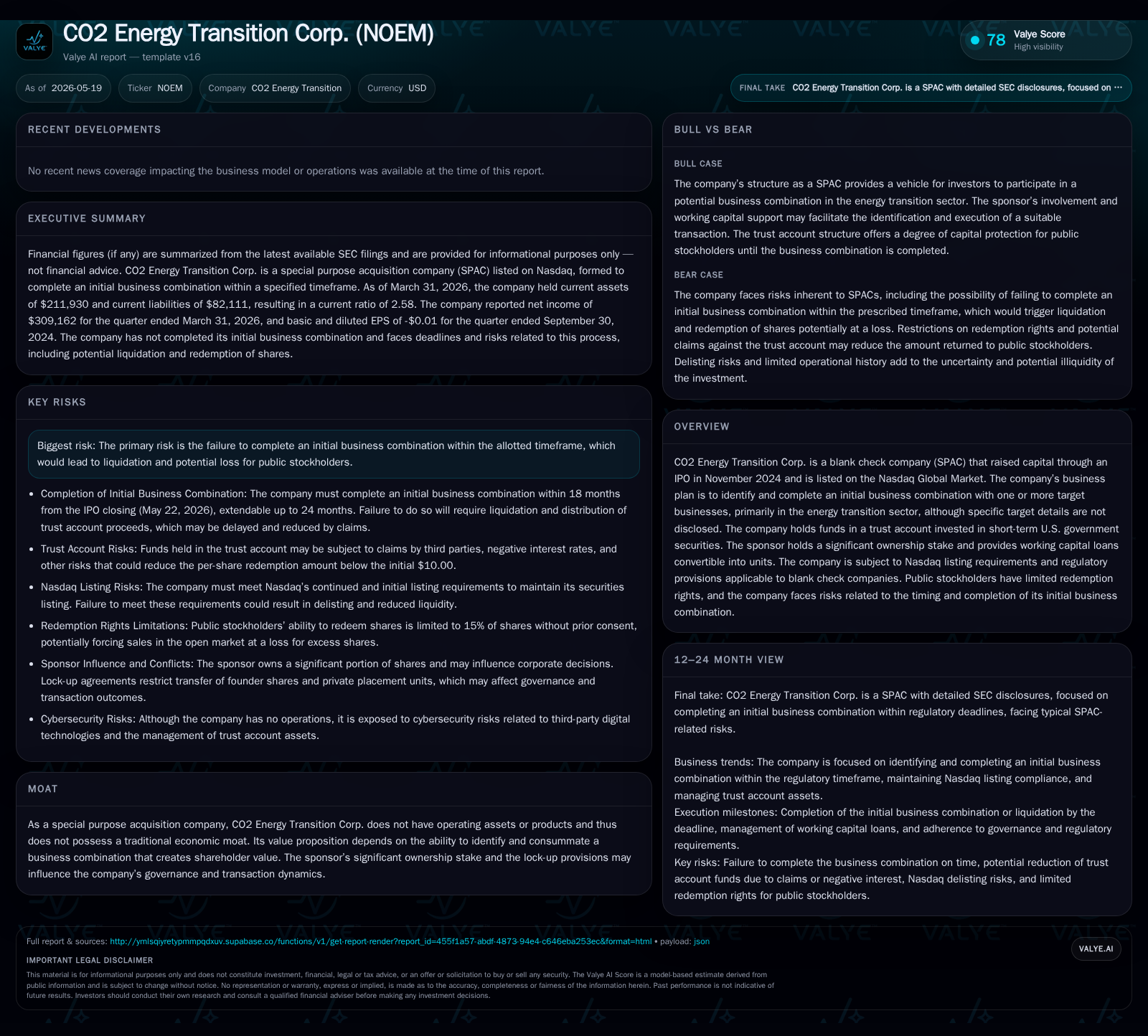
CO2 Energy Transition Corp., a SPAC focused on energy transition assets, is approaching its May 22, 2026 deadline to complete a qualifying business combination or risk liquidation. The company’s latest quarterly filing confirms no material changes to disclosed risks, highlights the typical sponsor and shareholder redemption rights interplay, and underscores liquidity sufficiency to support transaction efforts. Absent operating assets, CO2 Energy’s value hinges entirely on consummating a strategic deal aligned with clean energy themes amid a competitive SPAC investment environment with timing constraints.
Latest Operating Update: Countdown to Initial Business Combination
CO2 Energy Transition Corp. recently filed its Form 10-Q for the quarter ending March 31, 2026 [S2], reiterating its status as a special purpose acquisition company (SPAC) with no operational revenues or ongoing business activities aside from preparing for an initial business combination (IBC). The filing underscores the critical timeline: the company must consummate an IBC by May 22, 2026 — eighteen months following its IPO in November 2024 — unless it opts to extend this deadline by six months to November 22, 2026.
This timeline imposes rigor on CO2 Energy’s management as it balances due diligence processes against shareholder redemption rights. Notably, these rights are capped: if public shareholders collectively own over 15% of outstanding common stock post-announcement of a proposed combination and redemptions proceed outside tender offer rules, shares redeemable are limited to this threshold without prior consent [S1]. This structural provision can significantly shape pre-deal dynamics by potentially constraining redemptions that might jeopardize deal financing or strategic viability.
The company’s risk disclosures confirm no material changes since the last annual report [S17], signaling stable regulatory conditions but maintaining the inherent SPAC risk profile tied predominantly to deal execution timing.
Business Model Primer: SPAC Structure and Energy Transition Focus
CO2 Energy Transition Corp. operates as a blank check company founded specifically to identify and merge with one or more businesses primarily involved in the energy transition sector [S1]. It does not generate revenue or hold operating assets; instead, it serves as a capital-raising vehicle designed to execute an asset acquisition that unlocks shareholder value.
At IPO close in November 2024, proceeds net of underwriting fees were placed in a trust account invested exclusively in short-term U.S. Treasury securities or money market funds with negligible credit risk to preserve capital until deployment [S1]. This trust structure ensures principal protection but realistically limits interim returns given current interest rate environments affecting government instruments.
The sponsor holds substantial equity stakes through founder shares and private placement units acquired concurrent with the IPO [S1]. These units typically comprise one private share plus accompanying warrants and rights exercisable under defined terms. The sponsor also extended working capital loans convertible into units at $10 per unit if drawn [S20]. This setup aligns management incentives toward completing a beneficial transaction but introduces potential conflicts around target selection and deal terms since sponsors’ gains may diverge from public stockholder interests due to differences in voting control, lock-up provisions, and economic exposure.
The thematic focus on energy transition leverages growing regulatory encouragement for decarbonization technologies and ESG-conscious investing trends. While specifics of target candidates remain undisclosed—as is standard for SPACs pre-business combination—the commitment frames investor expectations around climate-related sectors without operational footprint until merger completion.
Capital Structure, Liquidity, and Sponsor Alignment
As of March 31, 2026, CO2 Energy Transition holds current assets of approximately $212 million against current liabilities near $82 million, resulting in a current ratio of about 2.58 [F1]. This liquidity supports ongoing administrative expenditures and potential transaction-related costs ahead of consummation.
Total debt is limited to approximately $11,730 related to outstanding working capital promissory notes from the sponsor as of late November 2024, with no significant interest obligations reported [F1][S14]. These convertible loans provide flexibility; upon business combination consummation, they may be converted into equity units mirroring private placement terms at $10 per unit [S20].
The sponsor’s continued material equity presence through private shares confers voting control influence but subjects governance interactions to scrutiny due to possible conflicts when evaluating business combinations or negotiating post-merger management roles [S1]. Lock-up restrictions typically delay resale opportunities for these holdings until defined post-merger periods elapse.
Industry Context: SPAC Competition and Energy Transition Investment Trends
Blank check companies focused on climate technology and energy transition have historically attracted substantial capital inflows amid shifting policy priorities worldwide—particularly following heightened ESG mandates from institutional investors. However, this thematic enthusiasm has generated an increasingly saturated SPAC landscape vying for quality targets offering scalable growth potentials backed by cutting-edge decarbonization solutions.
This competitive backdrop elevates execution risk for CO2 Energy Transition given constrained windows to source deals meeting both market valuation expectations and strategic fit within energy transition sub-segments such as renewable infrastructure development, carbon capture/utilization technologies, or electrification systems.
Moreover, regulatory scrutiny on SPAC disclosures has intensified recently; heightened expectations on transparency regarding conflicts of interest, redemption mechanics clarity, valuation fairness assessments, and governance arrangements add layers of compliance cost and procedural friction prior to finalizing merger agreements.
While CO2 Energy’s filings do not explicitly enumerate peer comparison metrics nor specific competitor dynamics due to its pre-transaction stage status [S1], these macro considerations are germane biases shaping decision-making environments across analogous thematic SPAC vehicles today.
Growth Potential: Unlocking Value Through Strategic Target Selection
Although CO2 Energy Transition currently lacks revenue-generating operations, its prospective growth hinges entirely on successfully effectuating an initial business combination with an entity aligned with energy transition imperatives.
Target company attributes fostering value creation could include scalable customer bases supported by long-term contracts or service agreements satisfying renewables integration demands; adoption of proprietary low-carbon technologies featuring embedded pricing power; or platform businesses capturing multiple market end-users within electrification or sustainable fuel supply chains.
Given regulatory trends emphasizing carbon reduction targets globally—particularly under frameworks promoting renewable portfolio standards or emissions pricing mechanisms—acquiring businesses positioned favorably within these ecosystems could yield compelling organic growth prospects post-merger.
By delivering an attractive merger proposal underpinned by synergistic operational enhancements or access to capital markets unavailable prior through standalone status, CO2 Energy can translate thematic promise into tangible shareholder returns. However, absent disclosed targets or signed agreements at this stage leaves uncertainty over timing or scale of such accretive growth pathways.
Risks and Constraints: Redemption Rights and Transaction Timing
The paramount risks confronting CO2 Energy Transition remain tethered to failure in closing an initial business combination within prescribed timeframes mandated by SEC regulations and Nasdaq listing rules [S1][S2]. Should the May 22 deadline pass unextended—or no deal closes by extended November date—the company will be required to liquidate its trust account proceeds minus permissible expenses leading to potentially disappointing returns for public stockholders who cannot recoup invested capital beyond pro-rata share distributions.
Further complicating transaction feasibility are redemption mechanisms permitting shareholders who qualify under tender offer rules—and subject to aggregate caps—to redeem their shares effectively reducing available cash consideration towards target acquisitions [S1]. Excessively high redemption rates may force renegotiations on price or dissuade sellers seeking fully funded mergers.
Sponsor-related conflicts constitute additional governance risks; founders’ financial interests diverging from public holders may influence decisions around whether particular acquisition proposals proceed based on personal retention arrangements or incentive compensation terms negotiated concurrently with merger activities [S1]. Transparency around these matters will be critical during proxy solicitations should stockholder approval become necessary.
Key Upcoming Milestones and What Investors Should Watch
Investors’ focal points encompass monitoring any formal announcement regarding target identification or signing of definitive agreements before expiration dates outlined above [S2]. Proxy materials requesting shareholder consents tied to business combinations will be pivotal moments influencing stock price behavior and redemption volumes.
Other attention areas include:
- Updates evidencing extension election decisions capturing management’s confidence in deal pipelines;
- Subsequent SEC filings clarifying conflict mitigation measures taken;
- Sponsor equity transactions potentially altering insider alignment profiles;
- Redemption statistics published periodically post-announcement shedding light on investor sentiment toward proposed transactions;
- Market price trends relative to trust account liquidation values indicating implicit expectations about deal success probability.
Absence of announced deals as deadlines approach heightens downside liquidation risk while progress disclosures would signal advancing transformation from blank check shell toward operational entity status.
Financial Overview: Snapshot of Balance-Sheet Health
Despite lacking operating cash flow given no commercial asset base, CO2 Energy Transition maintains healthy short-term solvency levels supporting ongoing administrative operations alongside preparatory transaction expenditures [F1]. The current ratio near 2.58 evidences sufficient liquidity coverage against immediate liabilities
Outstanding debt chiefly consists of minimal working capital notes convertible into private units at $10 apiece provided by the sponsor [F1][S20]. There is no indication of significant leverage that could burden balance sheet integrity prior to business combination closure.
Funds conserved within the trust account principally ensure preservation of IPO proceeds dedicated exclusively for acquisition financing [S1]. This financial profile typifies early-stage SPAC entities pending transformative deals rather than demonstrating conventional profitability metrics [S2].
This analysis is based solely on information publicly disclosed in SEC filings as referenced herein through May 19, 2026. Valye News presents this report strictly for informational purposes without providing investment advice nor recommending any action regarding securities discussed.
Disclaimer: This is research-only, informational analysis and not investment advice. It may include AI-generated interpretation and general industry context. Always verify important details using primary sources.

Comments