
New Providence Acquisition III Advances Abra Merger Ahead of Nasdaq Deadline
NPAC’s latest quarterly filing confirms steady progress toward completing its initial business combination with Abra by April 2027, navigating competitive pressures and regulatory milestones.
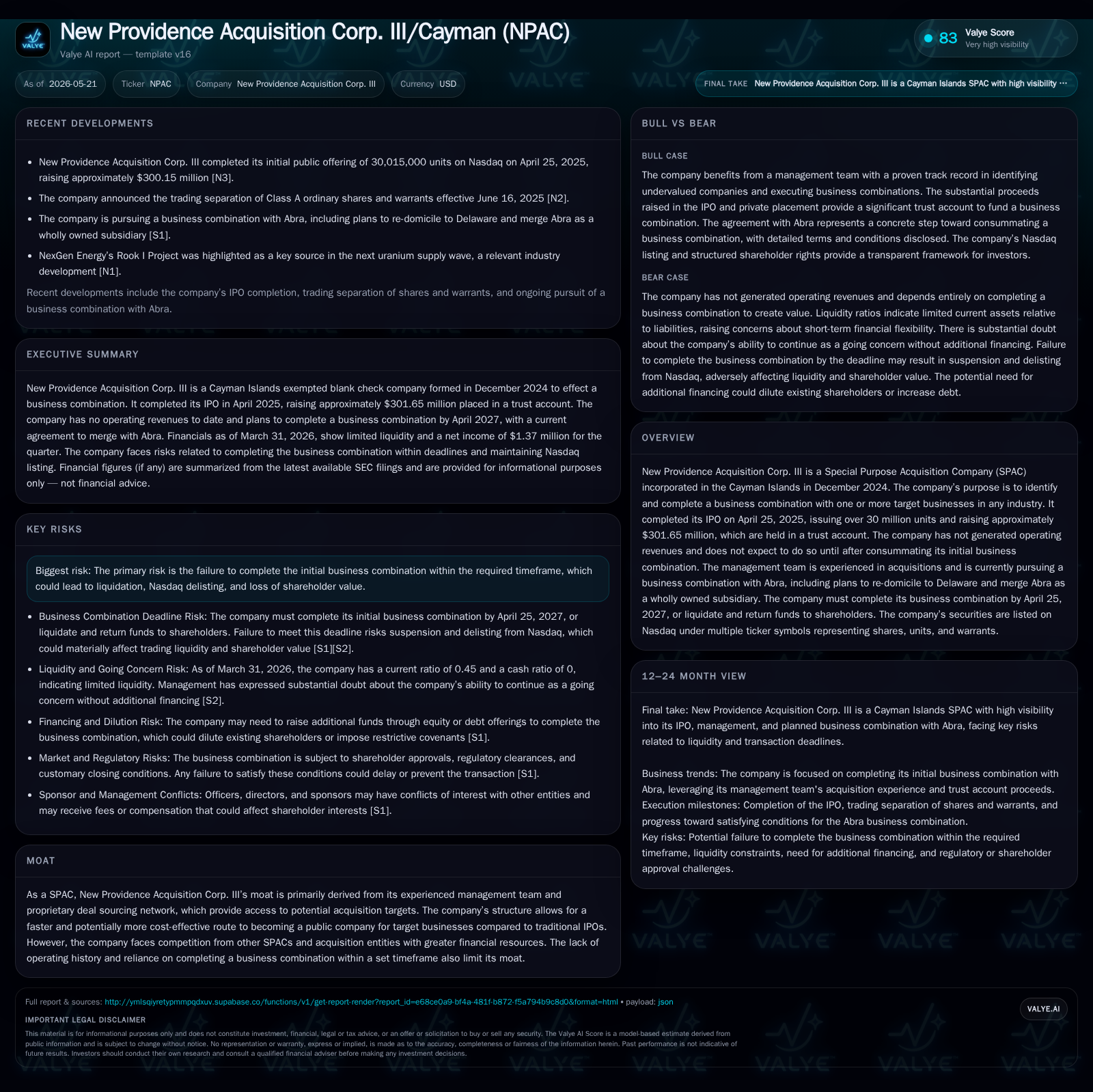
New Providence Acquisition Corp. III (NPAC) is advancing the completion of its initial business combination with Abra, with key regulatory and financing milestones underway. The SPAC faces a strict April 2027 deadline mandated by Nasdaq, requiring timely shareholder approvals, audited financial disclosures from Abra, and transaction financing commitments. NPAC’s experienced management leverages proprietary deal sourcing amid intense competition for consumer-sector targets. The company maintains typical SPAC liquidity profiles, holding IPO proceeds in trust while arranging supplemental capital to support deal execution and post-merger operations.
Latest Quarterly Progress on Business Combination
New Providence Acquisition Corp. III (NPAC) reported in its May 14, 2026 Form 10-Q that it remains on track to consummate its initial business combination with Abra by April 25, 2027—the firm deadline set forth in its governing documents and Nasdaq rules [S2]. The filing indicates no material changes to previously disclosed risks or operational delays that might impede closing.
Critical near-term steps include receipt of audited financial statements from Abra prepared under PCAOB standards within 45 days of the March 16, 2026 Business Combination Agreement signing date—an essential prerequisite for proxy materials and shareholder voting processes [S3]. Concurrently, NPAC is pursuing shareholder consent in accordance with SEC regulations following registration statement effectiveness.
Additionally, NPAC plans to secure transaction financings targeting at least $150 million through flexible structures involving equity and/or debt instruments [S3]. These funds are intended to supplement existing trust account proceeds to cover cash consideration obligations at closing and provide necessary working capital post-closing
Failure to complete the business combination by the April 25, 2027 deadline would result in automatic trading suspension and delisting from Nasdaq pursuant to the exchange's ‘36-Month Rule,’ which imposes strict timing constraints on SPACs without completed combinations [S2]. Such an outcome would force liquidation of trust funds back to shareholders.
NPAC’s Business Model and Strategic Positioning
Incorporated as a Cayman Islands exempted company on December 4, 2024, NPAC completed its IPO on April 25, 2025, raising approximately $301.65 million through units priced at $10 each comprising Class A ordinary shares and redeemable warrants [S1][F1]. These proceeds are held in a trustee-managed trust account until consummation of an initial business combination event such as the announced merger with Abra
As a blank check company, NPAC generates no operating revenues prior to completing a business combination. Its value proposition lies in facilitating private companies’ access to public markets more rapidly and cost-effectively than traditional IPO routes by leveraging streamlined merger processes that reduce underwriting costs and market uncertainties.
Management’s decades-long acquisition experience combined with proprietary deal sourcing networks form a competitive moat enabling targeted identification of consumer-sector companies that align with NPAC’s strategic focus. Post-combination benefits for the target include enhanced capital access, employee equity incentives capacity, acquisition currency via publicly traded shares, and increased market profile [S1][S6]
Competitive Landscape for SPAC Acquisitions
The SPAC ecosystem faces intense competition from numerous blank check companies and private equity firms vying for limited attractive consumer-sector targets. Many competitors possess larger capital bases or longer operating histories affording greater strategic flexibility than NPAC [S1][S6]. This dynamic exerts upward pressure on valuation multiples demanded by targets while constraining deal availability.
Nasdaq’s strict ‘36-Month Rule’ imposes additional temporal pressure on smaller SPACs like NPAC to close transactions promptly or risk delisting. Public shareholders’ redemption rights further complicate deal negotiations by potentially reducing available cash consideration pools unless offset by alternative financing arrangements or backstop agreements.
Against this backdrop, NPAC’s experienced leadership serves as a differentiating factor through ongoing deal sourcing capabilities supported by deep industry relationships.
Growth Drivers Supporting Completion
Key operational catalysts include timely delivery of Abra’s audited financials certified by PCAOB-qualified auditors—critical for SEC filings and shareholder vote preparations—and achieving registration statement effectiveness enabling proxy dissemination [S3][S7].
Securing transaction financing commitments totaling at least $150 million is vital for supplementing trust account proceeds to satisfy cash purchase price conditions as well as providing working capital buffers after closing [S3]. These financings may be structured as common equity, preferred equity, convertible securities, or debt instruments.
Management’s ability to leverage proprietary networks combined with rigorous due diligence aims at driving operational improvements within Abra post-combination—targeting revenue stability, growth potential, free cash flow generation capacity, and risk-adjusted returns consistent with stated investment criteria [S1]
Risks and Watchpoints
The paramount risk remains failure to consummate the initial business combination before the April 2027 Nasdaq deadline resulting in automatic trading suspension and delisting—potentially undermining shareholder value preservation prospects [S2]. Competitive bidding may inflate acquisition costs beyond forecasted levels while high redemption rates could reduce available cash consideration pools.
Governance complexities around obtaining requisite shareholder consents under SEC rules pose execution challenges alongside possible delays fulfilling closing conditions stipulated in merger agreements. Post-closing integration risks are typical of SPAC mergers including operational alignment between management teams and managing any leverage if external debt financing is employed.
Market skepticism toward SPACs may also impact investor confidence or share liquidity unless post-merger performance meets elevated expectations set during transaction announcements.
Financial Overview and Liquidity Position
As of March 31, 2026—the latest quarter end—NPAC reported current assets of approximately $531 thousand against current liabilities exceeding $1.17 million resulting in a current ratio near 0.45 [F1][S2]. This reflects constrained short-term liquidity consistent with typical pre-combination SPAC profiles where cash resources reside primarily within trust accounts reserved explicitly for merger transactions rather than operational use
Operating income remains negligible given absence of substantive business activities prior to combination; net income figures reflect non-operational accounting adjustments unrelated to ongoing operations [F1]
This financial posture underscores reliance on planned transaction financings arranged during the interim period coupled with disciplined expense management ahead of closing given limited operating cash equivalents.
Disclaimer: This analysis is based exclusively on recent SEC filings available as of May 2026. It does not constitute investment advice or an offer to buy or sell securities. All forward-looking statements reflect assumptions subject to change based on market dynamics or unforeseen developments affecting New Providence Acquisition Corp. III.
Disclaimer: This is research-only, informational analysis and not investment advice. It may include AI-generated interpretation and general industry context. Always verify important details using primary sources.

Comments