
National Presto Industries Navigates Mixed Segment Results with Defense Stability and Housewares Challenges
Fiscal 2025 results reflect solid Defense segment growth offset by Housewares softness amid supply chain and cost pressures.
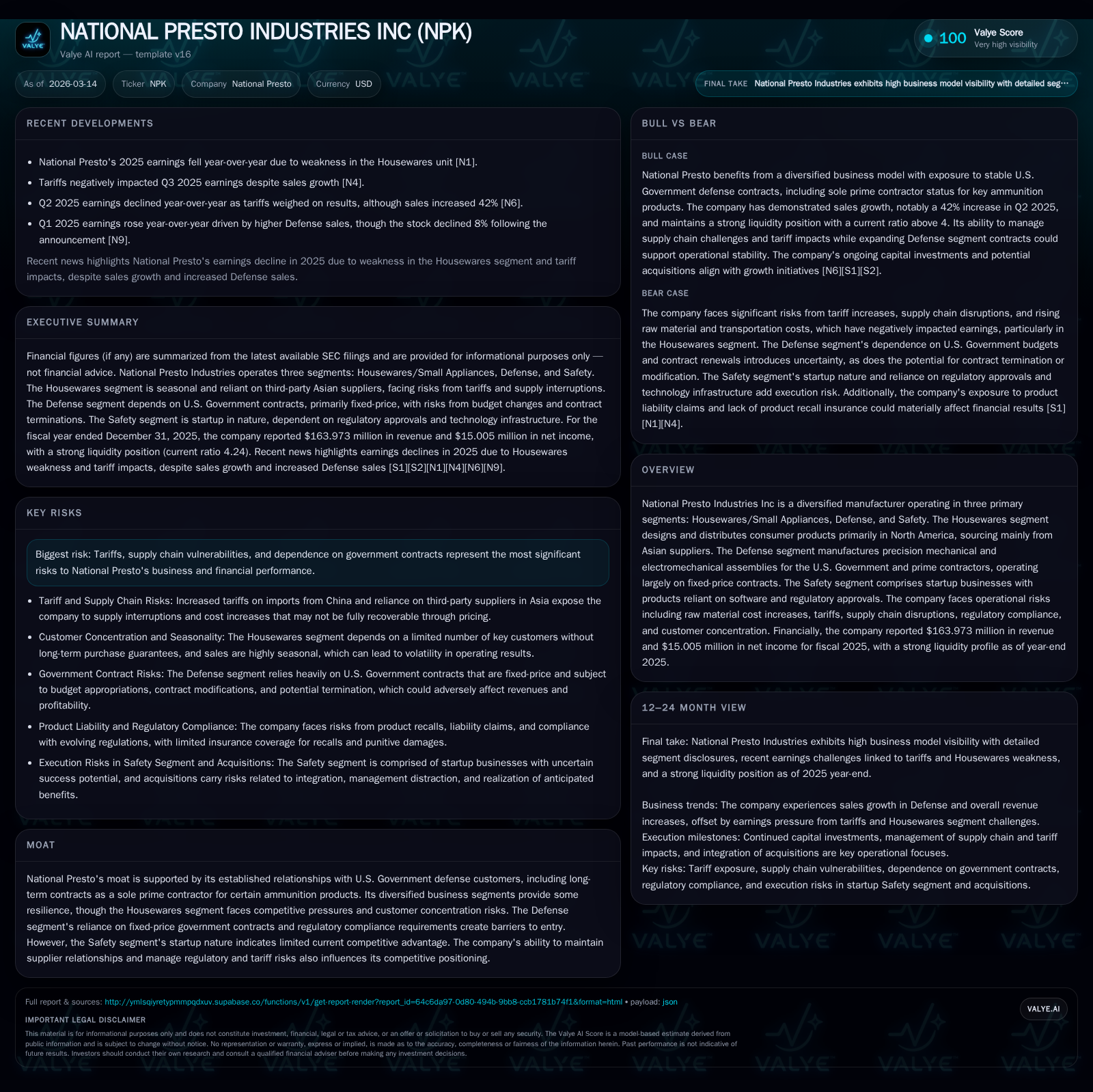
National Presto Industries reported fiscal 2025 revenue of $163.97 million, a 21.7% increase year-over-year, driven primarily by expansion in its Defense segment despite challenges in Housewares/Small Appliances. Operating income declined 11% to $40.24 million, and net income fell 27.6% to $15 million due to margin pressures and a vendor deposit impairment. Elevated capital expenditures of $27 million and negative operating cash flow contributed to a free cash flow deficit, while a strong current ratio of 4.24x supports liquidity. Key risks include raw material inflation, reliance on Asian suppliers, regulatory hurdles in the Safety segment, and the fixed-price nature of government contracts impacting margins.
Company Overview
National Presto Industries operates three primary segments: Housewares/Small Appliances, Defense, and Safety . The Housewares segment supplies consumer kitchen products predominantly sourced from third-party Asian vendors servicing North American retail customers. The Defense division manufactures precision mechanical assemblies under primarily fixed-price contracts for the U.S. Government, often acting as sole prime contractor for specific ammunition lines, creating a competitive moat. The Safety segment comprises startup businesses developing safety products dependent on software performance and regulatory approvals.
Historical Financial Performance
The company demonstrated notable revenue growth over recent years, rising from $98.42 million in fiscal 2023 to $134.69 million in fiscal 2024, reaching $163.97 million in fiscal 2025—a compound increase largely driven by Defense segment expansion offsetting softness in Housewares [F1]. Operating income peaked at $45.21 million in 2024 before contracting by approximately 11% to $40.24 million in 2025 due primarily to margin pressures from cost inflation and a non-cash impairment related to a vendor deposit within Housewares [F1][N1][S12][S25]. Net income declined by nearly 28% from $20.73 million in fiscal 2024 to $15.01 million last year.
Historical performance (annual)
| FY | Rev ($mm) | Net ($mm) | CFO ($mm) | OpInc ($mm) | Rev YoY | Net YoY |
|---|---|---|---|---|---|---|
| 2025 | 164 | 15 | -9 | 40 | +21.7% | -27.6% |
| 2024 | 135 | 21 | -53 | 45 | +36.9% | +57.5% |
| 2023 | 98 | 13 | 45 | 35 | -13.7% | +505.6% |
| 2022 | 114 | 2 | 9 | 22 |
Source: SEC companyfacts cache [F1].
Capital returns and efficiency (annual)
| FY | FCF ($mm) | ROE% |
|---|---|---|
| 2025 | -36 | 3.8 |
| 2024 | -61 | 5.6 |
| 2023 | 44 | 3.7 |
| 2022 | 8 | 0.6 |
Source: SEC companyfacts cache [F1].
Operating cash flow remained negative in fiscal 2025 but improved significantly compared with prior year levels, reflecting ongoing working capital pressures including inventory increases noted by management [F1][S8][S25]. Capital expenditures more than tripled year-over-year as investments were made across business segments including facilities and safety startups.
Segment Analysis
Housewares/Small Appliances
This segment encountered headwinds from rising raw material costs (metals, plastics), transportation expenses linked to fuel prices and shipping rates, tariff risks particularly involving China imports, and concentration among a few Asian suppliers [S1][S17]. Such dependence creates vulnerability to supply disruptions or pricing volatility which may not be fully passed on due to competitive retail environments amid industry consolidation [S4][S21]. Seasonal sales concentration during holiday periods adds variability.
Additionally, an impairment related to an unrecoverable vendor deposit estimated at approximately $2.7 million negatively impacted profitability during fiscal 2025 [N1][S12][S25]. Regulatory risks include potential product recalls under U.S Consumer Products Safety Commission oversight that could impose financial burdens or reputational damage if defective products arise [S4].
Defense Segment
The Defense business benefits from stable revenue streams as sole prime contractor for certain ammunition products under fixed-price U.S Government contracts—providing competitive advantage but exposing margins to raw material and labor cost fluctuations [S10][S26]. Compliance with extensive federal procurement regulations (e.g., FAR, cybersecurity mandates) adds complexity and cost but raises barriers for competitors.
While contract terminations remain a risk, large-scale government programs underpin this segment’s steady contribution.
Safety Segment
Comprising startup ventures focused on safety hardware-software solutions dependent on telecommunication networks and regulatory approvals, this segment faces uncertainty around commercial viability near term [S18]. Sales are constrained geographically by approval processes while technology reliance introduces execution risks tied to system uptime and software maintenance.
The Safety segment currently does not contribute materially but offers potential future growth contingent on certification achievements and scalable platform development.
Growth Outlook
Key growth drivers include:
- Expansion of Defense contracts supported by sustained or increased U.S military spending.
- Recovery in Housewares through supply chain normalization, tariff management or sourcing diversification, and product innovation.
- Progression of Safety startups unlocking new markets via regulatory certifications.
Challenges encompass:
- Raw material inflation pressures limiting price pass-through.
- Customer concentration without long-term purchase guarantees increasing order unpredictability.
- Regulatory compliance demands potentially delaying Safety product commercialization.
- Fixed-price Defense contracts constraining margin flexibility amid rising costs.
Financial Milestones & Capital Allocation
No explicit forward guidance has been provided; key indicators will include quarterly sales trends especially seasonally for Housewares, Defense contract renewals, Safety certification milestones, and capital expenditure pacing reflecting strategic investments.
Return on equity approximates a modest ~3.8%, impacted by impairment charges and investment spending levels relative to shareholders' equity scale [F1]. Operating cash flow improved versus prior year but remained negative at -$9 million last year amid working capital buildup including inventory accumulation [F1].[S8]
Capital expenditures surged over threefold compared with prior year ($27m vs $7m), contributing to a free cash flow deficit near -$36 million indicating ongoing investment phase requiring liquidity vigilance [F1].[N1]
Current ratio stands robust at over four times reflecting strong short-term financial flexibility supported by sizable current assets including marketable securities; however, line of credit borrowings increased substantially from zero at prior year-end to $36.9 million at September quarter-end indicating either opportunistic liquidity management or funding needs during growth investments [F1].[S13].[S22]
Dividend policy remains consistent without extraordinary payouts recently reported alleviating some cash pressure while maintaining shareholder returns continuity subject to earnings stability going forward [N1].[F1]
Risks Summary
Principal risks include:
- Tariff escalations raising import costs given Asian sourcing dependence.
- Supply chain interruptions stemming from geopolitical events or vendor failures.
- Customer concentration without long-term commitments causing revenue volatility.
- Regulatory compliance complexities elevating costs or risking contract penalties.
- Elevated capital spending pressuring liquidity amid uncertain economic conditions.
- Early-stage operational uncertainties within the nascent Safety segment potentially extending breakeven timelines requiring further funding.,[S1],[S4],[S10],[S18]
Conclusion
National Presto Industries presents a profile combining stable defense contracting backed by unique government relationships with challenges in consumer-facing Housewares marked by supply chain vulnerabilities and industry consolidation effects while investing heavily in emerging Safety ventures facing regulatory hurdles.
Financials reveal solid top-line growth offset by margin pressures due mainly to impairments and inflationary costs alongside substantial investment outlays resulting in negative free cash flow highlighting liquidity management as a key focus area going forward.
Investors should monitor operational developments across segments alongside capital allocation effectiveness as indicators of National Presto’s ability to navigate its complex operating environment successfully.
Disclaimer: This report is based on information available as of March 14, 2026, intended solely for informational purposes without constituting investment advice.
Disclaimer: This is research-only, informational analysis and not investment advice. It may include AI-generated interpretation and general industry context. Always verify important details using primary sources.

Comments