
Nu Ride Inc.: Post-Bankruptcy Reinvention Hinges on Affinity Integration and Revenue Diversification
Nu Ride Inc., the successor to Lordstown Motors, is attempting to pivot from its legacy roots into insurance distribution and investment advisory.
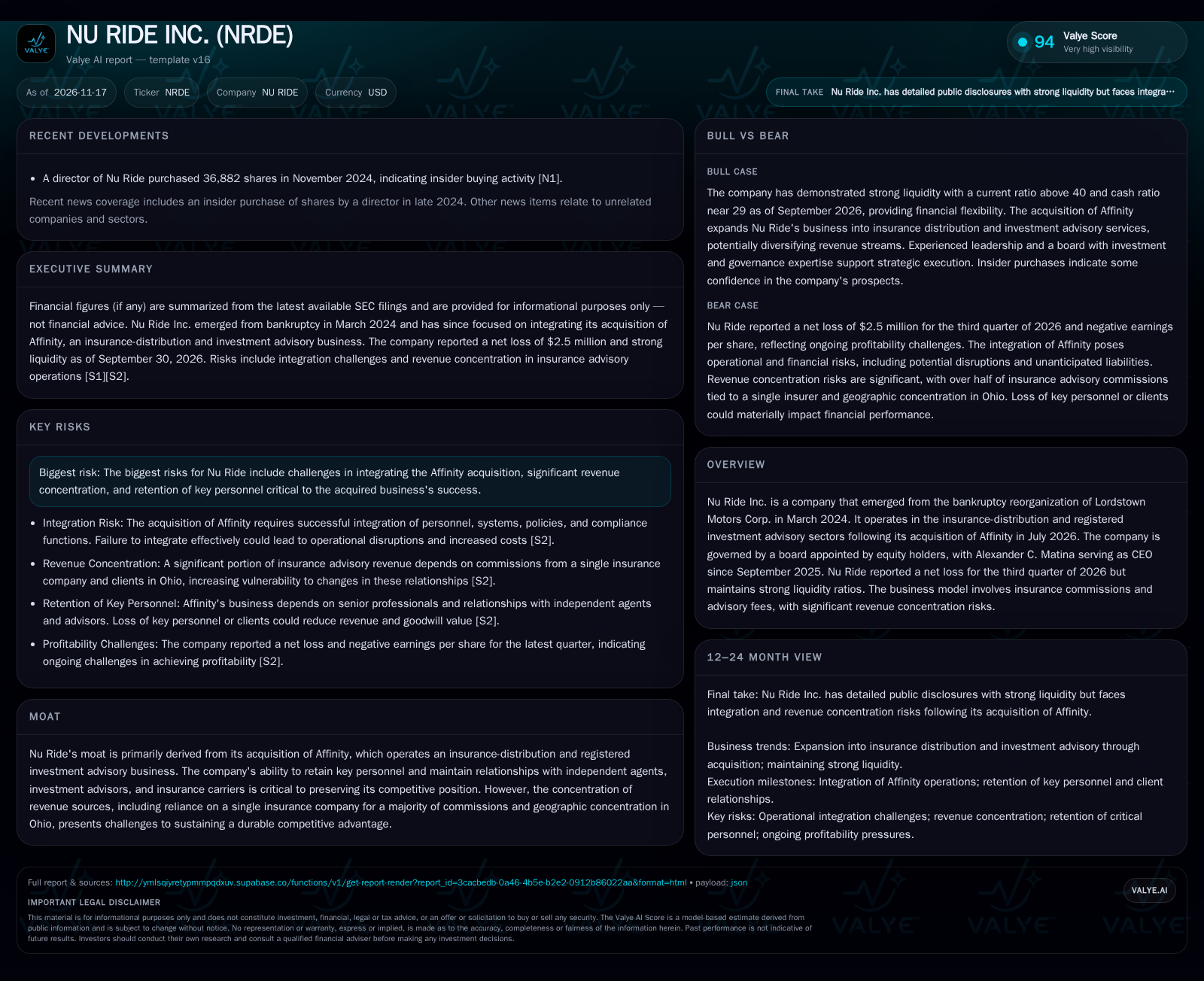
Nu Ride Inc. is navigating a high-stakes transformation following its bankruptcy emergence, with reported liquidity position offset by persistent losses and significant reliance on a single insurance partner and geographic market. The Affinity acquisition offers a pathway to revenue diversification, but execution risk and concentration remain material headwinds. Integration success and client retention will determine whether Nu Ride can establish a sustainable business model beyond its legacy.
Nu Ride Inc. stands at a pivotal crossroads after its emergence from the bankruptcy of Lordstown Motors, with a strategic shift into insurance distribution and investment advisory via the Affinity acquisition. Despite formidable liquidity, the company’s future is clouded by a net loss in its latest quarter and heavy revenue dependence on a single insurance partner and the Ohio market. The next chapter for Nu Ride relies on its ability to integrate Affinity, diversify its revenue base, and retain critical personnel—outcomes that will determine whether this post-bankruptcy pivot can yield lasting value.
Material Shifts: From Bankruptcy to Insurance Advisory, with Concentration Risks
Nu Ride Inc. emerged from the Chapter 11 reorganization of Lordstown Motors in March 2024, marking a complete reset of its strategic trajectory [S1]. The most consequential recent development is the July 2026 acquisition of Affinity, which operates in insurance distribution and registered investment advisory—a dramatic departure from the company’s prior automotive manufacturing focus [S2]. As of Q3 2026, Nu Ride reported a net loss of $2.5 million, with basic and diluted EPS of -$0.20 [S2]. Despite this, the company’s liquidity remains notably high, with a current ratio of 40.25 and a cash ratio of 28.71, supported by $16.0 million in cash and equivalents [S2]. However, the revenue base is fragile: approximately 59% of insurance advisory revenue stems from a single insurance carrier, and a significant share is concentrated among Ohio residents [S2]. These facts highlight both the potential for rapid business model reinvention and the acute risks that could undermine Nu Ride’s pivot.
How Nu Ride Could Make Money: Commission Flows, Advisory Fees, and Cost Structure
Nu Ride’s primary revenue streams now derive from commissions on insurance products and investment advisory fees, both acquired via Affinity [S2]. In such models, topline growth is typically a function of agent productivity, client acquisition, and the breadth of carrier/product relationships. Margins in insurance distribution are often slim, with profitability hinging on scale and retention: incremental revenue tends to carry high contribution margins once fixed costs related to compliance, technology, and personnel are covered. However, with over half of revenue tied to a single insurance partner, the risk is that any shift in carrier terms or client attrition could rapidly erode both revenue and operating leverage.
Fixed costs in this sector often include regulatory compliance, technology platforms, and compensation for licensed professionals. Variable costs align with sales commissions and incentive structures. The company reported cash and liquidity metrics for the period; these figures do not by themselves establish operating runway, investment capacity, financial flexibility, or financing capacity. The path to profitability will require either rapid scaling of new client relationships, expansion into additional carrier partnerships, or meaningful cost rationalization.
Competitive Dynamics: Can Nu Ride Carve Out a Defensible Niche?
The insurance-distribution and investment-advisory landscapes are highly fragmented, with competition from national brokerages, regional agencies, direct-to-consumer digital platforms, and captive agents of major carriers. Nu Ride’s competitive position currently hinges on Affinity’s existing relationships with independent agents, advisors, and insurance carriers [S2]. However, the heavy concentration with a single insurance partner and Ohio-based client base exposes the company to outsized risk from channel or regulatory disruptions.
Switching costs in insurance distribution are typically moderate: while personal relationships matter, clients and advisors can migrate if service or pricing deteriorate, or if a competitor offers a broader product suite. For Nu Ride to build sustainable advantage, it will need to deepen carrier diversification, invest in technology-enabled service delivery, and retain or attract high-performing agents. Without unique technology, proprietary product access, or scale-driven negotiating leverage, the company risks remaining a price-taker in a commoditized market.
If Integration and Diversification Succeed: Pathways to Margin Expansion and Growth
A favorable outcome for Nu Ride would see seamless integration of Affinity, with minimal operational disruption and high retention of key personnel and clients. This would enable the company to leverage its reported liquidity position for targeted investments in technology, client acquisition, or expansion into new geographic or carrier relationships. If Nu Ride can reduce its dependence on a single insurance carrier—either by onboarding additional partners or cross-selling more products to existing clients—its revenue base could become less volatile and margins could improve due to greater scale.
Confirmation of this scenario would come from sequential reductions in revenue concentration metrics, growth in client and carrier counts, and a narrowing of net losses or transition to profitability. Evidence of successful cross-selling, expansion outside Ohio, and retention of top-producing agents would further validate the upside thesis.
A Cautious Outlook: Incremental Progress, Ongoing Profit Pressure
The most likely near-term trajectory is one of incremental progress but continued financial strain. Nu Ride may achieve moderate success in integrating Affinity, retaining a core group of key personnel and clients, while making only gradual headway in diversifying its revenue streams.
Validation of this base case would be evidenced by stable but not rapidly growing revenue, persistent (though potentially shrinking) net losses, and slow improvement in revenue concentration. Signs of modest expansion into adjacent states or new carrier relationships, without dramatic swings in client retention or cost structure, would support this scenario.
What Could Go Wrong: Integration Failure, Client Attrition, and Revenue Shocks
The most material risk is that Nu Ride fails to integrate Affinity smoothly, leading to the departure of key personnel or the loss of major clients. Given that nearly 60% of insurance advisory revenue is dependent on a single carrier, any change in commission rates, termination of the relationship, or regulatory intervention could trigger a steep decline in revenue [S2]. Geographic concentration heightens vulnerability to local economic or competitive shocks.
Evidence for this scenario would include a spike in client churn, loss of major agents, sudden drops in commission revenue, or regulatory disclosures about compliance failures. Persistent or escalating net losses, coupled with rapid depletion of cash reserves, would further confirm a downside outcome.
Testing the Nu Ride Thesis: 2027 Outcomes to Clarify
Quarterly trends in insurance advisory revenue by carrier and by geography—if disclosed—will reveal whether concentration risk is declining.
Net client and agent retention rates following the Affinity integration would help assess the effectiveness of personnel and relationship management.
Operating expense trends, particularly in compliance, technology, and personnel, will show whether Nu Ride can realize integration-related cost efficiencies.
Sequential changes in net loss and earnings per share will indicate progress (or lack thereof) toward profitability.
Expansion into new states or the addition of new carrier partnerships would provide evidence of successful diversification.
Cash burn rate and liquidity trajectory, as reflected in quarterly cash flow statements, will clarify the sustainability of the current capital base.
Disclosures around regulatory or compliance issues, especially tied to insurance licensure or investment advisory oversight, could signal emerging risks.
If disclosed, metrics on cross-selling or product mix (e.g., percentage of clients with multiple policies or services) would illuminate upsell potential and stickiness.
Disclaimer: This is research-only, informational analysis and not investment advice. It may include AI-generated interpretation and general industry context. Always verify important details using primary sources.

Comments